


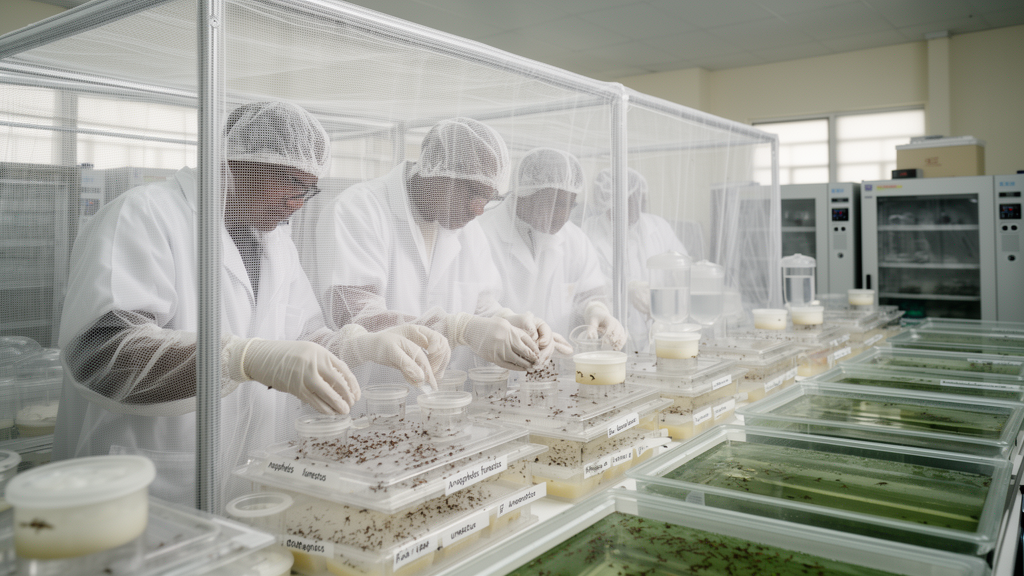
Researchers in Burkina Faso established a laboratory colony of Anopheles funestus s.s. and maintained it for 24 generations with sustained egg production. The mosquito is a major malaria vector in sub-Saharan Africa, but persistent difficulties in maintaining stable laboratory colonies have hindered research on its biology and the development of effective control strategies. The study followed the colony from field collection through 24 laboratory generations and measured reproductive performance, larval development, adult emergence, blood feeding, insemination and oviposition. The resulting strain, named FUNBF, provides a locally derived experimental population for further study.
To establish the colony, the researchers collected 1,871 adult female mosquitoes over two years from Diébougou and Soumousso using mouth- and battery-powered electric aspirators. The females were initially identified morphologically as members of the An. funestus group. Each female was then placed in a separate 200-milliliter disposable cup to oviposit, isolating the offspring of individual mosquitoes. Subsequent molecular testing confirmed the mosquitoes as An. funestus s.s. Adults were maintained at 27 ± 2 °C and 60–80% relative humidity under a 12-hour light–dark cycle, while larvae were kept at 29 ± 2 °C under the same lighting schedule. These procedures enabled the researchers to compare traits in the founding generation, F0, with those in the 24th generation, F24.
Mean fecundity was similar in the two generations, although it was somewhat lower in F24. Founding females produced an average of 85.33 eggs, with a 95% confidence interval of 79.43–91.24, compared with 78.87 eggs per female in F24, whose 95% confidence interval was 69.33–88.30. Egg hatching showed a larger difference: the mean hatching rate was 88.62% in F0, with a 95% confidence interval of 85.79–91.41%, and 55.20% in F24, with a 95% confidence interval of 45.77–64.64%. In F24, the mean pupation rate was 58.5%, with a 95% confidence interval of 47.81–69%, and the median pupation time was 15 days. The colony nevertheless continued producing eggs through its 24th generation, as reported by the researchers.
Adult emergence in F24 was high in both sexes. A mean of 84.0% ± 3.37% of male pupae and 85.0% ± 5.92% of female pupae emerged as adults, with no statistically significant difference between the sexes. The researchers also assessed blood feeding, insemination and oviposition in F24. Mean blood feeding was 85.21%, although the reported 95% confidence interval was broad, spanning 40.45% to 104.91%. Insemination and oviposition each averaged 37.5%; the respective reported variability was ±5.83% and ±9.17%, and each estimate was based on two observations. Mortality 24 hours after blood feeding averaged 4.51%, with a 95% confidence interval of 0.64–8.37%. These measurements show that F24 mosquitoes could blood-feed, become inseminated, oviposit and yield adult offspring, while the limited replication behind the insemination and oviposition estimates constrains their precision.
The findings document the domestication and long-term laboratory maintenance of a field-collected African population of An. funestus s.s. under controlled conditions. FUNBF maintained measurable reproductive capacity for 24 generations, but the results also show a lower mean egg-hatching rate in F24 than in F0 and relatively modest sample sizes for some reproductive measurements. This was a colony-establishment study rather than a trial of malaria control, so it did not test whether the strain reduces human malaria transmission or produce a clinical benefit. Its demonstrated outcome is more specifically laboratory-based: mosquitoes collected in Burkina Faso could be colonized, propagated and characterized through 24 generations, giving researchers a maintained strain with which to investigate the biology of an important malaria vector.
Subject of Research: Laboratory establishment and reproductive performance of the Anopheles funestus s.s. malaria-vector colony in Burkina Faso
Article Title: From the field to the laboratory: establishment of Anopheles funestus s.s. colony in Burkina Faso
Article References: Sawadogo, G., Yemien, S. O. G., Diallo, I., Zongo, O. N., Kaboré, H., Agolinou, A., Ouédraogo, B., Chumbe, S. A., Traore, N., Humphreys, H., Ilboudo, S., Namountougou, M., Kientega, M., Lanfrancotti, A., Nolan, T., Maiga, H., & Diabaté, A. (2026). From the field to the laboratory: establishment of Anopheles funestus s.s. colony in Burkina Faso. Parasites & Vectors. https://doi.org/10.1186/s13071-026-07652-2
Image Credits: AI Generated
DOI: 10.1186/s13071-026-07652-2
Keywords: Anopheles funestus, malaria vector, mosquito colony, Burkina Faso, laboratory domestication, mosquito reproduction, vector biology, insectary, malaria research, field, laboratory, establishment
Cite Scienmag News
Drew Townsend. (October 20, 2026). Burkina Faso researchers maintain Anopheles funestus colony for 24 generations. Scienmag. https://scienmag.com/burkina-faso-researchers-maintain-anopheles-funestus-colony-for-24-generations/
Drew Townsend. "Burkina Faso researchers maintain Anopheles funestus colony for 24 generations." Scienmag, 20 October 2026, https://scienmag.com/burkina-faso-researchers-maintain-anopheles-funestus-colony-for-24-generations/. Accessed 20 October 2026.
Drew Townsend. "Burkina Faso researchers maintain Anopheles funestus colony for 24 generations." Scienmag. October 20, 2026. https://scienmag.com/burkina-faso-researchers-maintain-anopheles-funestus-colony-for-24-generations/


