


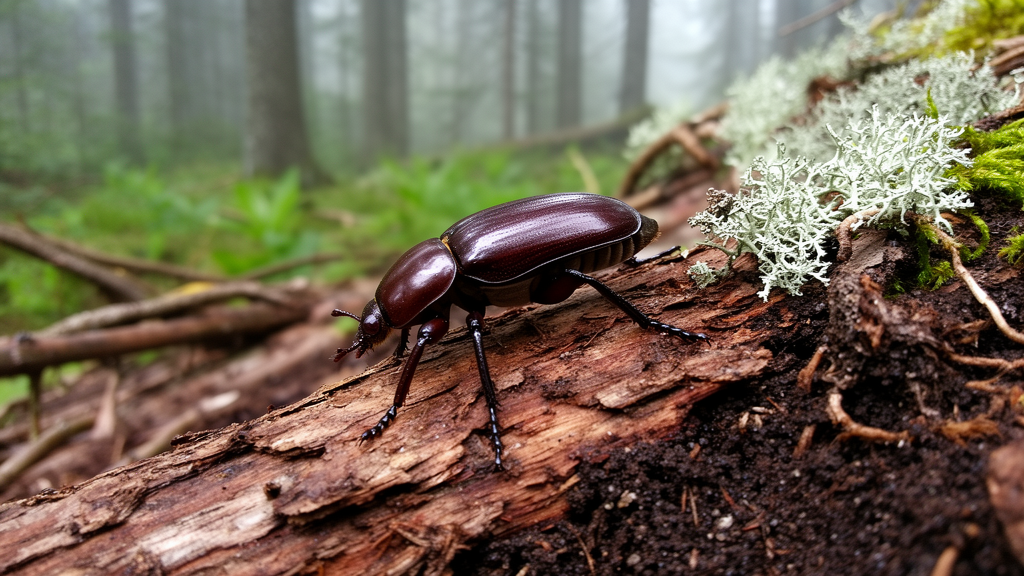
A rare beetle regarded as a living trace of Europe’s primeval forests has been found at three sites in Switzerland, providing the country’s first confirmed records of Pytho abieticola and extending the known range of the species far to the west. Surveys in 2021 and 2022 yielded 29 adults and several dozen larvae in the Jura mountains and the Swiss National Park in the eastern Alps. The discoveries show that small, isolated populations may persist where humid old-growth conifer forests retain the particular form of dead wood this species requires.
Pytho abieticola belongs to the family Pythidae, a group of saproxylic beetles whose larvae and adults live under the bark of dead conifers. Ten species in the genus Pytho are recognized, six of them in the Palaearctic region, while three occur in Europe. The more widespread Pytho depressus was the only member of the genus previously known from Switzerland.
P. abieticola is rare in Central Europe and is classified among primeval forest relict species, animals restricted to remnants of natural forests. The Swiss records place its distribution at a new western limit, beyond the isolated populations previously documented in Central Europe and within the broader range that extends through Fennoscandia and Russia to northern China. The first population was detected in the Ponts-de-Martel Valley, a peat bog of national importance in the canton of Neuchâtel at about 1,000 metres above sea level.
The landscape combines scattered birch stands with denser forests of Swiss mountain pine and spruce. Historical maps show that these coniferous forests have persisted for a long time, with the stands already marked on Switzerland’s first edition of the Siegfried National Map in 1886. Ten Polytrap flight-interception traps were deployed in different forest associations between April and September 2022, including a sphagnum-rich, waterlogged spruce association.
Three male P. abieticola were captured at three trap sites about 50 metres apart. The traps stood near spruce trunks and Swiss mountain pine logs felled in previous years, some of which were elevated above the ground. Searches around the traps later found several dozen larvae and about 10 adults of P. depressus in pupal cells beneath the bark of pine and spruce logs, but no immature stages or additional adults of P. abieticola.
A second population was confirmed near Saignelégier in the canton of Jura, roughly 40 kilometres from Ponts-de-Martel. This site is also a peat bog of national importance at about 1,000 metres above sea level, with vegetation similar to that of the first locality. It was selected because its ecological features resembled those at Ponts-de-Martel, where the species had already been detected.
During a one-day survey in autumn, researchers searched beneath the bark of spruce and Swiss mountain pine logs for larvae and adults in pupal cells. A single male and a single female P. abieticola were found on 20 October 2022 in a small spruce forest at the bog’s edge. Both occupied pupal cells beneath the bark of a spruce trunk about 30 centimetres in diameter.
The trunk had been cut along a forest path in an earlier year and lay partly above the ground on its branches; bark was missing from about half its length, while the remaining bark detached easily by hand. Eight P. depressus were found under the same bark, along with specimens of Ips typographus, Rhagium inquisitor and Rhizophagus dispar. The record establishes sympatric occurrence at the site and shows that the two Pytho species can occupy the same log.
The third set of records came from the Swiss National Park in the eastern Alps, a high-altitude strict nature reserve that has received no habitat management since 1914. One-third of its 170-square-kilometre area is forested. Swiss mountain pine dominates higher elevations and southern slopes, while spruce, Scots pine and European larch are characteristic of lower and more exposed areas.
Flight-interception traps were established in several parts of the park during 2021 and 2022, including Plan Praspöl at 1,650 metres and Stabelchod at 1,900 metres. At Plan Praspöl, P. abieticola was captured in five of 11 traps operated from May to August 2021; four of the five traps with captures were positioned where lying and standing dead wood was abundant. Traps at Stabelchod produced P. abieticola, but an intensive active search in the surrounding Swiss mountain pine forest found none, leading the researchers to suggest that the trapped beetles may have originated in wetter neighbouring forests.
Additional adults and larvae were found in the national park in 2022. At the southeastern end of the park, near Laj dad Ova Spin, one male, one female and several larvae occurred beneath decayed bark of a Swiss mountain pine. On a slope toward Laj dad Ova Spin, five males, one female and several larvae were recovered from beneath the bark of three spruce trunks about 25 centimetres in diameter.
All four trees carrying larvae lay horizontally just above the ground in a very humid environment on the steep slope above the Spöl stream. Their bark was heavily colonised by fungi, and no other beetle species were present on the trees. In drier areas above the wet slope, only P. depressus was found.
The results provide the first Swiss evidence that P. abieticola can develop in Swiss mountain pine as well as spruce, although most subcortical observations involved the latter. These records fit the species’ demanding ecological profile, although important aspects of its biology remain incompletely understood. P. abieticola is associated principally with spruce forests, often in primeval forest areas, and usually inhabits swampy or otherwise humid sites.
Its flattened, flexible body is adapted to life beneath bark. Larvae develop in recently dead trees, especially trunks of medium or small diameter, and the available literature gives a broad size range from 6 to 25 centimetres. Suitable logs tend to lie horizontally and to be supported clear of direct contact with the ground, as occurs when a tree is broken or uprooted and remains raised by its branches.
The bark is generally already loosening and can be detached in pieces, while the locations where such wood lies tend to be semi-shaded or open rather than within dense forest. The species is often reported from older and drier wood than the other two European Pytho species, although all three may sometimes be present on the same tree. The beetle appears to depend on decay processes that follow other bark insects.
Trees previously colonised by bark beetles, including species of Pityogenes, Polygraphus and Hylastes, may provide the decaying cambial and phloem layers in which its larvae feed. Although one source has classified P. abieticola as zoophagous, the authors consider it more likely that its larvae feed primarily on decaying wood and fungi, as has been demonstrated for P. depressus. They are probably opportunistic and have also been reported to cannibalise one another.
Larval development probably lasts several years, and at least three years according to one cited account. Larvae of different sizes can be present throughout the year. Pupation is reported to occur from the second half of July to the first half of September, the pupal stage lasts about two weeks, and adults overwinter in pupal cells beneath bark before emerging in spring, chiefly in April and May.
The Swiss finds match this general pattern: the beetles occurred in open or relatively open forest beside peat bogs, and every tree carrying larvae was horizontal and just above the ground. Adults can be distinguished from P. depressus by a combination of colour, body form and genital characters. P. abieticola measures 7 to 11 millimetres and has black elytra without the blue or green metallic lustre usually present in P. depressus, although immature P. abieticola elytra may be brown.
Its abdomen is blackish or brown, sometimes dark reddish, and the pronotum is more evenly rounded, with its greatest width at midlength. The aedeagus is short with short parameres, the last segment of the maxillary palpi is hardly widened, and the labrum is about 2.5 times wider than long. P. depressus is usually larger, commonly 10 to 14 millimetres, with a yellowish abdomen, an unevenly rounded pronotum, a longer aedeagus, enlarged terminal palpal segments and a labrum about three times wider than long.
Larvae are also distinguishable: P. abieticola has two unequal teeth on the inner margin of each urogomphus, backward-directed tubercles, a slightly curved plate between the urogomphi and a pale greyish body reaching 18 to 28 millimetres. P. depressus has equal teeth, forward-directed tubercles arranged in a regular arc, a straight-edged plate and a yellowish body reaching 22 to 30 millimetres. The Swiss discoveries are encouraging but do not remove the species’ severe conservation concerns.
P. abieticola is listed as Vulnerable in Sweden, Endangered in Poland, Critically Endangered in the Czech Republic and Norway, and regionally extinct in Austria and Germany, although the sole German record is considered doubtful. Finland lists it as Near Threatened. At global scale, it has been treated as Least Concern, apparently because populations are considered more numerous in western Russia, where Karelian forests were less intensively managed and remained less fragmented.
The global assessment is under revision, and the authors state that the species is likely to be classified as threatened in the next European Red List. Intensive logging, destruction of natural forests, fragmentation and the resulting loss of dead wood are the principal threats. Because the required resources are specific—small to medium spruce logs with loosened dry bark, elevated above the soil in semi-shaded or open places—and become unsuitable within only a few years, populations need a continuous renewal of favourable wood rather than one isolated fallen trunk.
The findings indicate a practical route for conservation: retain or create the dead wood on which the beetle depends, including trees produced by mechanised felling when suitable natural dead wood is scarce. Surveys in other old-growth conifer forests, especially at the edges of open peat bogs, may reveal additional populations. The Jura localities lie within 10 kilometres of the French border, making the beetle’s occurrence in French peat bogs probable, while the Swiss National Park borders Italy, where its presence also seems possible.
These inferences identify priorities for further investigation rather than confirmed new country records. The Swiss populations are not evidence that the species is secure; instead, they reveal that a rare primeval-forest beetle persists in a handful of humid, dead-wood-rich sites at the western edge of its range.
Subject of Research: Swiss distribution, ecology and conservation of the relict beetle Pytho abieticola
Article Title: On the occurrence of relict populations of Pytho abieticola J. R. Sahlberg, 1875 in Switzerland ( Coleoptera , Pythidae )
Article References: Chittaro, Y., Sanchez, A., Szallies, A., Gossner, M. M., & Lachat, T. (2023). On the occurrence of relict populations of Pytho abieticola J. R. Sahlberg, 1875 in Switzerland (Coleoptera, Pythidae). Alpine Entomology, 7, 1-11. https://doi.org/10.3897/alpento.7.98799
Image Credits: AI Generated
Keywords: Pytho abieticola, Swiss fauna, Jura Mountains, Swiss National Park, primeval forest relicts, saproxylic beetles, peat bog forests, deadwood ecology, conifer habitats, species conservation, occurrence, relict
Cite Scienmag News
Margaret Porter. (October 20, 2026). Research report: On the occurrence of relict populations of Pytho abieticola J. R. Sahlberg, 1875 in Switzerland ( Coleoptera , Pythidae ). Scienmag. https://scienmag.com/research-report-on-the-occurrence-of-relict-populations-of-pytho-abieticola-j-r-sahlberg-1875-in-switzerland-coleoptera-pythidae/
Margaret Porter. "Research report: On the occurrence of relict populations of Pytho abieticola J. R. Sahlberg, 1875 in Switzerland ( Coleoptera , Pythidae )." Scienmag, 20 October 2026, https://scienmag.com/research-report-on-the-occurrence-of-relict-populations-of-pytho-abieticola-j-r-sahlberg-1875-in-switzerland-coleoptera-pythidae/. Accessed 20 October 2026.
Margaret Porter. "Research report: On the occurrence of relict populations of Pytho abieticola J. R. Sahlberg, 1875 in Switzerland ( Coleoptera , Pythidae )." Scienmag. October 20, 2026. https://scienmag.com/research-report-on-the-occurrence-of-relict-populations-of-pytho-abieticola-j-r-sahlberg-1875-in-switzerland-coleoptera-pythidae/


