


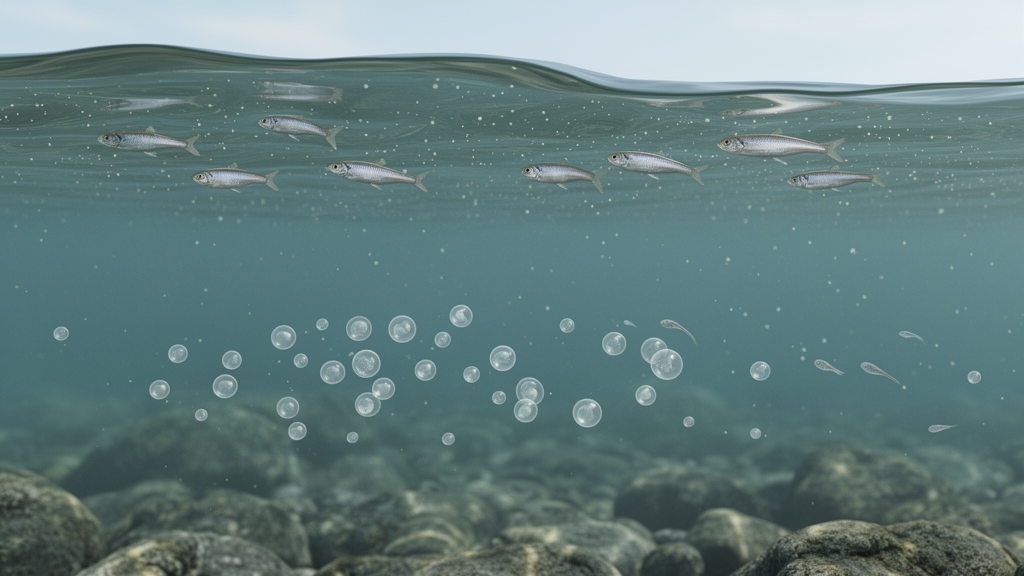
A standardized nationwide survey of fish eggs and larvae around the Korean Peninsula documented pronounced differences between winter and summer and among four marine regions. In February and July 2017, researchers recorded 30 egg taxa and 61 larval taxa in February, compared with 53 egg taxa and 154 larval taxa in July. Engraulis japonicus dominated both the egg and larval assemblages in July, while Ammodytes japonicus accounted for 75.32% of winter larval abundance. Regional differences were statistically detectable in both surveys and tended to be more pronounced in July, although the researchers did not formally compare the strength of separation between the two months. The observational study provides a standardized baseline for fish early life stages across the Yellow Sea, Korea Strait, East Sea and Jeju waters.
The research, published in Frontiers in Marine Science, was designed to compare ichthyoplankton assemblages across the major marine ecosystems surrounding Korea. Investigators sampled 133 stations during each survey, obtaining valid samples from 130 stations in February and all 133 in July. Coverage included the Yellow Sea, Korea Strait, East Sea and Jeju waters. Each sample was collected with a bongo net equipped with a calibrated flowmeter and depth sensor. Oblique tows extended from a maximum depth of 150 metres, or near the bottom at shallower stations, to the surface at 1.5–2.0 knots. Abundance was standardized as individuals per 1,000 cubic metres of filtered seawater, and surface temperature and salinity were measured at 5 metres with a conductivity-temperature-depth profiler.
Laboratory identification combined morphological examination with DNA barcoding. Fish eggs were separated into morphotypes using shape, diameter, embryonic developmental stage, oil globules and melanophore pigmentation. Larvae were identified to the lowest reliable taxonomic level with published taxonomic references. Up to five representative eggs were selected from each egg morphotype, while larval material included dominant taxa, commercially important species and specimens that could not be identified confidently by morphology. Researchers amplified the mitochondrial cytochrome c oxidase subunit I and 16S ribosomal RNA regions, compared the sequences with reference data in GenBank and the Barcode of Life Data System, and cross-checked molecular identifications against morphology when available. This approach improved taxonomic resolution without requiring every collected specimen to be sequenced.
The surveys collected 3,950 eggs representing 30 taxa and 18,836 larvae representing 61 taxa in February. In July, they collected 57,783 eggs representing 53 taxa and 25,907 larvae representing 154 taxa. Lateolabrax japonicus and the flatfish Glyptocephalus kitaharae each contributed close to 30% of the February egg assemblage, at 29.83% and 29.80%, respectively. A. japonicus was the principal winter larval taxon, accounting for 75.32% of total larval abundance, followed by Pholis fangi at 10.41%. By July, E. japonicus represented 47.17% of eggs and 62.62% of larvae. Maurolicus japonicus supplied 25.53% of summer egg abundance, and the unidentified gobiid taxon AJ was the second-most abundant summer larval taxon at 7.69%. Four egg taxa and 13 larval taxa occurred in both survey months.
The replacement of dominant taxa was consistent with species-specific spawning periods. February assemblages included winter-spawning fishes such as L. japonicus, G. kitaharae, Platichthys bicoloratus, Microstomus achne and A. japonicus. July assemblages were characterized by E. japonicus, M. japonicus, Coryphaena hippurus, Sphyraena pinguis and Pennahia argentata. E. japonicus has an extended spawning season from spring to autumn in Korean waters, with major spawning activity during the warmer months. Trichiurus japonicus was detected as both eggs and larvae in July, also consistent with its reported spawning season in Korean waters. Similarity percentage analysis estimated average dissimilarity between the February and July assemblages at 99.9% for eggs and 98.9% for larvae. These estimates describe strong compositional separation between the two sampled months but do not represent the full annual cycle.
Regional differentiation was evident for both eggs and larvae. Global analyses of similarities produced significant regional effects for February eggs, July eggs, February larvae and July larvae, each with a permutation-based p-value of 0.001. The global R statistic was higher in July than in February for both eggs, increasing from 0.257 to 0.382, and larvae, increasing from 0.189 to 0.287. These values suggest that spatial separation tended to be stronger during the July survey, but the difference between the two R values was not formally tested. All pairwise regional comparisons were significant in July. The greatest egg-assemblage separation occurred between the East Sea and Jeju waters, with R = 0.597, while the strongest larval separation occurred between the East Sea and Korea Strait, with R = 0.489.
Hydrographic conditions varied substantially across space and between the two survey months. Surface temperature at 5 metres ranged from 5.3 to 17.5 °C in February and 16.9 to 31.7 °C in July. Mean February temperature was lowest in the Yellow Sea at 8.1 °C and highest in Jeju waters at 13.4 °C; July means ranged from 23.6 °C in the East Sea to 29.5 °C in Jeju waters. Salinity at 5 metres ranged from 31.9 to 34.7 in February and 26.7 to 34.3 in July. Jeju waters had the lowest mean summer salinity, at 30.0, whereas the East Sea averaged 33.6. In February, egg and larval abundance, species richness and Shannon diversity were positively correlated with both surface temperature and salinity. In July, egg and larval abundance were negatively correlated with temperature and positively correlated with salinity, while most relationships with richness and diversity were weak or not statistically significant.
Those environmental correlations require caution because the net samples integrated the water column vertically. The investigators could not directly associate organisms with measurements at their exact sampling depth, so temperature and salinity at 5 metres served as consistent station-level indicators. The two variables also covaried with broader regional differences involving shelf depth, basin topography, coastal configuration, water clarity and freshwater influence. The reported correlations therefore describe statistical associations and do not demonstrate that temperature or salinity directly caused the observed changes in abundance or diversity. Low within-region assemblage similarities, particularly in the Korea Strait and Jeju waters, further showed that stations within the same region did not form uniform communities. Multivariate analyses excluded zero-catch stations because these samples contained no species-composition information, and the R statistics can also be influenced by differences in within-region dispersion.
The study’s principal contribution is its standardized scale: the same sampling design, abundance calculations, identification framework and molecular criteria were applied across all four regions and both survey months. The July assemblages contained substantially more taxa, and spatial structure was more evident, but the observations came only from February and July of a single year. They therefore cannot describe spring and autumn succession, complete annual variability or interannual trends, and the authors did not present the results as a long-term nationwide inventory. Instead, they described the dataset as an ecological reference that could support comparisons with future standardized surveys. Additional years and seasons would be needed to determine how spawning phenology, species distributions and assemblage structure change over time and in response to shifting oceanographic conditions. Subject to those limitations, the survey shows that regional ecological differentiation recognized among Korean fish populations is detectable during their egg and larval stages, while also documenting extensive seasonal replacement in the species responsible for reproduction and early development.
Subject of Research: Seasonal and regional variation in fish egg and larval assemblages around the Korean Peninsula
Article Title: Species composition and assemblages of ichthyoplankton during winter and summer around the Korean Peninsula
Article References: Ji, H.-S., Kim, J.-K., Myoung, S. H., & Ryu, J.-H. (2026). Species composition and assemblages of ichthyoplankton during winter and summer around the Korean Peninsula. Frontiers in Marine Science, 13, Article 1990248. https://doi.org/10.3389/fmars.2026.1990248
Image Credits: AI Generated
DOI: 10.3389/fmars.2026.1990248
Keywords: ichthyoplankton, Korean Peninsula, fish eggs, fish larvae, spawning ecology, DNA barcoding, Yellow Sea, East Sea, Korea Strait, Jeju waters, Species, composition
Cite Scienmag News
Gavin Prescott. (October 20, 2026). Species composition and assemblages of ichthyoplankton during winter and summer around the Korean Peninsula. Scienmag. https://scienmag.com/species-composition-and-assemblages-of-ichthyoplankton-during-winter-and-summer-around-the-korean-peninsula/
Gavin Prescott. "Species composition and assemblages of ichthyoplankton during winter and summer around the Korean Peninsula." Scienmag, 20 October 2026, https://scienmag.com/species-composition-and-assemblages-of-ichthyoplankton-during-winter-and-summer-around-the-korean-peninsula/. Accessed 20 October 2026.
Gavin Prescott. "Species composition and assemblages of ichthyoplankton during winter and summer around the Korean Peninsula." Scienmag. October 20, 2026. https://scienmag.com/species-composition-and-assemblages-of-ichthyoplankton-during-winter-and-summer-around-the-korean-peninsula/


