

Tuesday, October 20, 2026
Science
No Result
View All Result
  • Login
  • HOME
  • SCIENCE NEWS
  • CONTACT US
  • HOME
  • SCIENCE NEWS
  • CONTACT US
No Result
View All Result
Scienmag
No Result
View All Result
Home Science News Technology and Engineering

Research report: High-temperature molten salt electrophoretic deposition of TiB2 coatings on graphite: an experimental and first-principles study

October 20, 2026
in Technology and Engineering
Denise Maddox
By Denise Maddox Scienmag Editorial Profile - Mechanical Engineering
Reading Time: 2 mins read
0
Research report: High-temperature molten salt electrophoretic deposition of TiB2 coatings on graphite: an experimental and first-principles study

Research report: High-temperature molten salt electrophoretic deposition of TiB2 coatings on graphite: an experimental and first-principles study

65
SHARES
587
VIEWS
Share on FacebookShare on Twitter
ADVERTISEMENT

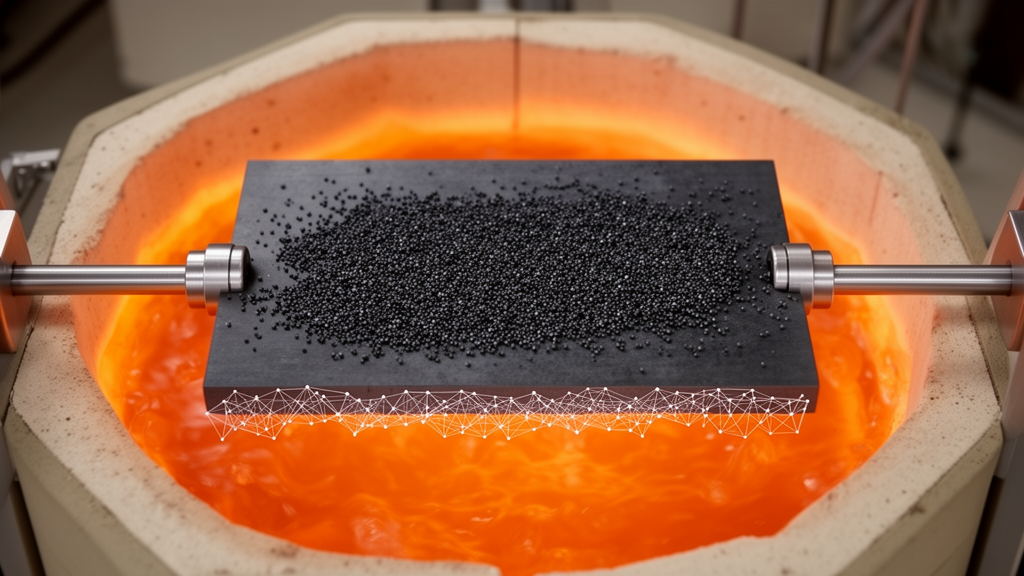
A laboratory study of titanium diboride (TiB2) coatings deposited on graphite has identified a 1.5 wt% particle formulation that produced a dense, crack-free coating 53.15 μm thick. The research combined high-temperature molten-salt electrophoretic deposition, first-principles calculations and laboratory-scale aluminum electrolysis tests to examine coating growth, interfacial adhesion and the performance of an optimized graphite cathode. The results provide evidence for TiB2 deposition within a Na 3 AlF 6 -AlF 3 -CaF 2 -Al 2 O 3 system, but the electrolysis findings were limited to a 72-hour laboratory test rather than an industrial operating period.

The researchers deposited TiB2 onto graphite substrates at particle concentrations of 1–2 wt% and current densities of 60–280 mA/cm 2 , systematically evaluating effects on coating thickness, morphology and uniformity. Across all concentrations tested, thickness varied non-monotonically with current density: it initially increased, reached a maximum and then decreased at higher current densities. Increasing the TiB2 concentration from 1 to 2 wt% raised the maximum coating thickness from 29.55 to 56.82 μm and shifted the current density at which agglomeration began from 120 to 225 mA/cm 2 .

These measured trends show that both particle concentration and electrical current affected the coating process, while the highest tested current densities were associated with agglomeration. The study attributed the concentration effect to the balance between particle surface area and the available surface charge. At a higher TiB2 concentration, the total surface area of the particles increased, reducing the effective surface charge per particle.

A higher current density was therefore needed to sustain stable deposition. The authors selected 1.5 wt% TiB2 as the best overall compromise between coating quality and particle consumption; at this concentration, the coating reached 53.15 μm and was dense and crack-free. First-principles calculations examined bonding between the graphite (0001) and TiB2 (0001) surfaces.

The B-terminated interface had a calculated work of adhesion of 0.378 J/m 2 , substantially higher than the 0.101 J/m 2 calculated for the Ti-terminated interface. The authors associated the difference with stronger B–C electronic interaction at the B-terminated boundary. These model results describe the adhesion of the specified idealized interfaces; they do not directly measure the strength of the complete deposited coating or establish that the observed electrolysis performance was caused solely by this atomic-scale bonding.

Laboratory-scale aluminum electrolysis tests assessed the practical relevance of the optimized coating. After 72 hours of operation, the TiB2-coated cathode retained coating integrity and favorable wettability by molten aluminum, while the cell voltage remained stable. These observations apply specifically to the optimized coated cathode under the laboratory test conditions.

Together, the experiments and calculations show that high-temperature molten-salt electrophoretic deposition can produce a thick, dense and crack-free TiB2 layer on graphite, with adhesion calculations and a short electrolysis test providing complementary evidence about interfacial bonding and behavior in an operating cell.

Subject of Research: Molten-salt deposition and interfacial adhesion of TiB2 coatings on graphite cathodes

Article Title: High-temperature molten salt electrophoretic deposition of TiB2 coatings on graphite: an experimental and first-principles study

Article References: Liu, P., Chen, X., Han, J., & Liang, X. (2026). High-temperature molten salt electrophoretic deposition of TiB2 coatings on graphite: an experimental and first-principles study. Journal of Materials Science, 61(42), 32820-32837. https://doi.org/10.1007/s10853-026-13717-5

Image Credits: AI Generated

DOI: 10.1007/s10853-026-13717-5

Keywords: TiB2 coatings, electrophoretic deposition, molten salts, graphite cathodes, aluminum electrolysis, first-principles calculations, interfacial adhesion, ceramic materials, surface engineering, High-temperature, molten, salt

Cite Scienmag News

Denise Maddox. (October 20, 2026). Research report: High-temperature molten salt electrophoretic deposition of TiB2 coatings on graphite: an experimental and first-principles study. Scienmag. https://scienmag.com/research-report-high-temperature-molten-salt-electrophoretic-deposition-of-tib2-coatings-on-graphite-an-experimental-and-first-principles-study/


Denise Maddox. "Research report: High-temperature molten salt electrophoretic deposition of TiB2 coatings on graphite: an experimental and first-principles study." Scienmag, 20 October 2026, https://scienmag.com/research-report-high-temperature-molten-salt-electrophoretic-deposition-of-tib2-coatings-on-graphite-an-experimental-and-first-principles-study/. Accessed 20 October 2026.

Denise Maddox. "Research report: High-temperature molten salt electrophoretic deposition of TiB2 coatings on graphite: an experimental and first-principles study." Scienmag. October 20, 2026. https://scienmag.com/research-report-high-temperature-molten-salt-electrophoretic-deposition-of-tib2-coatings-on-graphite-an-experimental-and-first-principles-study/

Tags: aluminum electrolysisaluminum electrolysis with coated cathodesceramic materialscurrent density influence on coating thicknessdense crack-free TiB2 coatingselectrolysis testing of coated electrodeselectrophoretic depositionfirst-principles calculationsfirst-principles modeling of coating adhesiongraphite cathodeshigh temperaturehigh-temperature ceramic coatingshigh-temperature electrochemical processesinterface analysis between TiB2 and graphiteinterfacial adhesionmoltenMolten salt electrophoretic deposition of TiB2 coatings on graphitemolten saltsnanostructured ceramic coatings for energy applicationsoptimization of coating parameters for industrial applicationsparticle concentration effects on coating morphologySALTsurface engineeringTiB2 coatings
Share26Tweet16
Previous Post

Survey links social norms and support to farmers’ water-scarcity adaptation

Next Post

Research report: A qualitative study of the communication and information needs of parents of preterm Infants in a tertiary health facility in Northeast Nigeria

Related Posts

Ultrasound-assisted solvent extraction boosts Houttuynia flavonoids
Technology and Engineering

Ultrasound-assisted solvent extraction boosts Houttuynia flavonoids

October 20, 2026
Research report: Is a cost-optimal wind farm also carbon-optimal? A layout optimization and control co-design study
Climate

Research report: Is a cost-optimal wind farm also carbon-optimal? A layout optimization and control co-design study

October 20, 2026
Physics-Constrained Ka-Band Radar Retrieval Tested for Coastal Fog Visibility
Athmospheric

Physics-Constrained Ka-Band Radar Retrieval Tested for Coastal Fog Visibility

October 20, 2026
Medical imaging foundation models lack a universally superior adaptation strategy
Technology and Engineering

Medical imaging foundation models lack a universally superior adaptation strategy

October 20, 2026
Research report: A lightweight multi-scale fourier enhancement network for image forgery detection
Technology and Engineering

Research report: A lightweight multi-scale fourier enhancement network for image forgery detection

October 20, 2026
MFLRA improves multi-label text classification across ten benchmarks
Technology and Engineering

MFLRA improves multi-label text classification across ten benchmarks

October 20, 2026
Next Post
Research report: A qualitative study of the communication and information needs of parents of preterm Infants in a tertiary health facility in Northeast Nigeria

Research report: A qualitative study of the communication and information needs of parents of preterm Infants in a tertiary health facility in Northeast Nigeria

  • Mothers who receive childcare support from maternal grandparents show more optimized

    Mothers who receive childcare support from maternal grandparents show more parental warmth, finds NTU Singapore study

    27656 shares
    Share 11059 Tweet 6912
  • University of Seville Breaks 120-Year-Old Mystery, Revises a Key Einstein Concept

    1061 shares
    Share 424 Tweet 265
  • Bee body mass, pathogens and local climate influence heat tolerance

    682 shares
    Share 273 Tweet 171
  • Researchers record first-ever images and data of a shark experiencing a boat strike

    546 shares
    Share 218 Tweet 137
  • Groundbreaking Clinical Trial Reveals Lubiprostone Enhances Kidney Function

    531 shares
    Share 212 Tweet 133
Science

Embark on a thrilling journey of discovery with Scienmag.com—your ultimate source for cutting-edge breakthroughs. Immerse yourself in a world where curiosity knows no limits and tomorrow’s possibilities become today’s reality!

RECENT NEWS

  • Holokinetic chromosomes reshape—but do not accelerate—insect genome evolution
  • Species composition and assemblages of ichthyoplankton during winter and summer around the Korean Peninsula
  • Mitochondrial type shapes hybrid vigor and yield in oyster mushrooms
  • Epimedium alpinum subspecies newly recorded in Kosovo

Categories

  • Agriculture
  • Anthropology
  • Archaeology
  • Athmospheric
  • Biology
  • Biotechnology
  • Blog
  • Bussines
  • Cancer
  • Chemistry
  • Climate
  • Earth Science
  • Editorial Policy
  • Marine
  • Mathematics
  • Medicine
  • Pediatry
  • Policy
  • Psychology & Psychiatry
  • Science Education
  • Science News
  • Social Science
  • Space
  • Technology and Engineering

Subscribe to Blog via Email

Enter your email address to subscribe to this blog and receive notifications of new posts by email.

Join 5,150 other subscribers

© 2025 Scienmag - Science Magazine

Welcome Back!

Login to your account below

Forgotten Password?

Retrieve your password

Please enter your username or email address to reset your password.

Log In
No Result
View All Result
  • HOME
  • SCIENCE NEWS
  • CONTACT US

© 2025 Scienmag - Science Magazine

Discover more from Science

Subscribe now to keep reading and get access to the full archive.

Continue reading