


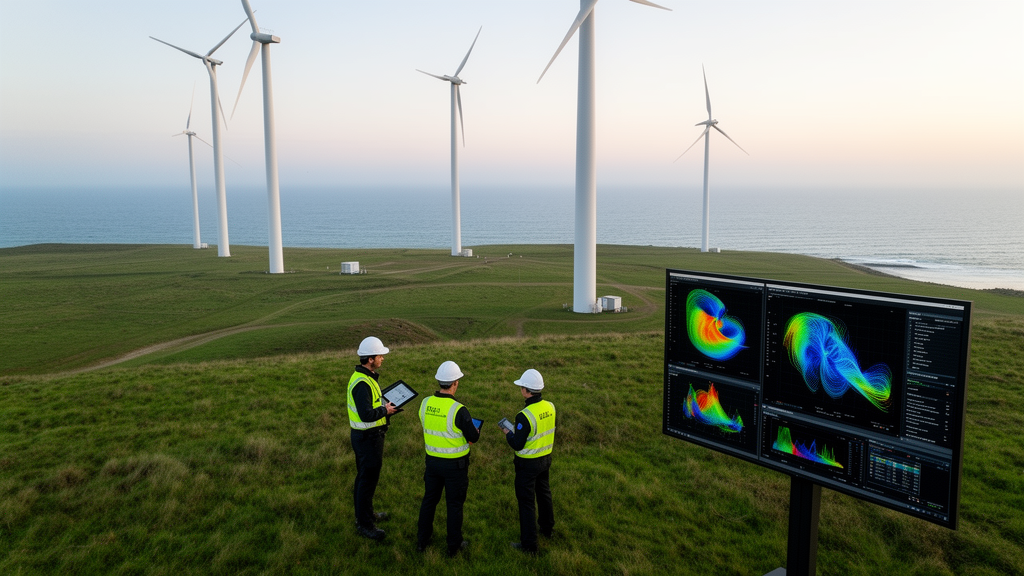
A preprint modeling study finds that optimizing a wind farm for a carbon-related objective can produce economic performance comparable to conventional cost-based optimization. The authors examined turbine layout, wind-farm flow control, and their combination in a series of case studies, including a large-scale offshore wind farm under varying site conditions. The results suggest that environmental and economic goals may be largely aligned in the scenarios tested, although the resulting turbine layouts can differ.
Wind-farm design and operation are traditionally approached through economic objectives such as annual energy production and levelized cost of energy. The study notes that this focus can overlook environmental impacts. Wind energy has substantially lower greenhouse-gas emissions than fossil-fuel-based plants, but those emissions are not negligible when assessed over the entire life cycle.
The research therefore examines whether a carbon-related objective can be introduced alongside conventional objectives during design and control optimization. The analysis treats wind-farm performance as a combined design problem. One component is layout optimization, which determines turbine positions.
The study also considers co-design, in which layout and control strategies are optimized together rather than handled as separate, sequential tasks. This approach allows the analysis to compare the performance of a farm designed with attention to cost or energy against one designed with attention to carbon. Across the illustrative examples and the offshore cases, the main comparison was unexpectedly favorable.
Designs selected using a carbon-related objective achieved economic performance very similar to that obtained with conventional economic objectives. The reverse pattern was also reported: designs optimized using economic objectives performed similarly when assessed against the carbon-related objective. In the authors’ interpretation, these modeled results indicate that prioritizing carbon need not necessarily compromise economic performance, and vice versa.
The similarity in overall performance does not mean the two objectives generate identical wind farms. The researchers found that turbine positions differed depending on the selected objective and on whether layout and control were optimized jointly or sequentially. Thus, a carbon-focused design and an economics-focused design may reach comparable aggregate results while placing turbines in different locations.
The finding concerns compatibility between the objectives, not a single turbine arrangement that the study identifies as universally optimal. The offshore case studies were evaluated under varying site conditions. This was the study’s largest-scale application and provided an additional test of whether the carbon-oriented strategy could retain economic performance in a large wind-farm setting.
The reported comparison used the modeled performance measures of the optimized designs; it does not establish that a particular layout would have the same results in operation, nor does it extend beyond the sites and assumptions represented in the analysis. Instead, it shows that the two optimization approaches can produce similar economic performance in the cases examined, with the most visible difference appearing in the locations selected for turbines. The work is a preprint in Wind Energy Science Discussions , received on 30 September 2026 and posted for discussion on 20 October 2026.
At the time of the posting, it was under review for the journal Wind Energy Science . The findings should therefore be understood as preliminary research awaiting peer review and public discussion. The authors’ conclusion is bounded by the case studies, modeled objectives, site conditions and life-cycle assumptions used in the study: within those scenarios, carbon-related and conventional economic optimization achieved comparable economic performance, while yielding layouts with different turbine positions.
Subject of Research: Wind-farm layout and control optimization for carbon and economic objectives
Article Title: Is a cost-optimal wind farm also carbon-optimal? A layout optimization and control co-design study
Article References: Baricchio, M., Kainz, S., van Wingerden, J.-W., & Bottasso, C. L. (2026). Is a cost-optimal wind farm also carbon-optimal? A layout optimization and control co-design study. https://doi.org/10.5194/wes-2026-178
Image Credits: AI Generated
DOI: 10.5194/wes-2026-178
Keywords: wind energy, wind-farm optimization, carbon emissions, life-cycle assessment, offshore wind, turbine layout, flow control, levelized cost of energy, co-design, preprint research, cost-optimal, wind
Cite Scienmag News
Sloane Callahan. (October 20, 2026). Research report: Is a cost-optimal wind farm also carbon-optimal? A layout optimization and control co-design study. Scienmag. https://scienmag.com/research-report-is-a-cost-optimal-wind-farm-also-carbon-optimal-a-layout-optimization-and-control-co-design-study/
Sloane Callahan. "Research report: Is a cost-optimal wind farm also carbon-optimal? A layout optimization and control co-design study." Scienmag, 20 October 2026, https://scienmag.com/research-report-is-a-cost-optimal-wind-farm-also-carbon-optimal-a-layout-optimization-and-control-co-design-study/. Accessed 20 October 2026.
Sloane Callahan. "Research report: Is a cost-optimal wind farm also carbon-optimal? A layout optimization and control co-design study." Scienmag. October 20, 2026. https://scienmag.com/research-report-is-a-cost-optimal-wind-farm-also-carbon-optimal-a-layout-optimization-and-control-co-design-study/


