


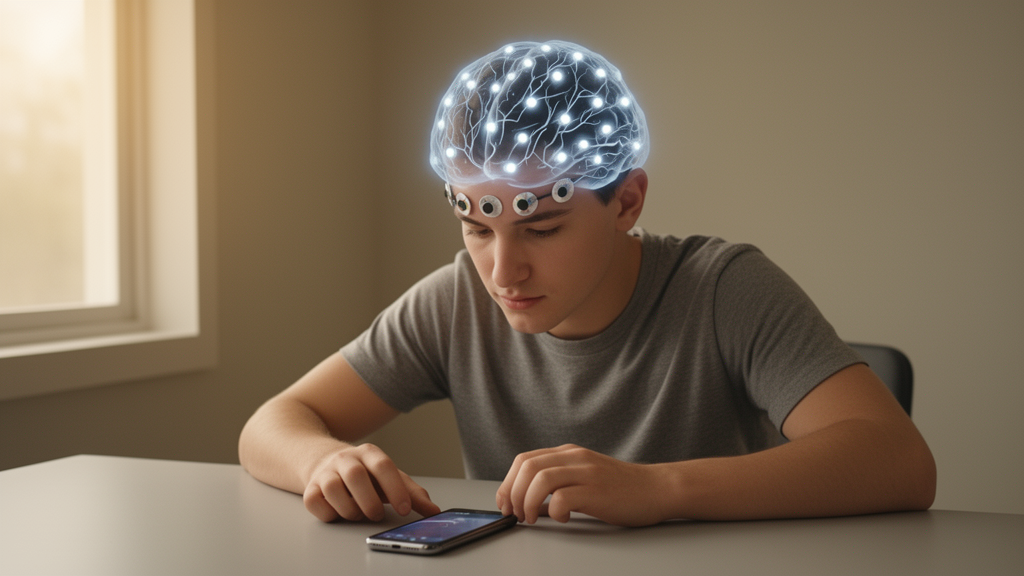
In a randomized, sham-controlled study of 80 university students with problematic smartphone use, repeated stimulation of the left dorsolateral prefrontal cortex was associated with less daily smartphone use, lower craving and reduced functional impairment. The experiment also revealed selective changes in the timing of large-scale brain activity measured by resting-state EEG microstates, offering a window into how the participants’ brains may have reorganized as their behavior improved. The findings are preliminary, however: the study was exploratory, was not registered prospectively as a clinical trial and does not establish that electrical stimulation caused the behavioral improvements or produced a specific brain mechanism.
The participants, aged 18 to 25, were recruited from university campuses between March and July 2024. Eligibility required elevated scores on the 10-item Smartphone Addiction Scale–Short Version, using study-specific thresholds of at least 40 for males and 42 for females, as well as an average of at least six hours of smartphone use per day during the preceding month. The sample had a mean age of 20 years, 50% were female, and participants reported an average of 8.1 hours of daily smartphone use. They were not selected through formal psychiatric diagnostic criteria; instead, the study focused on impaired self-regulation and excessive engagement with smartphones.
Using computer-generated randomization, the researchers assigned 40 participants to active tDCS and 40 to sham stimulation, with allocation concealed in sequentially numbered opaque envelopes. Participants and outcome assessors were blinded, while staff delivering the intervention necessarily knew the assignment. Active treatment delivered 2.0 milliamperes for 20 minutes, including 30-second ramp-up and ramp-down periods, with an anodal electrode placed over F3 to target the left dorsolateral prefrontal cortex and the cathodal electrode placed over the contralateral right supraorbital area. The regimen consisted of three sessions per week for 12 weeks, totaling 36 sessions. This schedule was defined by the researchers and has not been established as an optimized dose for problematic smartphone use.
The sham condition used the same electrodes and positioning but delivered current only during the first and final 30 seconds, reproducing the transient sensations of active stimulation without sustained stimulation. The design was intended to preserve participant blinding, although the researchers did not formally assess blinding with a prospectively standardized instrument, and potential bias from providers’ awareness of allocation could not be excluded. Participants were monitored for itching, tingling, headache, dizziness and discomfort, but adverse events were not recorded in a standardized format that would permit a quantitative comparison between groups.
Behavioral outcomes were measured before treatment, immediately afterward and during a 90-day follow-up. The primary outcome was daily smartphone-use duration recorded by built-in operating-system monitoring tools, with a 28-day Timeline Follow-Back serving as another measure of retrospective use. Researchers also used ecological momentary assessment to record craving repeatedly on a scale from 0 for no craving to 100 for extreme craving, and measured work and social impairment with the Work and Social Adjustment Scale. Relative to sham, active stimulation produced a post-treatment difference of minus 44 minutes per day in objectively recorded use, with a 95% confidence interval from minus 68 to minus 20 minutes and p = 0.0004.
Those behavioral advantages became smaller over time but remained directionally apparent. At one month, the active-minus-sham difference in daily use was minus 36 minutes, with a 95% confidence interval of minus 60 to minus 12 minutes; at three months it was minus 24 minutes, with an interval from minus 48 to minus 0.4 minutes. Average craving intensity, summarized as the area under the curve of repeated ecological assessments, differed by minus 9.2 points immediately after treatment and minus 7.1 points at one month, but the three-month difference of minus 4.8 points was not statistically significant. Work and social impairment showed a similar trajectory, with a post-treatment difference of minus 3.2 points and a one-month difference of minus 2.6 points, while its three-month difference did not meet the statistical threshold.
An exploratory durability analysis suggested that participants receiving active stimulation were less likely to return to elevated smartphone use during follow-up. The cumulative event rate was 31% in the active group and 47% in the sham group at three months, a risk difference of minus 16 percentage points with a 95% confidence interval of minus 31 to minus 1. The Cox model gave a hazard ratio of 0.62 for active versus sham stimulation, with a 95% confidence interval of 0.41 to 0.93, while restricted mean survival time was 6.2 days longer over 90 days, with an interval of 0.8 to 11.5 days. These estimates came from a nonvalidated, study-defined threshold and sensitivity analyses using alternative thresholds; they describe behavioral persistence rather than clinical remission.
To investigate brain dynamics, researchers recorded 64-channel EEG before and after the intervention under eyes-closed and eyes-open resting conditions. After filtering, artifact removal and independent component analysis, they extracted global field power peaks and used k-means clustering with at least 200 random initializations to identify four canonical microstates, conventionally labeled A through D. Each microstate represents a brief, relatively stable scalp topography and was characterized by occurrence, mean duration, coverage and global explained variance, the proportion of EEG topographic variance captured by the fitted model. Because scalp recordings provide only indirect information about distributed brain networks, the investigators treated the microstate analysis as exploratory and did not predict directions of change for individual classes.
The most notable neurophysiological result was a pattern of temporal reorganization rather than wholesale spatial change. With eyes closed, microstate C occurrence fell more in the active group than in the sham group: the between-group change was minus 1.7 Hz, with a 95% confidence interval of minus 3.0 to minus 0.5 Hz, p = 0.006 and partial eta squared about 0.086. Microstate D occurrence increased by 1.0 Hz more with active treatment, with an interval of 0.2 to 1.8 Hz, p = 0.014 and partial eta squared about 0.074. With eyes open, microstate B occurrence rose by 1.6 Hz more than with sham, with an interval of 0.3 to 2.8 Hz, p = 0.017, while its coverage increased by 3.4 percentage points, with an interval of 0.6 to 6.2, p = 0.018. Other tested metrics, including global explained variance, did not differ significantly between groups.
Previous EEG–fMRI and source-localization studies have linked microstate C with salience-related processing, microstate D with attention and executive processes, and microstate B with visual and attentional activity. If those associations apply here, the active-treatment pattern might be consistent with reduced salience-driven activity during eyes-closed rest, greater recruitment of attentional or executive configurations and altered externally directed attention with eyes open. That remains a tentative interpretation rather than a demonstrated mechanism: scalp EEG microstates do not map one-to-one onto functional brain networks, and the study did not include functional imaging or test whether EEG changes mediated the behavioral improvements. Overall, the results show concurrent improvements in smartphone-related behavior and selective changes in the timing of resting brain states, but larger confirmatory studies with standardized blinding, validated clinical outcomes, multimodal imaging and longer follow-up are needed before tDCS can be considered an established intervention for problematic smartphone use.
Subject of Research: Randomized sham-controlled trial of prefrontal tDCS and resting-state EEG microstate dynamics in young adults with problematic smartphone use.
Article Title: Repeated prefrontal transcranial direct current stimulation improves behavioral regulation and modulates resting-state EEG microstate dynamics in young adults with problematic smartphone use: a randomized sham-controlled longitudinal study
Article References: Chen, J., Cheng, J., Teng, J., Liu, H., Yang, B., Zhu, Y., Zhang, E., Cheng, F., & Zeng, Y. (2026). Repeated prefrontal transcranial direct current stimulation improves behavioral regulation and modulates resting-state EEG microstate dynamics in young adults with problematic smartphone use: a randomized sham-controlled longitudinal study. Frontiers in Psychiatry, 17, Article 1928163. https://doi.org/10.3389/fpsyt.2026.1928163
Image Credits: AI Generated
DOI: 10.3389/fpsyt.2026.1928163
Keywords: problematic smartphone use, transcranial direct current stimulation, prefrontal cortex, EEG microstates, resting-state EEG, digital behavior, craving reduction, neuromodulation, sham-controlled trial, behavioral regulation, Repeated, prefrontal
Cite Scienmag News
Cassandra Pierce. (October 20, 2026). Prefrontal stimulation reduces smartphone use and reshapes brain timing. Scienmag. https://scienmag.com/prefrontal-stimulation-reduces-smartphone-use-and-reshapes-brain-timing/
Cassandra Pierce. "Prefrontal stimulation reduces smartphone use and reshapes brain timing." Scienmag, 20 October 2026, https://scienmag.com/prefrontal-stimulation-reduces-smartphone-use-and-reshapes-brain-timing/. Accessed 20 October 2026.
Cassandra Pierce. "Prefrontal stimulation reduces smartphone use and reshapes brain timing." Scienmag. October 20, 2026. https://scienmag.com/prefrontal-stimulation-reduces-smartphone-use-and-reshapes-brain-timing/


