


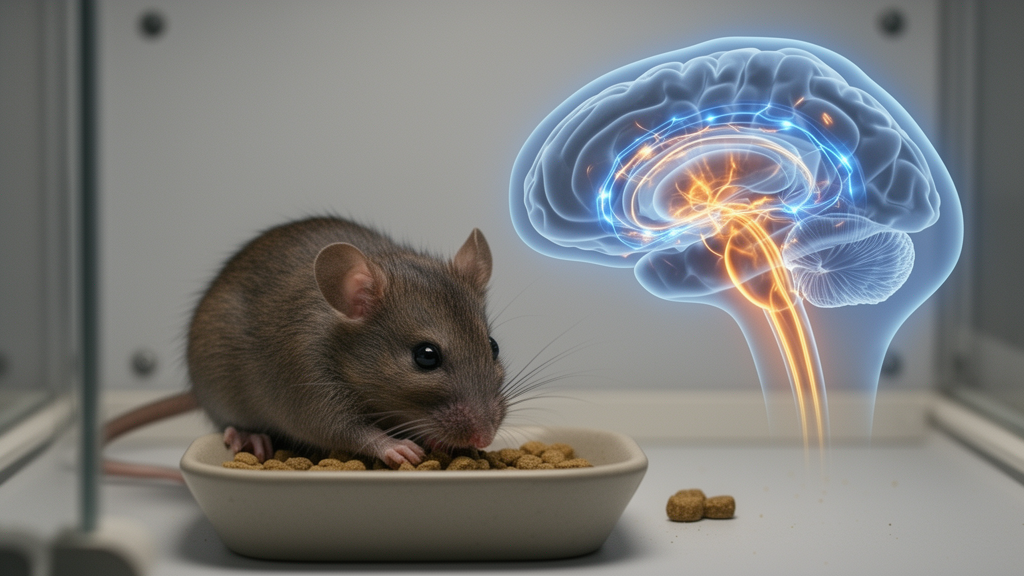
An automated analysis of feeding behavior in mice found that social isolation and intermittent access to a high-fat diet produced longer feeding bouts, a pattern the researchers call “protracted feeding.” Local dopamine delivery to the nucleus accumbens shell shortened those bouts, while chemogenetic inhibition of dopamine neurons in the ventral tegmental area prolonged them. The experiments link the temporal structure of feeding to mesolimbic dopamine signaling, although the mouse findings do not establish a comparable mechanism in people.
The study used DeepLabCut to track the ears, nose and tail base of freely moving mice, then applied the SimBA machine-learning framework to classify feeding frame by frame. Investigators recorded four-hour sessions in an arena containing four food-bait containers, with standard chow available throughout. Before each session, mice were food-deprived for four hours while retaining access to water. The principal measure was the mean duration of feeding bouts for each mouse, calculated after feeding periods separated by gaps of less than seven seconds were merged. This per-mouse endpoint was intended to summarize temporal organization without treating individual bouts or video frames as independent biological replicates.
To evaluate the automated pipeline, researchers compared its bout-duration estimates with blinded manual scoring of the same recordings from 170 mice drawn from the intermittent high-fat diet, social-isolation and physical-restraint experiments. The two methods were positively associated, with an R² of 0.5819 and p<0.0001. That association supports the system’s usefulness for group-level quantification, but the scatter around the regression means that automated and manual estimates are not interchangeable for individual animals. The feeding classifier itself was trained on 8,992 manually annotated frames from one male mouse and achieved precision of 0.994, recall of 0.993 and an F1 score of 0.994 on a held-out test set. Because predictions for that training animal were not fully out of sample, it was excluded from the manual-versus-automated regression and the corresponding automated group comparison.
Social isolation was induced by housing wild-type C57BL/6J mice individually for seven days, while age-matched controls remained group-housed in groups of four. In the intermittent high-fat diet experiment, six-week-old mice received the diet for two hours every other day for two weeks; controls remained on standard chow. Both stressors significantly increased mean feeding-bout duration compared with their controls, with p-values of 0.0213 for isolation and 0.0110 for intermittent high-fat diet exposure. Manual scoring independently confirmed the pattern, yielding p-values of 0.0096 and p<0.0001, respectively. The number of bouts, latency to first feeding and mean interval between bouts did not change significantly in either comparison, indicating that the clearest detectable alteration concerned how long feeding episodes lasted once initiated.
These findings were not simply reflections of eating more food. The study’s earlier analysis of the same recordings found that intermittent high-fat diet exposure increased total intake in male mice, with a similar trend in females, whereas social isolation produced no consistent change in consumption. Yet both conditions prolonged individual bouts. Total feeding time was significantly greater in socially isolated mice, while the increase associated with intermittent high-fat diet exposure was numerically greater without reaching statistical significance. The experiments therefore suggest that intake and temporal feeding structure can dissociate: a mouse may consume a different quantity without exhibiting a different pattern of feeding episodes. This distinction matters because the authors argue that total consumption alone may miss stress-associated changes in the organization of reward-related behavior.
Physical restraint did not produce the same temporal effect. Seven-week-old mice were completely immobilized for two hours a day for five consecutive days before recording. Restrained mice had a slightly lower mean feeding-bout duration than controls, but the difference was not statistically significant, with p=0.1661; blinded manual scoring also found no significant difference. Restrained animals spent less total time feeding, while bout number, latency and inter-bout interval did not differ significantly. Because the primary comparison was not significant, restraint alone cannot be described as a robust inducer of protracted feeding under the conditions used. The authors suggest that the autonomic and gastrointestinal state produced by restraint may constrain sustained feeding or mask a stress-related temporal deviation, but the experiment did not directly measure either gastrointestinal motility or sympathetic activity.
To probe that possibility, the researchers administered mosapride, a peripheral 5-HT4 receptor agonist that promotes gastrointestinal motility, after restraint periods. In male mice already exposed to restraint, mosapride significantly increased mean feeding-bout duration compared with restraint plus control treatment, with p=0.0374, and increased total feeding time with p=0.0384. It did not significantly alter bout number, latency, inter-bout interval, spatial fixated-feeding behavior or total intake during the recording. The result is consistent with peripheral physiological state influencing the expression of a central feeding pattern, but it does not establish a specific autonomic mechanism. The absence of a non-stressed mosapride-treated group also prevents the investigators from determining whether the drug’s effect on bout duration is specific to restraint stress.
Central dopamine manipulation produced the clearest mechanistic evidence. In mice exposed to intermittent high-fat diet or social isolation, dopamine administered directly into the nucleus accumbens shell significantly reduced mean feeding-bout duration, with p=0.0332 and p=0.0440, respectively. Previously reported intake measurements from those same cohorts did not differ significantly between dopamine and vehicle treatment, reducing the likelihood that shorter bouts merely reflected reduced consumption. In a separate chemogenetic experiment, mice expressing the inhibitory designer receptor hM4Di in ventral tegmental area dopamine neurons received either clozapine-N-oxide or vehicle in a counterbalanced, within-subject design. Inhibition increased mean bout duration, with p=0.0360 in a paired test, even though it reduced total food intake, with p=0.0075. These complementary interventions implicate the ventral tegmental area–nucleus accumbens shell dopamine axis in maintaining the temporal organization of feeding.
Several limitations constrain how far the results can be generalized. Most recordings were originally acquired for an earlier study rather than collected in prospectively designed, independent cohorts, although the earlier investigators had not analyzed bout duration. Some experimental groups also underwent stereotaxic surgery, and the absolute bout-duration means differed across cohorts, so the study does not establish whether surgery shifted the entire distribution. The mosapride, nucleus accumbens and chemogenetic experiments included only male mice; sex-stratified results in the broader cohorts pointed in the same direction but were underpowered and cannot demonstrate equivalence between sexes. Standardized food deprivation standardized pre-recording access but did not guarantee equal hunger or satiety at the start of a session, particularly because the stress paradigms themselves could alter intake. The four-bait assay, mouse strains and laboratory environment also limit transfer to other behavioral settings, and the automated workflow has not been validated across a wider range of behaviors. Combining bout-duration measures with established compulsivity assays would be necessary to determine whether protracted feeding captures the same construct as inflexible or compulsive behavior.
For the scientists, the broader significance lies in a new behavioral readout that complements the group’s earlier description of fixated feeding, an abnormal preference for particular food locations. Fixated feeding concerns where a mouse feeds, whereas protracted feeding concerns how long each feeding episode persists. The automated workflow links the spatial and temporal dimensions of stress-related feeding to mesolimbic dopamine dysfunction without reducing either measure to the amount consumed. It also illustrates why machine-assisted behavioral analysis can uncover patterns that may be difficult to score consistently by hand, although human observers and the automated classifier are not interchangeable. The authors present protracted feeding as a candidate preclinical marker of stress-associated reward-system dysfunction, not as a clinical test or a demonstrated human symptom. Future work will need independent validation, direct measurements of peripheral state, broader behavioral sampling and testing in female mice to determine how robustly the phenotype and its proposed mechanisms generalize.
Subject of Research: Automated analysis of stress-related feeding patterns and mesolimbic dopamine in mice
Article Title: Automated temporal analysis reveals stress-induced protracted feeding regulated by mesolimbic dopamine in mice
Article References: Guo, X., Fujioka, Y., Kawai, K., & Ishigaki, S. (2026). Automated temporal analysis reveals stress-induced protracted feeding regulated by mesolimbic dopamine in mice. Frontiers in Neuroscience, 20, Article 1959447. https://doi.org/10.3389/fnins.2026.1959447
Image Credits: AI Generated
DOI: 10.3389/fnins.2026.1959447
Keywords: mouse feeding behavior, mesolimbic dopamine, nucleus accumbens, ventral tegmental area, social isolation, high-fat diet, physical restraint, DeepLabCut, SimBA, behavioral neuroscience, Automated, temporal
Cite Scienmag News
Cassandra Pierce. (October 20, 2026). Mouse study links stress to prolonged feeding bouts through mesolimbic dopamine. Scienmag. https://scienmag.com/mouse-study-links-stress-to-prolonged-feeding-bouts-through-mesolimbic-dopamine/
Cassandra Pierce. "Mouse study links stress to prolonged feeding bouts through mesolimbic dopamine." Scienmag, 20 October 2026, https://scienmag.com/mouse-study-links-stress-to-prolonged-feeding-bouts-through-mesolimbic-dopamine/. Accessed 20 October 2026.
Cassandra Pierce. "Mouse study links stress to prolonged feeding bouts through mesolimbic dopamine." Scienmag. October 20, 2026. https://scienmag.com/mouse-study-links-stress-to-prolonged-feeding-bouts-through-mesolimbic-dopamine/


