


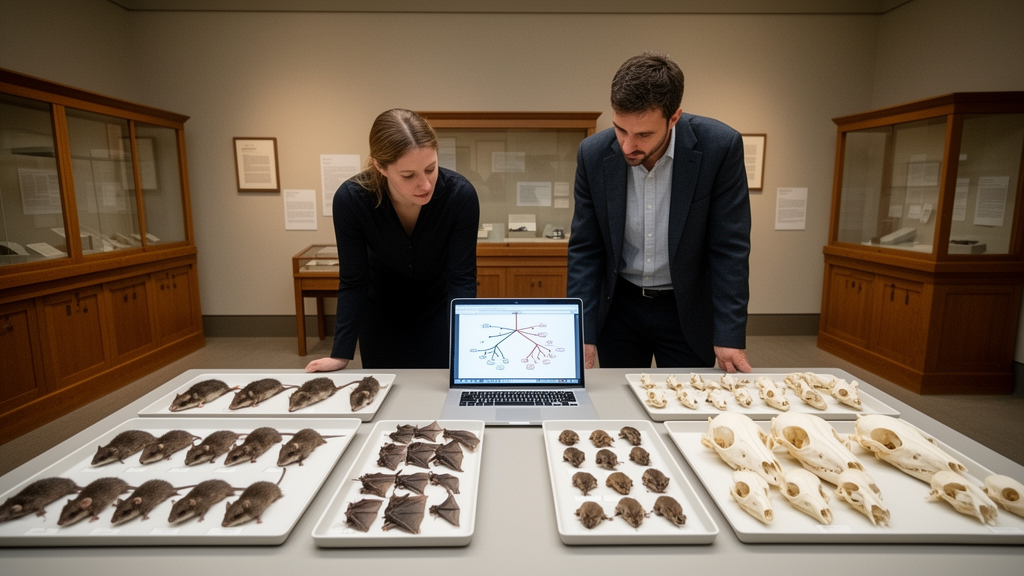
A new open-source method can align two large biological checklists in less than 30 seconds by comparing the organisms that their taxonomic records share. In a demonstration with mammal classifications, the software identified 6,129 relationships among accepted species concepts in the Mammal Diversity Database and the Catalogue of Life, including cases in which names referred to the same group, one concept included another, or historical taxonomic changes produced overlap. The study presents the method as a practical way to move beyond simple name matching while avoiding the labour-intensive manual reconciliation of thousands of records.
The central distinction is between a scientific name and a taxonomic concept. A checklist may appear to be a simple inventory, but each accepted record is intended to represent a particular set of organisms. That set can change when a species is split, narrowed, expanded or otherwise revised. Two checklists may therefore use the same name for groups of different sizes, or they may assign different names to the same organisms. Existing tools such as PhyloMatcher, the Taxonomic Name Resolution Service, gnparser and taxamatch help identify name-based correspondences, but a textual match alone does not establish that two records have identical biological meanings. False matches and missed matches can lead to errors when researchers reason about information of biological importance.
The proposed method fills the gap with “exemplars,” which are sampled organisms whose classification is known in both checklists. An exemplar can be linked to a record in each list, allowing the software to compare sets of exemplars associated with their taxonomic concepts. If two records contain the same exemplars, the method estimates that their concepts are congruent. If every exemplar in one set also occurs in the other, it estimates a relationship of inclusion. Shared exemplars combined with distinct exemplars indicate a non-trivial overlap, while sets with no members in common suggest disjointness. The approach is therefore based on how occurrences are distributed across concepts rather than on whether name strings resemble one another.
These possible relationships are expressed through Region Connection Calculus-5, or RCC-5, a framework for describing relations between sets. Its five basic relations are congruence, in which two sets have the same members; inclusion, in which every member of one is also a member of the other; the reverse of inclusion; disjointness; and non-trivial overlap, in which two sets share some members but neither contains the other. The resulting alignment is a model of the RCC-5 relationships between records in two checklists, constrained by the hierarchies within each list. Because most pairs are expected to be disjoint, an exhaustive table of every relationship would be unwieldy, and the software can treat disjointness as the default for pairs that are not listed.
Type specimens provide the default source of exemplars. Under the rules of biological nomenclature, a named species is associated with a type specimen that anchors the application of its name. When two checklist records imply the same type specimen or protonym, that shared reference can represent an organism known to belong to both corresponding concepts even if the concepts themselves differ. List Tools uses gnparser to parse, stem and normalize names, then applies heuristics for variations such as spelling differences, authorship and year errors, gender changes and genus changes. It also groups records by epithet through a block nested join, reducing the number of candidate comparisons and making ambiguity detection more efficient.
After exemplar collection, the software assigns each exemplar set to individual records and propagates those sets upward through each taxonomic hierarchy. A specimen classified in a species is therefore also a member of the concepts represented by that species’ parent and other ancestors. Comparisons are then made between the resulting sets in the two checklists. Records with no exemplars are evaluated through the closest ancestors that have them, although some combinations remain logically undetermined. Where available information does not distinguish broader relationships, the method can use the taxonomic ranks recorded in the checklists as a heuristic. It generally prefers a definite containment relationship over overlap, because confirming overlap would require additional exemplars.
The demonstration aligned Mammal Diversity Database version 2.0 with the mammal section of the 2024 annual Catalogue of Life. The Mammal Diversity Database file contained 34,439 rows, including 6,759 accepted species, while the Catalogue of Life file contained 25,664 rows, including 6,082 accepted species. The alignment procedure, including the type-specimen exemplar search, took under 30 seconds on a personal Linux laptop computer with a maximum processor speed of 3,500 MHz and 16 GB of RAM. It generated 13,649 exemplars and 6,129 inferred RCC-5 relationships between intersecting accepted species-ranked concepts. Of these, 5,175 expressed congruence. A further 1,187 records had no known species relationship to the other checklist, while 954 fell into inclusion, reverse-inclusion or overlap categories.
One example recovered a taxonomic split that was obscured by an outdated name. Genetic evidence has led to proposals dividing the deermouse Peromyscus maniculatus into as many as six species, and the Mammal Diversity Database recognizes four of them: P. sonoriensis, P. gambelii, P. labecula and P. maniculatus with a reduced circumscription. The corresponding Catalogue of Life concept had not been updated after its taxonomic review was dated April 30, 2015. By tracing historical synonyms and type specimens, List Tools distributed the Catalogue of Life concept among the newer accepted names and estimated the four-way split. The example also shows why the distinction matters for biodiversity data: GBIF reported 316,249 occurrence records under Peromyscus maniculatus as of December 30, 2025, while the revised geographic concepts are relevant to discussions of the species as a reservoir host for Sin Nombre virus.
A second example involved the common vole, Microtus arvalis, which has been linked with Tula virus. The two checklists distributed accepted names and synonyms differently, combining a proposed split with the reshuffling of synonymy. Catalogue of Life treated Microtus levis as accepted, whereas the Mammal Diversity Database reduced it to a synonym of M. arvalis and assigned some of its Catalogue of Life synonyms to M. rossiaemeridionalis. Meanwhile, names placed under M. arvalis in Catalogue of Life were divided among M. arvalis, M. obscurus and M. mystacinus in the Mammal Diversity Database. List Tools estimated three containment relationships and one overlap among the affected concepts. That overlap could not be inferred from string matching alone because the records do not correspond directly by name.
The study did not quantitatively validate every inferred RCC-5 relationship against expert judgment, and the authors note that performance depends on the quality and completeness of both the exemplars and the nomenclatural information in the input checklists. The method is most effective when synonym lists provide enough historical information to connect newly recognized groups with earlier concepts. If a species was newly named after the older checklist was last updated, without a synonym, subspecies or other occurrence linking the two, the required exemplar may not exist. Some Darwin Core files can also violate assumptions about accepted records, parents and synonyms, making prior correction or removal of problematic records important. Preliminary comparisons with published difference reports for Mammal Diversity Database versions showed agreement, but the authors did not identify a comprehensive external knowledge base suitable for fully validating the Catalogue of Life comparison.
The proposed applications extend beyond one-to-one reconciliation. List Tools is a free package for checklist alignment and related operations, including conversion to Darwin Core, cleaning, sorting, subsetting and exemplar extraction. It could compare classifications from different sources, generate difference reports between versions of the same taxonomy, and help organizations managing threatened or protected-species lists prioritize records for expert review. Future development may include curator-facing tools for adding, removing or reassigning exemplars, comparisons above species level, coordinated reports involving more than two checklists, and workflows tailored to particular taxonomy or biodiversity-data systems. The method’s broader value is not that it replaces taxonomic expertise, the authors argue, but that it can automate a first pass and focus attention on the differences most likely to require human judgment.
Subject of Research: Computational alignment of biological taxonomic checklists using shared exemplars
Article Title: A scalable exemplar-based method for aligning biological taxonomies
Article References: Rees, J., Franz, N., & Sterner, B. (2026). A scalable exemplar-based method for aligning biological taxonomies. Biodiversity Data Journal, 14, Article e191754. https://doi.org/10.3897/bdj.14.e191754
Image Credits: AI Generated
Keywords: taxonomic alignment, biodiversity data, exemplar sets, RCC-5, species checklists, List Tools, Mammal Diversity Database, Catalogue of Life, taxonomic concepts, nomenclature, scalable, exemplar-based
Cite Scienmag News
Drew Townsend. (October 20, 2026). Exemplar method aligns competing mammal taxonomies in under 30 seconds. Scienmag. https://scienmag.com/exemplar-method-aligns-competing-mammal-taxonomies-in-under-30-seconds/
Drew Townsend. "Exemplar method aligns competing mammal taxonomies in under 30 seconds." Scienmag, 20 October 2026, https://scienmag.com/exemplar-method-aligns-competing-mammal-taxonomies-in-under-30-seconds/. Accessed 20 October 2026.
Drew Townsend. "Exemplar method aligns competing mammal taxonomies in under 30 seconds." Scienmag. October 20, 2026. https://scienmag.com/exemplar-method-aligns-competing-mammal-taxonomies-in-under-30-seconds/


