


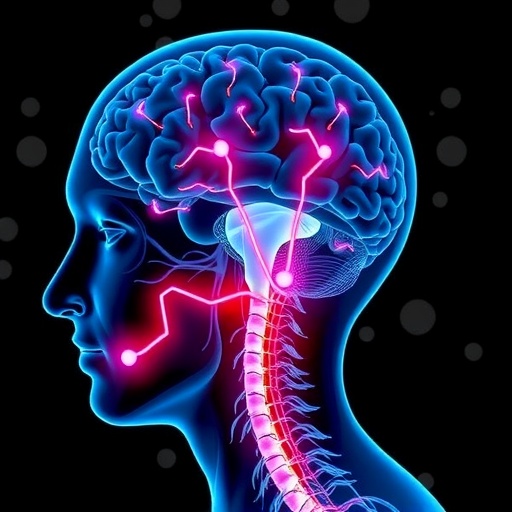
Vagus nerve stimulation (VNS) has long been recognized for its capacity to mitigate pain and modulate mood, yet the precise neural circuits underlying these effects have remained largely obscure. A groundbreaking study from Tang, Shao, Luo, and colleagues, published in Nature Neuroscience in 2026, has now illuminated a novel brainstem pathway crucial for the integration of somatic pain signals and the subsequent modulation of negative affect by VNS. Their work identifies a distinct population of neurons in the caudal nucleus of the solitary tract (cNTS) projecting to the periaqueductal gray (PAG), providing fresh insights into the neurobiological underpinnings of VNS-mediated analgesia.
The cNTS plays a pivotal role within the brainstem, acting as a hub where visceral afferents conveyed by the vagus nerve converge alongside somatic sensory inputs. However, discerning how this region translates nociceptive stimuli into behavioral and affective responses has posed a formidable challenge. The study’s authors pinpointed a specific subset of neurons within the cNTS, herein referred to as cNTS^PAG neurons, that project directly to the PAG, a midbrain structure critically involved in descending pain modulation.
Utilizing cutting-edge optogenetic tools, the researchers selectively activated cNTS^PAG neurons in mice, which resulted in behaviors indicative of pain and discomfort. This causative link not only underscores the functional relevance of this brainstem circuit but also mirrors the phenotypes typically alleviated by VNS, strengthening the conceptual framework that these neurons serve as a conduit between peripheral pain signaling and central modulation.
Intriguingly, cNTS^PAG neurons demonstrated a remarkable specificity in encoding pain modalities. When subjected to mechanical stimuli, these neurons exhibited robust firing patterns distinct from those evoked by thermal stimuli, implicating a nuanced sensory discrimination capability. Beyond mere sensory encoding, the neuronal activity was shown to carry predictive signals after associative learning, suggesting that the cNTS^PAG circuit is also involved in the anticipation of pain and potentially in the modulation of affective states linked to pain memory.
To further dissect the role of sensory inputs, the team employed targeted inhibition techniques focused specifically on spinal inputs converging onto cNTS^PAG neurons. This intervention led to a selective diminution of mechanical nociception without markedly affecting thermal pain responses. This differential outcome highlights a modality-specific gating mechanism operational within the cNTS^PAG pathway, an insight that could reorient therapeutic strategies towards more tailored pain interventions.
Perhaps most striking is the revelation that VNS exerts its analgesic influence by selectively attenuating activity within cNTS^PAG neurons in response to pain stimuli. The stimulation recruited local inhibitory circuits within the cNTS, dampening pain-evoked excitatory neuronal activity and thereby preventing the normal transmission of nociceptive signals to the PAG. This neural inhibition manifests as a tangible reduction in pain perception and accompanying negative affect, adding depth to our understanding of VNS’s multifaceted therapeutic effects.
Complementing these neuronal findings, the study also examined downstream effects on the nucleus accumbens, a key brain region implicated in reward processing and affect. VNS was found to counteract pain-induced dopamine reductions in this area, and this effect was mediated through the cNTS^PAG pathway. The maintenance of dopaminergic tone in the face of nociceptive stimuli potentially underlies the observed alleviation of negative affect, linking the brainstem circuitry with mesolimbic reward systems in a novel framework.
This integration of visceral sensory processing, midbrain pain regulation, and dopaminergic modulation forms the basis of a new conceptual model for VNS-induced analgesia and mood improvement. The identification of cNTS^PAG neurons as a nodal element offers a promising target for precision neuromodulation therapies. Unlike broad VNS approaches, which stimulate the vagus nerve indiscriminately, future interventions may hone in on this specific pathway to maximize efficacy and minimize side effects.
The implications of these findings extend beyond pain management alone. Given the centrality of the PAG in aversive behavior and affect, and the nucleus accumbens’ role in motivation and reward, the cNTS^PAG axis may participate in a broader spectrum of neuropsychiatric phenomena. Whether modulating anxiety, depression, or stress-related disorders, this brainstem circuitry could represent a universal hub for linking somatic sensations with emotional states.
Importantly, the use of advanced methodological approaches such as optogenetics, in vivo imaging, and cell type-specific inhibition lends robustness to the conclusions drawn. These tools allow for the dissection of neural circuits with unprecedented specificity, shedding light on the unique contribution of discrete neuronal populations in complex behaviors. The study’s careful delineation of sensory modalities and learning-dependent changes in neuronal activity enriches our understanding of the dynamic nature of pain processing.
Looking ahead, this research opens several avenues for exploration. For instance, the molecular identity of the inhibitory interneurons recruited by VNS and their synaptic mechanisms remain to be defined. Additionally, examining how chronic pain conditions alter cNTS^PAG circuit function could reveal maladaptive plasticity amenable to targeted intervention. Moreover, the potential for translating these findings into clinical neuromodulation devices poised to selectively engage cNTS^PAG neurons is tantalizing.
The paradigm-shifting discovery also challenges existing dogmas about the hierarchical organization of pain processing. Rather than a unidirectional pathway flowing from periphery to cortex, the cNTS^PAG axis exemplifies a brainstem circuit capable of bidirectional modulation, integrating sensory, affective, and neuromodulatory elements. This layered complexity enriches the broader narrative of how the nervous system orchestrates adaptive responses to aversive stimuli.
In summary, the identification of a cNTS to PAG projection as a critical mediator of vagal nerve stimulation’s analgesic and affective effects marks a seminal advance in pain neuroscience. By linking peripheral nerve stimulation to central circuit dynamics and behavioural outcomes, this discovery bridges a crucial knowledge gap. It offers a mechanistic foundation for the development of precisely targeted neuromodulation therapies that could revolutionize pain management and improve quality of life for millions suffering from chronic pain syndromes worldwide.
The work by Tang and colleagues thus redefines our perspective on the neurobiology of pain and neuromodulation. It underscores the importance of brainstem nuclei, often overshadowed by cortical and limbic regions, in orchestrating complex integrative processes. With the advent of more refined neuromodulatory technologies and a growing arsenal of circuit-level tools, the era of bespoke pain therapies informed by a detailed mechanistic understanding is now within reach.
As the field moves forward, leveraging the identified cNTS^PAG circuit and its molecular and electrophysiological characteristics promises to yield unprecedented therapeutic benefits. The prospect of fine-tuning the brainstem’s intrinsic capacity to regulate pain and affect holds great promise, heralding a future where debilitating pain can be alleviated through targeted, minimally invasive neuromodulation strategies grounded in fundamental neuroscience discoveries.
Cite Scienmag News
Ophelia Keating. (June 3, 2026). Brainstem Circuit Links Vagal Nerve to Pain, Emotion. Scienmag. https://scienmag.com/brainstem-circuit-links-vagal-nerve-to-pain-emotion/
Ophelia Keating. "Brainstem Circuit Links Vagal Nerve to Pain, Emotion." Scienmag, 3 June 2026, https://scienmag.com/brainstem-circuit-links-vagal-nerve-to-pain-emotion/. Accessed 4 September 2026.
Ophelia Keating. "Brainstem Circuit Links Vagal Nerve to Pain, Emotion." Scienmag. June 3, 2026. https://scienmag.com/brainstem-circuit-links-vagal-nerve-to-pain-emotion/


