


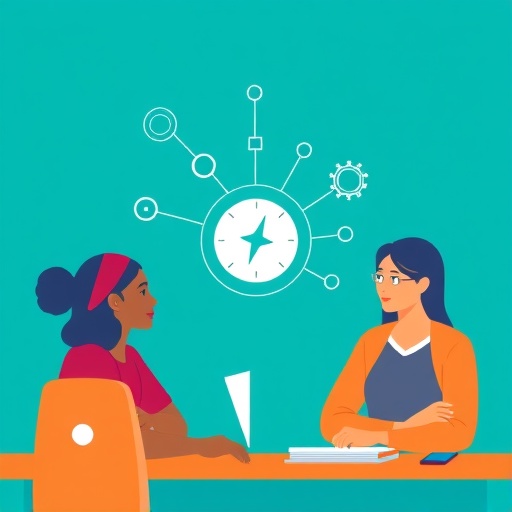
In recent years, STEM education has occupied a critical place in global discussions on innovation, economic growth, and workforce development. However, despite increased investment and strategic initiatives, many students still struggle to thrive in science, technology, engineering, and mathematics fields. A groundbreaking study by Lee, Mak, Lit, and colleagues, published in IJ STEM Education in 2025, introduces a paradigm-shifting approach that tackles these challenges by addressing one of the most overlooked yet pivotal elements within STEM education: mentorship compatibility. Entitled “Enhancing STEM outcomes through mentorship (Mis)matching: an identity grafting approach,” this research illuminates how the dynamics between mentors and mentees profoundly influence educational outcomes and proposes novel solutions for optimizing these relationships.
At the heart of this research lies an innovative framework coined the “identity grafting approach.” This concept refocuses conventional mentorship paradigms by emphasizing the interplay of identity elements—such as cultural, social, and academic identities—shared or divergent between mentors and mentees. Traditional mentorship programs often prioritize skills matching or subject matter expertise without accounting for the subtle yet powerful ways personal identity alignment shapes trust, motivation, and resilience in STEM learners. The authors assert that proper identity alignment in mentorship pairs is not just beneficial but essential for nurturing persistence and excellence.
STEM dropout rates have historically been alarmingly high, with underrepresented groups disproportionately affected. The “identity grafting approach” confronts this phenomenon by analyzing the relational mismatches that can arise when mentors and mentees operate from divergent identity frameworks. Through sophisticated qualitative and quantitative analyses of mentorship pairings across multiple institutions, the study uncovers that mismatches can lead to reduced engagement, eroded self-efficacy, and diminished achievement. Conversely, strong identity congruence fosters deeper psychosocial connections that empower mentees to navigate the inherent challenges in STEM curricula.
One of the pioneering methodological advancements of this research is its integration of intersectionality theory with educational psychology. By layering identity dimensions—race, gender, socioeconomic status, academic background—onto mentorship relationships, the study examines how these intersecting identities impact mentees’ experiences and outcomes. Results reveal that mentorship relationships embracing multidimensional identity congruency promote more effective knowledge transfer, heightened emotional support, and a sense of belonging frequently absent in less tailored mentorship arrangements.
The researchers also highlight systemic issues within STEM institutions that inhibit effective mentorship tailoring. Existing mentorship programs often suffer from logistical constraints, limited mentor availability, and insufficient training on identity dynamics. These structural barriers cause inadvertent mismatches, with mentors and mentees paired based solely on availability or superficial academic compatibility. The article calls for institutional reforms that incorporate identity mapping tools and mentor training modules to better align mentorship pairs.
Furthermore, the study delves into the neurocognitive implications of identity compatibility. Leveraging insights from social neuroscience, the authors argue that identity resonance activates neural pathways critical for social bonding and cognitive receptivity—key foundations for effective learning and motivation. When mentees perceive genuine identity alignment, oxytocin and dopamine responses facilitate greater trust and attentional focus, which translates into improved STEM skill acquisition and conceptual mastery.
Significantly, the identity grafting approach also surfaces potential pitfalls in mentorship homogeneity. The research cautions against the overemphasis on matching solely within identical identity groups, as this may limit the broadening of perspectives and reinforce segregated social loops. Instead, the approach advocates for nuanced identity grafting—where shared core identities provide a foundation of trust, while complementary differences encourage cognitive diversity and innovation thinking, vital for STEM problem-solving.
The study further explores how digital platforms can aid in implementing this approach at scale. Virtual mentorship programs, enhanced by AI-driven identity profiling and compatibility algorithms, emerge as promising avenues to facilitate more precise mentorship matching while overcoming geographic and resource limitations. By dynamically analyzing user-submitted identity and experience data, these platforms can recommend optimal mentorship pairings, monitor interaction quality, and adapt pairings over time, thereby revolutionizing STEM mentorship ecosystems.
Aside from technological solutions, the authors stress the importance of cultural competency training for mentors. Understanding the nuanced needs and background of mentees enhances empathic communication and reduces inadvertent biases. The article proposes comprehensive curricula that include implicit bias mitigation, active listening, and adaptive mentorship strategies as essential components for mentors operating in increasingly diverse STEM classrooms.
Applications of this research extend beyond formal education into STEM industry pipelines. Companies committed to diversity, equity, and inclusion can leverage identity grafting principles to design mentorship and sponsorship programs that better support underrepresented employees. The article underscores that fostering identity-aware mentorship within corporate environments can drive workforce retention, innovation, and employee satisfaction—factors crucial for maintaining competitive advantage in the tech-driven market.
Critically, the researchers acknowledge the complexity inherent in operationalizing identity grafting. They advocate for ongoing empirical refinement and validation through longitudinal studies that track mentees’ academic trajectories, psychological well-being, and career outcomes. Collaboration across disciplines—education, psychology, sociology, and data science—is necessary to refine models and disseminate best practices widely.
The implications for policy are equally profound. Educational policymakers are urged to integrate mentorship identity alignment metrics into accreditation standards and funding criteria. Such mandates could incentivize institutions to prioritize identity-informed mentorship frameworks, thus gradually transforming STEM education ecosystems toward inclusivity and efficacy.
To conclude, Lee, Mak, Lit, and their colleagues offer a compelling redefinition of mentorship’s role in STEM education. Their identity grafting approach reveals mentorship not simply as knowledge transmission but as a dynamic socio-cognitive co-construction shaped by identity interplay. By optimizing mentorship matching for identity compatibility, the STEM community can unleash latent potential among diverse learners, reduce attrition, and foster a more innovative and equitable scientific enterprise.
As demand for STEM professionals intensifies globally, this research provides a timely and necessary roadmap for academic institutions, educators, industry leaders, and policymakers alike. Embracing identity-informed mentorship could be the key to unlocking unprecedented gains in STEM education outcomes, ultimately catalyzing broader societal progress through enhanced diversity-driven creativity and problem-solving capacity.
Cite Scienmag News
Courtney Benton. (August 2, 2025). Boosting STEM Success via Identity-Based Mentorship Match. Scienmag. https://scienmag.com/boosting-stem-success-via-identity-based-mentorship-match/
Courtney Benton. "Boosting STEM Success via Identity-Based Mentorship Match." Scienmag, 2 August 2025, https://scienmag.com/boosting-stem-success-via-identity-based-mentorship-match/. Accessed 4 September 2026.
Courtney Benton. "Boosting STEM Success via Identity-Based Mentorship Match." Scienmag. August 2, 2025. https://scienmag.com/boosting-stem-success-via-identity-based-mentorship-match/


