


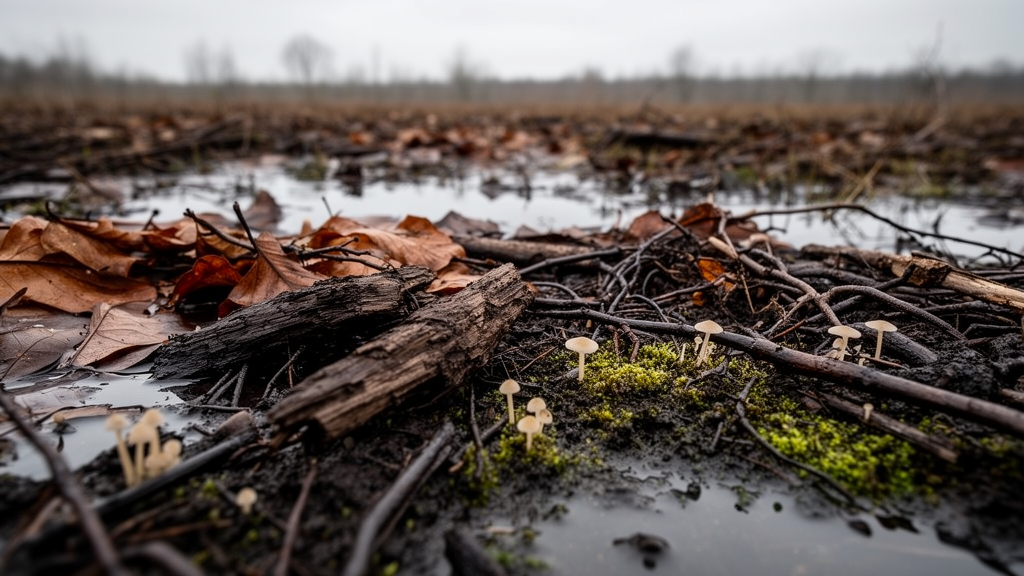
For more than a century, mycologists searching for fungi in peatlands have done the obvious thing: they have looked in the peat. That instinct made sense, because peat is the defining feature of bogs, the waterlogged archive of partially decomposed plant matter that gives these ecosystems their name and their enormous role in the carbon cycle. Yet a new study from a raised bog in northern West Siberia suggests that this long-standing focus has been pointing researchers at the wrong target. When scientists at the Mukhrino Bog systematically sampled not just peat but also plant litter, decaying wood and the mycorrhizal roots of bog trees, the fungal diversity they uncovered dwarfed everything recorded by traditional methods, revealing an estimated species pool of roughly 11,500 fungal species hypotheses in a single bog.
The scale of the discrepancy is striking. Eleven years of patient sporocarp-based observation, the classic approach of recording mushrooms and other fruiting bodies in the field, had documented 208 species at the site. Environmental DNA metabarcoding of 266 samples, sequenced on the ITS2 barcode region and clustered at 99 percent similarity, detected approximately forty times more species-level units. The molecular dataset spanned 14 fungal phyla and 862 genera, dominated by Ascomycota, which accounted for 66 percent of sequences, and Basidiomycota at 33 percent. Species richness estimation using the Chao1 index suggested the sequencing effort captured about 77.5 percent of the total fungal diversity at the site, implying that the true richness of a single Siberian raised bog may approach 11,500 species hypotheses, far beyond the roughly 1,500 peatland-associated species compiled from the entire global literature to date.
Where, then, is this hidden richness concentrated? Not in the peat, it turns out. Plant litter harboured the highest total diversity, with 7,297 species hypotheses across 84 samples, followed by peat at 3,590, wood at 1,585 and mycorrhizal roots at 1,091. Substrate type emerged as the primary driver of community composition, with PERMANOVA yielding a pseudo-F statistic of 10.82 and a p-value of 0.001, explaining the strongest dissimilarities in beta-diversity. Communities inhabiting different substrates showed remarkably low species overlap, with Jaccard similarity indices ranging from just 0.19 to 0.42, indicating strong substrate partitioning. Each substrate, in other words, supports its own largely distinct species pool, and sampling only one of them captures only one slice of the bog’s fungal life.
The litter layer proved to be the richest reservoir, but its full diversity only became visible when the researchers partitioned their samples by plant host. At the aggregate level, litter yielded a puzzlingly low eight indicator species, suggesting its communities were composed of generalists shared with other substrates. But when the same samples were separated by the identity of the plant species they came from, a different picture emerged: between 40 and 123 indicator species hypotheses per host plant, with consistently high point-biserial correlations between 0.55 and 0.59. The bog’s litter layer is not a uniform substrate but a mosaic of plant-specific microhabitats, each supporting its own specialised fungal consortium. Scheuchzeria palustris and Rhododendron groenlandicum supported the most host-specific taxa, with 123 and 118 indicator species respectively.
Several of these host associations were taxonomically telling. The genus Exobasidium, known as a gall-forming pathogen on ericaceous shrubs, was exclusively associated with Chamaedaphne calyculata. Nagrajchalara and Venturia were tied to Rhododendron groenlandicum, the Rhytismataceae family characterised Eriophorum vaginatum, and Coleophoma and Diplocarpon served as indicators of Vaccinium oxycoccus and Rubus chamaemorus respectively. The order Helotiales dominated the indicator communities of all seven host plants. These findings suggest that both pathogenic and saprotrophic fungi contribute to the host-specific differentiation of litter communities, and that plant identity, not just substrate chemistry, is a critical ecological filter in peatlands.
Mycorrhizal roots presented a contrasting profile. Although they harboured the least diverse communities overall, they contained the highest number of indicator species, 85 in total, reflecting the high specialisation of these communities. Functionally, mycorrhizal roots were overwhelmingly dominated by symbiotrophs, which made up 80.9 percent of relative abundance, consistent with the obligate biotrophic nature of mycorrhizal fungi. All the saprotrophic substrates, including litter, litter bags, wood dowels and both peat layers, showed mixed trophic strategies dominated by saprotrophs and pathotrophs, with saprotrophs accounting for 37 to 55 percent of relative abundance. The highest proportion of saprotrophs, 55.1 percent, occurred in the deep anoxic peat layer, where decomposer fungi persist despite oxygen starvation.
The vertical structure of the peat profile itself told an ecological story. In the upper aerobic layer, community composition was significantly shaped by habitat type, distinguishing treed pine-dwarf shrub bogs from open Sphagnum lawns, and to a lesser extent by depth between 2 and 30 centimetres. In the deep anoxic catotelm, by contrast, communities were homogeneous, showing no significant variation with depth down to three metres or between habitats. The deep layer harboured a unique set of indicators, including members of the early-diverging phylum Rozellomycota, often associated with low-oxygen environments, and the cold-adapted genus Oidiodendron. The upper layer, where tree roots occur, was characterised by ectomycorrhizal families such as Thelephoraceae and Russulaceae, with the genera Thelephora and Russula among its indicators.
One of the most intriguing results concerns ectomycorrhizal fungi detected far from any trees. Molecular analysis found the mycelium of Cortinarius, Suillus and Hebeloma widely distributed in both treed bog and Sphagnum lawn habitats, with Suillus detected in 100 percent of treed bog samples and 69.6 percent of lawn samples, and Cortinarius in 95.7 and 82.6 percent respectively. Yet the fruiting bodies of these genera were recorded almost exclusively in treed bog. This discrepancy is particularly puzzling because the Sphagnum lawns can extend up to 500 metres from the nearest trees. The researchers propose two non-exclusive explanations: either extensive mycelial networks extend far beyond root zones, or the detections reflect viable spores and mycelial fragments that persist in the peat matrix but cannot fruit under water-saturated conditions. Distinguishing between these alternatives will require approaches such as RNA-based metatranscriptomics or stable isotope probing to determine whether the detected mycelium is metabolically active or merely a legacy of inputs from forested microhabitats.
The comparison between methods also revealed complementary strengths. Of the 37 genera recorded in fruiting body surveys, 32 were also detected by metabarcoding, showing broad congruence at the genus level, but the molecular approach detected mycelium consistently across habitats and seasons, whereas fruiting bodies are ephemeral and appear only under suitable conditions. Meanwhile, the sporocarp data identified indicator species, such as Galerina sphagnicola and Arrhenia bigelowii in Sphagnum lawns, that characterised habitat types in ways the molecular data did not fully replicate. Wood-associated communities added another dimension: on standardised pine, larch and birch dowels buried in the peat surface, community composition changed significantly over the sampling series but not among wood species, suggesting that successional time overrides substrate chemistry in early wood decay.
The implications extend beyond mycological curiosity. Peatlands cover only about 3 percent of the terrestrial surface yet store approximately 30 percent of the world’s terrestrial soil carbon, and fungi are the primary decomposers operating in their upper aerobic horizons as well as the essential symbiotic partners of bog plants. Understanding where fungal diversity actually resides, and how specialised those communities are, is therefore directly relevant to modelling carbon cycling and decomposition in these ecosystems. The findings also carry a practical message for conservation and restoration: because peatland specialist fungi depend on specific host plants, successful restoration must rebuild not only the water table and peat layer but also the plant community that sustains the associated fungal diversity. The study’s conclusion is unambiguous. Only an integrated, substrate-focused approach, combining molecular surveys across litter, wood, roots and peat with long-term fruiting body monitoring, can uncover the full fungal richness hidden in these globally significant ecosystems, and the greatest hidden wealth of all lies in the humble layer of plant litter carpeting the bog’s surface.
Subject of Research: Fungal diversity and substrate partitioning in a West Siberian raised bog assessed by eDNA metabarcoding and sporocarp monitoring
Article Title: Where to look for fungi in a bog? Substrate partitioning reveals hidden richness
Article References: Where to look for fungi in a bog? Substrate partitioning reveals hidden richness. (n.d.). https://doi.org/10.3897/mbmg.10.189142
Image Credits: AI Generated
Keywords: fungi, peatland, raised bog, metabarcoding, environmental DNA, substrate partitioning, plant litter, mycorrhiza, West Siberia, carbon cycling, biodiversity, indicator species
Cite Scienmag News
Roger Howard. (October 15, 2026). Bog fungi hide in plain sight: litter, roots and wood dwarf peat’s hidden riches. Scienmag. https://scienmag.com/bog-fungi-hide-in-plain-sight-litter-roots-and-wood-dwarf-peats-hidden-riches/
Roger Howard. "Bog fungi hide in plain sight: litter, roots and wood dwarf peat’s hidden riches." Scienmag, 15 October 2026, https://scienmag.com/bog-fungi-hide-in-plain-sight-litter-roots-and-wood-dwarf-peats-hidden-riches/. Accessed 15 October 2026.
Roger Howard. "Bog fungi hide in plain sight: litter, roots and wood dwarf peat’s hidden riches." Scienmag. October 15, 2026. https://scienmag.com/bog-fungi-hide-in-plain-sight-litter-roots-and-wood-dwarf-peats-hidden-riches/


