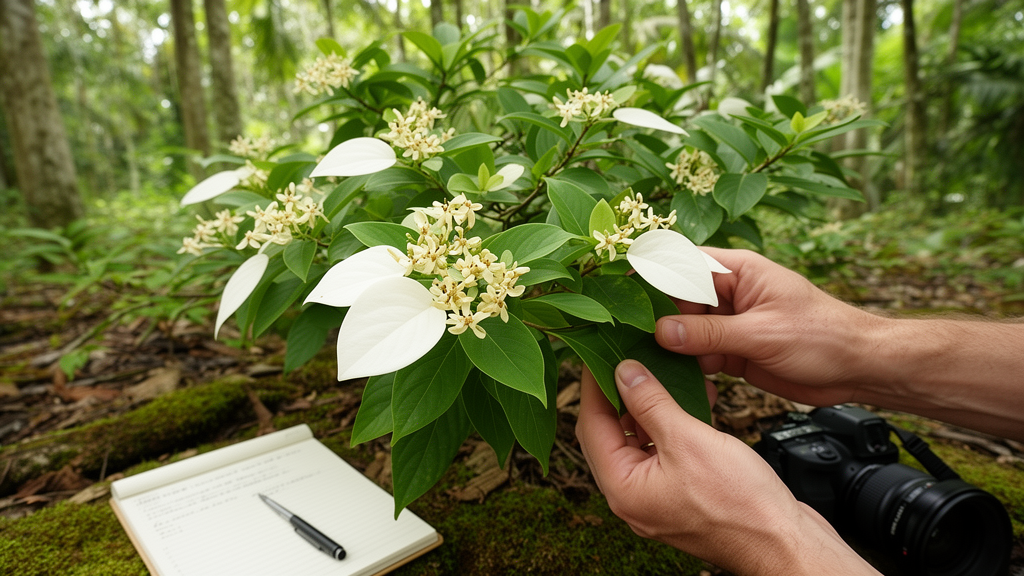
A shrub with striking white, leaf-like sepals that has quietly puzzled botanists for nearly two centuries has just been redrawn. In a taxonomic revision published in the journal PhytoKeys, researchers conclude that two species long treated as distinct members of the tropical genus Mussaenda are in fact the same plant as the widespread Mussaenda wallichii, a species that stretches from northeastern India across Myanmar, Thailand, Laos, and Peninsular Malaysia to southern and southwestern China. The finding collapses three names into one and, in doing so, offers a cautionary tale about how easily plant species can be inflated when herbarium specimens are examined in isolation.
Mussaenda is a paleotropical genus of the coffee family, Rubiaceae, comprising roughly 135 species distributed mainly in tropical Africa and Asia. Molecular and biogeographic work suggests the genus originated in Africa and later diversified across tropical Asia, with the Indochina Peninsula emerging as one of its major centers of diversity, harboring more than 50 recognized species. The genus is best known to gardeners and field botanists for its enlarged, petal-like sepals, technically called calycophylls or semaphylls, which flash white or colored among the ordinary green foliage and attract pollinators to otherwise modest flowers. Classification within the group has traditionally rested on morphology: the shape and venation of leaves, the form of stipules, the architecture of inflorescences, the relative lengths of calyx tubes and lobes, and the shape of calyx and corolla lobes.
The newly revised species, Mussaenda wallichii, was described in 1834 by the Scottish botanist George Don from material collected at Tavoy and Rangoon in southern Myanmar, catalogued under Wallich specimen number 6258. From the outset the species carried complications. Don himself noted that the two voucher specimens behind the name did not represent Mussaenda longifolia, as the botanist Nathaniel Wallich had annotated on the labels. When the authors of the new study re-examined those original sheets, they discovered something more troubling: the two specimens, labelled 6258A and 6258B, are morphologically distinct from each other. Specimen 6258A matches the original description, with its terminal, trichotomous inflorescence. Specimen 6258B, a fruiting branch bearing densely congested, subcapitate berries on short pedicels, does not fit at all.
After extensive comparison with numerous herbarium specimens and the relevant literature, the researchers determined that the mismatched specimen 6258B actually belongs to a different species, Mussaenda roxburghii. The two taxa are most reliably separated by inflorescence architecture: M. wallichii bears spreading corymbs, whereas M. roxburghii produces capitate cymes, along with differences in fruit shape and the persistence of calyx lobes. Because an earlier lectotypification of Wallich 6258 had failed to single out one specimen among the original material, and because one of those specimens is now known to belong to another species, the team designated specimen 6258A as a second-step lectotype under Article 9.17 of the International Code of Nomenclature for algae, fungi, and plants. This nomenclatural housekeeping anchors the name M. wallichii to a specimen that genuinely matches its description.
The heart of the revision, however, concerns two younger names. Mussaenda intuspilosa was described in 1963 by Jayaweera on the basis of specimens from Assam in India and from Upper and Lower Myanmar, with a collection made near Clegg Hill on the east bank of the Irrawaddy in Kachin as the holotype. In its protologue, the species was distinguished by larger leaves, larger stipules with distinctive pubescence and glands, larger sepals, a diffuse inflorescence, and calyx segments that fall away from the fruit. Mussaenda lancipetala followed in 2008, described by Deng and Zhang from Mengla County in Xishuangbanna, western Yunnan, China, and differentiated by larger leaf blades, entirely glabrous upper leaf surfaces, more numerous pairs of secondary veins, diffuse inflorescences, and longer corolla tubes and lobes.
When the researchers placed the type specimens and protologues of all three names side by side, and combined this with field observations of living plants across the Indochina Peninsula, the supposed boundaries dissolved. No stable morphological character was found that consistently separates the three taxa. All share oblong-elliptic leaves that are cuneate at the base and acuminate at the apex, terminal trichotomous cymes, and ovoid to elliptic berries. The apparent differences dissolved under scrutiny. M. wallichii had been described as entirely glabrous, yet young branches and leaves of both it and M. intuspilosa carry sparse pubescence just like M. lancipetala, and the calycine leaflets of all three are pubescent along the veins. A re-examination of the M. lancipetala type revealed 8 to 11 pairs of secondary veins, matching the other two taxa rather than the 11 to 13 pairs recorded in the original description, a discrepancy the authors attribute to the counting of minor secondary veins. And although the protologue of M. lancipetala described caudate corolla lobes while that of M. intuspilosa described merely acuminate ones, abundant specimens show that corolla lobes vary continuously from acuminate to caudate, with the length of the terminal tail grading between the two extremes.
Geography tells the same story. The three taxa were described from ranges that partially overlap or run continuously into one another: M. wallichii from southern and southeastern Myanmar with extensions to the Nicobar Islands, Thailand, and Peninsular Malaysia; M. intuspilosa from Myanmar and adjacent Assam; and M. lancipetala from southern and southwestern Yunnan. Together these distributions form an unbroken belt from Assam through Myanmar to Yunnan, with no geographic discontinuity corresponding to any morphological break. The authors conclude that M. intuspilosa and M. lancipetala are heterotypic synonyms of M. wallichii, meaning they are separate names published for what is in reality a single biological species.
The revision also required untangling a nomenclatural irregularity. When M. lancipetala was published, the same gathering, Deng and Ren 410, was cited simultaneously as both holotype and isotype, which does not satisfy the Code’s requirement for a single holotype. Under the rules, the two duplicate sheets deposited at the herbarium IBSC must be treated as syntypes, and the team has now designated one of them, specimen IBSC0733503, as the lectotype. The Chinese name for the species, xia ban yu ye jin hua, is retained, because it was originally applied to M. lancipetala, now subsumed within M. wallichii. The revised species is a shrub with angular young branches, oblong-lanceolate to elliptic-lanceolate leaves 8.5 to 24 centimeters long, white ovate semaphylls up to 10 centimeters long, corolla tubes 2.5 to 3.6 centimeters long, and heterostylous flowers, a breeding system in which long- and short-styled floral forms promote cross-pollination. It occupies a striking breadth of habitats, from tropical lowland evergreen rain forests and dry evergreen forests to coastal forests, limestone hills, lower montane rain forests, and secondary growth, from near sea level to roughly 1,000 meters, flowering from April to October and fruiting from June to December. Given its wide range and numerous recorded populations, the authors assess it as Least Concern under the IUCN Red List criteria.
Why did three species become one? The authors point to a familiar pattern in tropical taxonomy: early treatments were often based on a small number of collections, leading variable characters to be overinterpreted as species-level differences. Pubescence density in Mussaenda varies among individuals and developmental stages, with young organs sometimes hairy and mature organs glabrescent, a pattern documented in other species of the genus as well. Vein counts, corolla lobe tips, and calycophyll hairiness all show continuous variation across populations rather than the discrete gaps that would justify separate species. The lesson extends beyond this one shrub. Previous estimates of species richness in Mussaenda have been shaped by incomplete knowledge of morphological variation and insufficient examination of type materials, and the new synthesis suggests the true diversity of the genus in Southeast Asia may be lower than current checklists imply. The authors argue that continued revisionary work integrating field observations, herbarium research, and molecular evidence will be essential for resolving the remaining uncertainties in this morphologically diverse genus, and for building the stable taxonomic framework on which conservation, ecology, and evolutionary studies ultimately depend.
Subject of Research: Taxonomic revision and synonymization of Mussaenda wallichii (Rubiaceae) in Southeast Asia
Article Title: Taxonomic revision of Mussaenda wallichii ( Rubiaceae ): two new synonyms from Southeast Asia
Article References: Duan, T.-T., Li, Y.-X., & Li, J. (2026). Taxonomic revision of Mussaenda wallichii (Rubiaceae): two new synonyms from Southeast Asia. PhytoKeys, 280, 93-104. https://doi.org/10.3897/phytokeys.280.209108
Image Credits: AI Generated
DOI: 10.3897/phytokeys.280.209108
Keywords: Mussaenda, Rubiaceae, taxonomy, lectotypification, Southeast Asia, herbarium, plant morphology, species delimitation, PhytoKeys, biodiversity, Indochina, heterotypic synonyms
Cite Scienmag News
Gavin Prescott. (October 15, 2026). Two Southeast Asian Mussaenda Species Turn Out to Be One Widespread Plant. Scienmag. https://scienmag.com/two-southeast-asian-mussaenda-species-turn-out-to-be-one-widespread-plant/
Gavin Prescott. "Two Southeast Asian Mussaenda Species Turn Out to Be One Widespread Plant." Scienmag, 15 October 2026, https://scienmag.com/two-southeast-asian-mussaenda-species-turn-out-to-be-one-widespread-plant/. Accessed 15 October 2026.
Gavin Prescott. "Two Southeast Asian Mussaenda Species Turn Out to Be One Widespread Plant." Scienmag. October 15, 2026. https://scienmag.com/two-southeast-asian-mussaenda-species-turn-out-to-be-one-widespread-plant/