


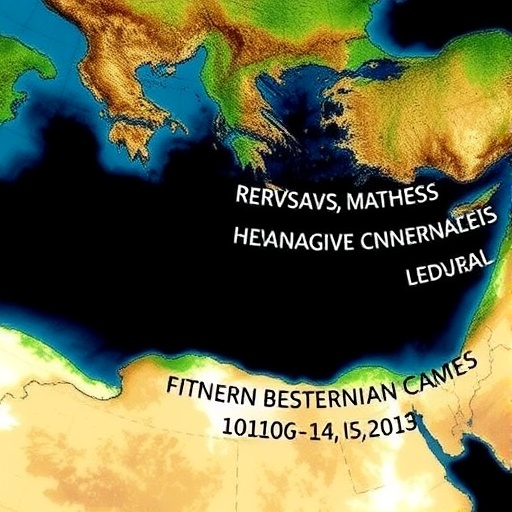
An international research team led by the University of Barcelona has identified a major, previously underestimated driver of Early Holocene environmental change across the Eastern Mediterranean: a large, low-salinity outflow from the Black Sea into the Aegean Sea. Occurring roughly between 11,000 and 6,000 years ago, this freshwater pulse helped reshape regional circulation more profoundly than earlier models had suggested.
The study, published in Communications Earth & Environment (published 20-Jun-2026), shows that Black Sea freshwater strengthened surface-water stratification in the Aegean. When the upper ocean became more layered, the formation of deep waters was suppressed—an oceanographic shift that strongly affects how nutrients and organic matter are transported and preserved.
A key outcome of this altered circulation was the development of Sapropel 1, a widespread organic-rich sediment layer deposited across the Eastern Mediterranean during the Early Holocene. The researchers argue that the Black Sea outflow provided a critical mechanism, helping create conditions favorable for organic material to accumulate on the seafloor.
For decades, explanations for Sapropel 1 emphasized increased freshwater delivery from North African rivers and enhanced precipitation over the northern Mediterranean region. The new results challenge that view by demonstrating that the Black Sea drainage basin itself acted as a powerful freshwater source, capable of reorganizing water masses through the Dardanelles Strait.
The researchers connect intensified meltwater input and wetter conditions across the Black Sea basin to stronger export of low-salinity water. This reorganization occurred in the northern and central Aegean Sea, changing the balance between stratification and deep-water convection during a warm climatic interval.
To reconstruct these processes, the team analyzed a marine sediment core from the central Aegean Sea near important deep-water formation areas in the north. The archive spans more than 42,000 years, enabling comparisons of long-term variability with the specific environmental transition linked to the Early Holocene.
They combined multiple advanced techniques—grain-size analysis, X-ray fluorescence scanning, radiogenic isotopes, and stable isotope geochemistry—to distinguish the fingerprint of Black Sea outflow from other climatic and hydrological signals.
Beyond reconstructing the past, the findings provide a “stress test” for future climate scenarios. If large freshwater inputs can disrupt deep-water formation and reorganize circulation in warm periods, similar mechanisms could influence marine ecosystems and carbon burial under ongoing climate change.
Cite Scienmag News
Violet Maxwell. (July 16, 2026). Black Sea Flood Reshaped Eastern Mediterranean Currents 11,000 Years Ago. Scienmag. https://scienmag.com/black-sea-flood-reshaped-eastern-mediterranean-currents-11000-years-ago/
Violet Maxwell. "Black Sea Flood Reshaped Eastern Mediterranean Currents 11,000 Years Ago." Scienmag, 16 July 2026, https://scienmag.com/black-sea-flood-reshaped-eastern-mediterranean-currents-11000-years-ago/. Accessed 3 September 2026.
Violet Maxwell. "Black Sea Flood Reshaped Eastern Mediterranean Currents 11,000 Years Ago." Scienmag. July 16, 2026. https://scienmag.com/black-sea-flood-reshaped-eastern-mediterranean-currents-11000-years-ago/


