


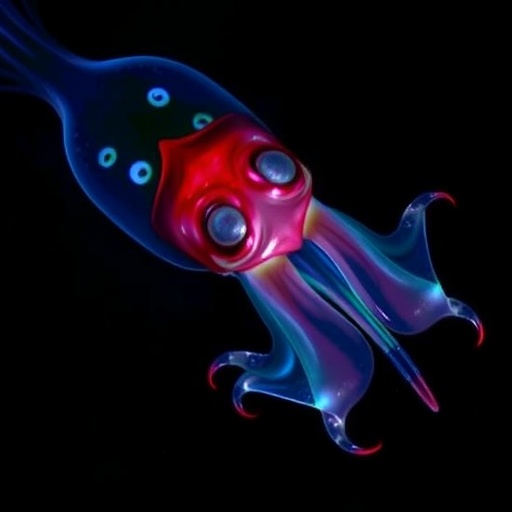
In the vibrant coastal waters of Hawai‘i, a diminutive creature known as the Hawaiian bobtail squid has evolved an extraordinary survival strategy that transcends mere camouflage. This cephalopod’s mastery over its environment hinges not only on its ability to glow but also on a finely tuned symbiotic relationship with a bioluminescent bacterium named Vibrio fischeri. Recent groundbreaking research from the University of Hawai‘i at Mānoa has unveiled that the significance of this partnership goes far beyond light production: the bacteria play a crucial role in the developmental biology of the squid itself, reshaping our understanding of host-microbe interactions.
For decades, the scientific narrative has focused predominantly on how Vibrio fischeri illuminates the squid’s light organ, allowing it to evade predators through counter-illumination. However, Jill Kuwabara Smith, the project’s lead author and former postdoctoral researcher at UH’s Pacific Biosciences Research Center, led a pioneering study revealing that the bacteria provide a molecular toolkit essential for the squid’s morphogenesis. Specifically, they secrete a protein known as SypC, packaged within microscopic outer membrane vesicles, which orchestrates not just luminescence, but also the proper formation of the squid’s light organ structure.
Outer membrane vesicles (OMVs) are tiny, lipid-enclosed parcels secreted by many Gram-negative bacteria, serving as vehicles for delivering proteins, enzymes, DNA, and signaling molecules to their hosts. While pathogenic bacteria have long been noted to leverage OMVs as virulence factors, the role of these vesicles in beneficial symbioses is emerging as equally profound. In Vibrio fischeri, SypC contained within these vesicles was already known to facilitate the initial colonization of the host squid, but its newly identified developmental role represents an unexpected layer of complexity in this mutualistic relationship.
Using advanced fluorescence confocal microscopy, the research team chemically tagged SypC with fluorescent markers, enabling the visualization of its transit within the tiny squid host. This approach illuminated the dynamic journey of SypC-loaded vesicles from the bacterial colonies into the squid’s tissues. Strikingly, they observed that the squid’s immune cells, known as hemocytes, actively internalize these vesicles and ferry them to distant sites critical for initiating organogenesis of the light organ, a finding that challenges previous assumptions about immune system functions.
The absence of SypC within the bacterial vesicles triggered profound developmental defects, revealing SypC’s indispensability. The team’s transcriptomic analyses demonstrated that a staggering 138 genes in the squid’s genome had altered expression when the symbiont failed to deliver SypC. These genetic changes spanned numerous physiological pathways, underscoring how a single microbial protein can influence a wide range of host responses, from immunity to tissue remodeling, thus reinforcing the concept that microbial symbionts are integral architects of host biology.
Margaret McFall-Ngai, the study’s senior author and a leading authority on host-microbe symbiosis, emphasized the unparalleled clarity of the squid-vibrio model system. Unlike most animals whose microbiomes comprise complex bacterial communities, the bobtail squid primarily maintains a mono-specific association with Vibrio fischeri, enabling precise dissection of molecular dialogues. This simplicity provides an unprecedented window into the evolutionary origins and conserved mechanisms by which microbes modulate animal development.
This research carries profound implications beyond marine biology. Human health research increasingly recognizes the significance of microbiomes—the vast arrays of microorganisms inhabiting our bodies—in shaping physiological functions, immune responses, and disease susceptibility. Similar to the squid system, commensal bacteria in the human gut secrete OMVs that can travel through the bloodstream, influencing the function of distal organs. However, the intricate complexity and diversity of human microbiomes have historically impeded definitive mechanistic insights, making the squid model a valuable proxy for unraveling these sophisticated interkingdom interactions.
Moreover, the technological advancements harnessed in this study, including fluorescent tracking of microbial proteins within host tissues, exemplify the emergent frontier in symbiosis research. Such tools allow scientists to not only identify microbial molecules essential for host development but also visualize their spatiotemporal dynamics with exceptional resolution. Insights gleaned from these systems could inform novel therapeutic avenues that harness microbial products or mimic their activities to promote tissue healing or modulate immune functions in humans.
The Hawaiian bobtail squid’s evolutionary partnership with Vibrio fischeri stands as a testament to nature’s ingenuity, illustrating that microbial symbionts serve as architectural partners shaping host form and function. As the study’s authors reflect on decades of collaborative discovery, it becomes evident that lessons from this diminutive cephalopod may reverberate across biology and medicine, guiding future explorations into the molecular intricacies that govern life’s interconnectedness.
With over 35 years of research investment, the squid-vibrio system continues to illuminate fundamental biological principles that transcend species boundaries. As Jill Kuwabara Smith now fosters scientific curiosity in young minds as a teacher, the ripples from this research extend outward, inspiring the next generation to explore the unseen microbial world that shapes our own development and health. The evolutionary conservation of these symbiotic mechanisms suggests that the molecular language spoken between microbes and animals is not only ancient but also integral to life’s tapestry across myriad ecosystems.
The findings presented here, published in the Proceedings of the National Academy of Sciences, represent a significant leap forward in our comprehension of symbiotic relationships, microbial communication, and developmental biology. They underscore the importance of integrating microbiology, immunology, and advanced imaging techniques to decode the nuanced molecular conversations that sculpt animal life. As the scientific community continues to unravel these complex interactions, the bobtail squid and its luminous companion remain emblematic of the deep-seated connections that bind all organisms in the web of life.
News Publication Date: 11-Mar-2026
References:
DOI: 10.1073/pnas.252464812
Cite Scienmag News
Violet Maxwell. (March 26, 2026). Bioluminescent Bacteria Crucial for Squid Development, Study Finds. Scienmag. https://scienmag.com/bioluminescent-bacteria-crucial-for-squid-development-study-finds/
Violet Maxwell. "Bioluminescent Bacteria Crucial for Squid Development, Study Finds." Scienmag, 26 March 2026, https://scienmag.com/bioluminescent-bacteria-crucial-for-squid-development-study-finds/. Accessed 3 September 2026.
Violet Maxwell. "Bioluminescent Bacteria Crucial for Squid Development, Study Finds." Scienmag. March 26, 2026. https://scienmag.com/bioluminescent-bacteria-crucial-for-squid-development-study-finds/


