


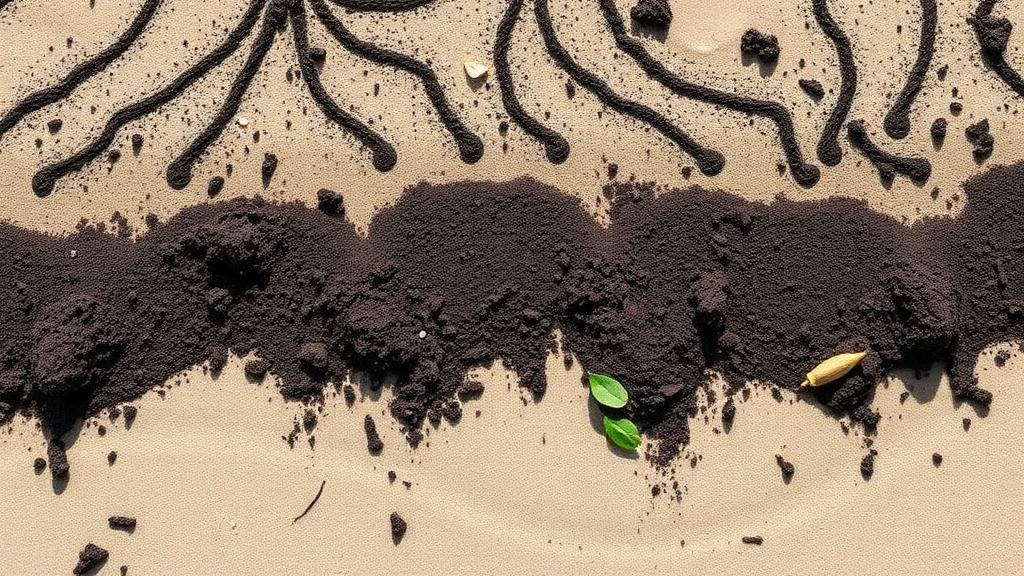
Sandy soils are among the most unforgiving growing media on Earth. Their oversized particles create vast macropores that drain water almost as fast as it arrives, their organic matter content is typically meager, and their nutrients leach away with every heavy rain or irrigation event. For farmers in semiarid regions, where these constraints are compounded by heat and erratic rainfall, the result is chronically low productivity and high vulnerability to erosion by both wind and water. A new open-access review published in Discover Soil by a team at Brazil’s Federal Rural University of the Semi-Arid Region has now taken stock of how the scientific world has responded to this challenge, and the answer is a striking story of exponential growth around one deceptively simple material: biochar.
The study is a bibliometric analysis, a mathematical and statistical mapping of academic activity rather than a laboratory experiment. The researchers systematically searched the Web of Science database using the descriptors biochar, bio-char, biological charcoal, or agrichar in combination with sandy soil, then filtered the results to articles and review articles. That search yielded 543 publications spanning 1992 to 2024, with records from 2025 excluded because indexing was still incomplete. The corpus was then processed with two dedicated tools: VOSviewer version 1.6.18, which built co-authorship, citation, and keyword co-occurrence networks using thresholds of five minimum documents and five minimum citations, and the Bibliometrix extension version 3.0 in R, which generated rankings, three-field plots, and thematic clusters using the Walktrap algorithm and multiple correspondence analysis.
The temporal picture is dramatic. The first publication in the field appeared in 1992, in the journal Geoderma, and has since accumulated roughly 2,443 citations. Yet for years the topic barely registered: only four articles were recorded up to 2010, and no publications at all appeared between 1993 and 2006. In 2011 the annual count doubled to eight, and after 2015 the field entered genuine exponential growth, peaking in 2021 with 73 publications registered for that year. The authors caution that apparent fluctuations after 2021 likely reflect delays in database indexing rather than a real decline in research activity. What the curve captures is the consolidation of biochar as a mainstream strategy for soil conditioning, driven by its dual promise of agricultural improvement and climate change mitigation through carbon sequestration.
Geographically, the analysis reveals a field with clear power centers. China leads in publication volume and sits at the center of the international collaboration network, maintaining exchanges with Brazil, Germany, the United States, Canada, and Egypt. The United States and Germany rank as the next most prolific contributors. Intriguingly, when citations are normalized by output, Germany leads the impact ranking, indicating higher average influence per paper. At the institutional level, the Chinese Academy of Sciences tops productivity with eighteen articles, alongside the University of Florida and Assiut University, but smaller institutions such as Tottori University, Kangwon National University, and University College Dublin outperform them on citations per article. Among individual authors, Amin Abu El-Eyuoon Abu Zied leads productivity with twelve papers, while researchers like Gao Bin, with an average of 164 citations per article, and Ok Yong Sik, with 133, demonstrate that influence and volume do not always coincide.
The most cited works cluster between 2010 and 2016, the period when the field matured, and together they define the scientific agenda. Yao and colleagues tested thirteen biochar types for retention of nitrate, ammonium, and phosphate in sandy soil and found that most had little or no capacity to sorb nitrate and phosphate, while nine effectively removed ammonium, a result underscoring that performance depends on both the biochar and the nutrient in question. Abel and coauthors, in the field’s most cited paper with 546 citations, showed that biochar and hydrochar applied at 1, 2.5, and 5 percent by weight reduced bulk density, increased total pore volume, and raised water content at the permanent wilting point, expanding available water capacity except in highly humic soils. Uzoma’s team demonstrated that cattle manure biochar, rich in essential nutrients, boosted maize productivity in sandy conditions, while Kammann and colleagues found that biochar enhanced quinoa growth, water- and nitrogen-use efficiency, and drought tolerance even under moderate water stress.
Not every result is a success story, and the review is candid about the contradictions. Jeffery and colleagues conducted field experiments in the Netherlands with herbaceous-feedstock biochars and found no significant improvement in water retention, aggregate stability, or hydraulic conductivity despite the chars’ high porosity and internal connectivity, concluding that hydrophobicity must be considered alongside porous structure. Namgay’s work showed that activated wood biochar can significantly reduce plant availability of arsenic, cadmium, copper, lead, and zinc in maize, pointing to a remediation role, while Haefele’s rice husk biochar increased soil organic carbon, nitrogen, phosphorus, and potassium availability but showed little pH effect and, notably, some carbon migration to deeper soil layers in sandy profiles. Schulz and Glaser found that compost alone outperformed biochar-compost combinations for oat yields in infertile tropical sandy soil, a reminder that biochar works best as part of integrated nutrient management rather than as a standalone fix.
Thematic mapping of the literature reveals where the intellectual energy lies. Environmental Sciences dominates with 38 percent of publications, or 207 of the 543 articles, encompassing carbon sequestration, contamination mitigation, and biogeochemical cycling. Soil Science follows at 32 percent with 174 publications focused on structure, porosity, pH, and water-holding capacity, while Agronomy and Plant Sciences account for 19 and 16 percent respectively. Keyword clustering identified five thematic groups: soil physical properties such as hydraulic conductivity and water holding capacity; chemical aspects including cation exchange capacity and ammonium; sustainability and greenhouse gas emissions; contaminant sorption, mobility, and desorption; and residue-derived biochars for heavy metal remediation. The term biochar itself is the most recurrent keyword with 316 occurrences and a total link strength of 2,150, followed by sandy soil with 129 occurrences, confirming the field’s tight focus.
Beneath the statistics, the review also synthesizes the technical fundamentals that determine whether biochar helps or disappoints. Feedstock is decisive: lignocellulosic residues such as coconut shells, sugarcane bagasse, rice straw, bamboo, and wood are favored because their high carbon content and structure favor water and nutrient retention, while manure-based and waste-derived materials such as sewage sludge are gaining attention for their nutrient richness. Pyrolysis temperature shapes the product, with chars made around 600 degrees Celsius tending toward greater porosity and surface area that enhance water retention in sandy profiles. Heating rate and residence time matter too: slower heating maximizes biochar yield and produces more stable carbon structures, while longer residence times raise fixed carbon content, pH, and surface area at the cost of yield. Because alkaline chars from materials like coconut shells and rice straw can also correct soil acidity and improve phosphorus availability, matching production parameters to target soil problems is emerging as a core engineering challenge.
The overall verdict from three decades of literature is that biochar is a genuinely promising strategy for sandy soils, particularly through enhanced water retention, improved nutrient dynamics, and reduced leaching, with added potential to immobilize toxic trace elements and stabilize erodible aggregates. But the variability in reported outcomes, driven by feedstock, pyrolysis conditions, application rate, and edaphoclimatic context, means there is no universal prescription. The authors identify clear gaps: long-term field validation, regional adaptability, and standardization of feedstock selection and application rates all remain underdeveloped. Their roadmap calls for extended field experiments across diverse climates, standardized production protocols, and integration of biochar with other sustainable soil management practices, including exploration of its role in climate change mitigation. For a material that began as little more than charcoal rebranded, biochar’s trajectory from a single 1992 paper to a 543-article global research enterprise suggests that the scientific community sees in it something durable: a way to make the world’s thirstiest soils hold onto water, nutrients, and carbon at the same time.
Subject of Research: Bibliometric analysis of global research trends on biochar application to sandy soils
Article Title: Bibliometric analysis of global research trends in biochar application to sandy soils
Article References: de Paiva, F. D. C. A., de Assis Freire, J. V., de Sousa Antunes, L. F., Fernandes, G. M., Alves, A. B., Bezerra, H. N., de Morais Rosária, P. C., de Medeiros, C. C., de Souza, D. C. S., de Oliveira, E. K. G., & da Silva, P. P. (2026). Bibliometric analysis of global research trends in biochar application to sandy soils. Discover Soil, 3(1), Article 105. https://doi.org/10.1007/s44378-026-00270-5
Image Credits: AI Generated
DOI: 10.1007/s44378-026-00270-5
Keywords: biochar, sandy soils, bibliometrics, pyrolysis, water retention, nutrient leaching, soil fertility, carbon sequestration, soil remediation, feedstock, Web of Science, sustainable agriculture
Cite Scienmag News
Alan Morgan. (October 7, 2026). Biochar on Sandy Soils: A 32-Year Map of a Quiet Agricultural Revolution. Scienmag. https://scienmag.com/biochar-on-sandy-soils-a-32-year-map-of-a-quiet-agricultural-revolution/
Alan Morgan. "Biochar on Sandy Soils: A 32-Year Map of a Quiet Agricultural Revolution." Scienmag, 7 October 2026, https://scienmag.com/biochar-on-sandy-soils-a-32-year-map-of-a-quiet-agricultural-revolution/. Accessed 7 October 2026.
Alan Morgan. "Biochar on Sandy Soils: A 32-Year Map of a Quiet Agricultural Revolution." Scienmag. October 7, 2026. https://scienmag.com/biochar-on-sandy-soils-a-32-year-map-of-a-quiet-agricultural-revolution/


