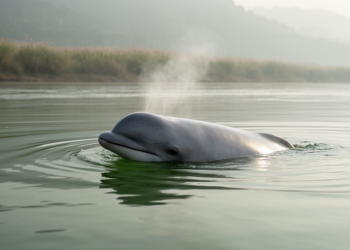
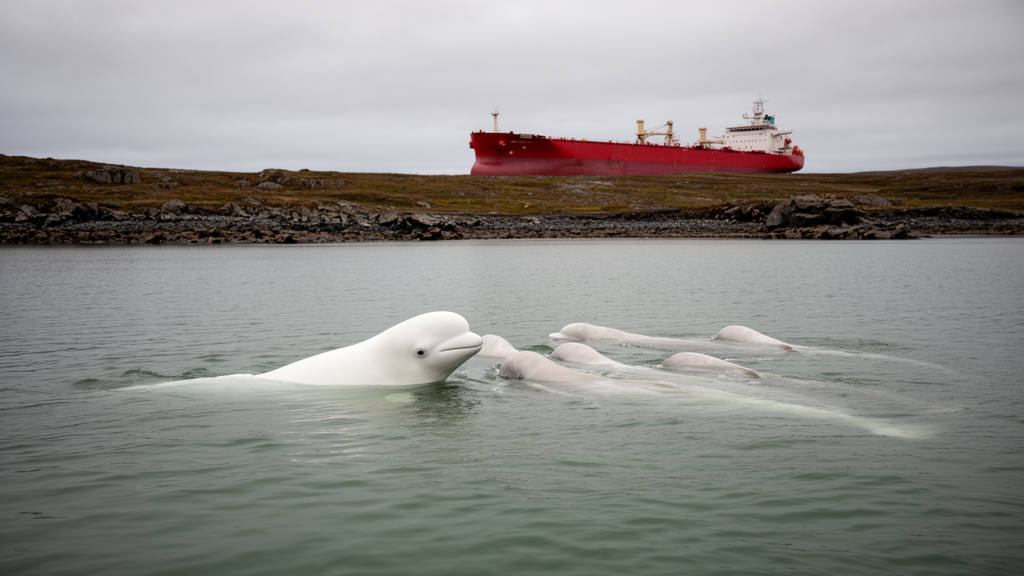
Every summer, thousands of beluga whales crowd into the Churchill River estuary in Manitoba, forming the largest summer aggregation of belugas anywhere on Earth. The Western Hudson Bay population returns year after year to this shallow, turbid mixing zone of fresh and salt water, where the whales whistle, click, and buzz in a constant underwater chorus. A new study has now captured that chorus in unprecedented detail, and its recordings contain a moment that reads like a thriller: a marked, estuary-wide drop in beluga vocalizations recorded just before the first cargo ship of the season entered the river.
The research, published in Frontiers in Mammal Science, presents the first passive acoustic monitoring survey of beluga habitat use in the Churchill River estuary. Because the monitoring took place in summer 2020, during COVID-19 travel restrictions and the early stages of the Port of Churchill’s reopening, maritime activity was unusually low. Whale-watching was limited to a handful of motorboats, and commercial traffic consisted of a single vessel. That quiet window gave scientists a rare chance to record beluga vocal behavior under near-natural conditions, establishing an acoustic benchmark before planned port expansion increases vessel traffic and underwater noise.
The technical setup was ambitious. Two single-channel Porpoise hydrophones, mounted on custom moorings designed to eliminate any moving parts that could generate noise, were deployed roughly two kilometers apart in the estuary. One recorder sat in deeper water in front of the Port of Churchill; the other lay upstream, away from the main navigational channel. The hydrophones sampled at 192 kilohertz, fast enough to capture both beluga tonal sounds and echolocation clicks, whose energy is concentrated between 30 and 50 kilohertz. Over 33 days, the recorders logged 1,315 hours of audio across 2,720 files, running on a duty cycle of 29 minutes on and 1 minute off.
Automated detectors developed by JASCO Applied Sciences identified beluga vocalizations in two categories: tonal sounds, including whistles and buzzes, and clicks. Six contour detectors followed the time-frequency traces of tonal calls, while a click detector based on the Teager-Kaiser energy method processed high-pass-filtered data. To verify performance, the team manually analyzed a random 5 percent subset of recordings, comparing hand annotations with algorithm output. The detectors proved reliable, achieving precision of 0.85 and recall of 0.91 for clicks, and precision of 0.79 and recall of 0.91 for tonal sounds, with manual and automated counts strongly correlated.
Statistical models then linked the vocalization counts to environmental variables. Generalized linear mixed models with a negative binomial distribution tested vocal activity against tide phase and light level, with hydrophone location as a random effect and an autoregressive structure to handle temporal autocorrelation. Light level and tide phase both emerged as significant predictors. Vocal activity was substantially higher during daytime than nighttime, and flood tide produced more vocalizations than high tide for both clicks and tonal sounds. Tonal sounds were also more frequent during flood tide than ebb tide.
The spatial patterns were just as revealing. The deeper downstream recorder, near the river mouth, consistently logged more vocalizations than the shallower upstream site, regardless of time of day or tide. At the downstream site, tonal sounds peaked during flood tide, declined during high and ebb tides, and rose again at low tide, a sequence consistent with belugas entering the estuary on rising water, moving upstream, and returning downstream. The upstream site showed maximum tonal sound detections during flood and high tides, when water levels were highest, and minimum detections at low tide. Belugas appear to use high tides to access shallow upstream areas that would strand them at lower water, a pattern matching earlier visual studies of the estuary.
Because tonal sounds in belugas are typically associated with social interactions, while clicks are linked to echolocation for navigation and prey detection, the acoustic geography hints at behavioral functions. Upstream shallow areas, busy with tonal sounds during high water, may serve primarily as social grounds, possibly including molting. The high click counts at the deeper downstream site during low tide suggest increased echolocation, potentially for navigation or opportunistic foraging, since tidal currents can aggregate prey in deeper channels. Notably, the waters in front of the port itself showed elevated tonal sounds during low and flood tide, indicating that this area, too, is important for social behavior.
Then came the dramatic moment. Beginning in the first week of September, detections of both clicks and tonal sounds dropped sharply at both locations, with the upstream site declining by up to two orders of magnitude from mid-August onward. The timing coincided with the strongest winds and heaviest precipitation of the monitoring period, with gusts peaking at 80 kilometers per hour on September 7. It also occurred shortly before a 137-meter general cargo ship entered the estuary on the morning of September 8 and departed the next day. Because belugas can detect vessel noise over considerable distances, they may have perceived the approaching ship before it arrived. The authors caution that vessel traffic and weather cannot be disentangled with the present dataset, and that no marked increase in background noise appeared in the spectrograms, making reduced detectability alone an unlikely explanation. A modest rebound in vocalizations the following week suggests some belugas returned while others may have moved offshore.
The seasonal decline itself likely reflects the onset of fall migration, consistent with decades of visual observations documenting belugas leaving the estuary between late August and early September. But migration timing may be shifting. Recent satellite-tagging work indicates departures occurring as late as early October, potentially linked to changing sea-ice conditions that prolong the open-water season. Meanwhile, climate change is projected to increase the frequency and intensity of Arctic storms, which could conversely trigger earlier departures. Multi-year acoustic monitoring will be needed to determine whether beluga migration timing in the estuary is responding to climate change.
The conservation stakes are high. The estuary lies within an Ecologically and Biologically Significant Area and is proposed for inclusion in a National Marine Conservation Area, while the Port of Churchill, the only rail-serviced deep-water port in North America with Arctic access, has announced upgrades, dredging, and potential ice-breaking operations to extend the shipping season. Given the strong site fidelity of Western Hudson Bay belugas, which return to the same estuary each year and pass knowledge of these summering grounds across generations, the overlap between persistently high vocal activity in the deeper central estuary and port operations raises concern about increasing exposure to disturbance. The acoustic benchmark established during this quiet summer now provides a critical pre-expansion reference, allowing future recordings to reveal whether growing maritime activity is silencing the world’s largest beluga gathering.
Subject of Research: The first passive acoustic survey of the Churchill River estuary reveals tidal and diel patterns in beluga vocal activity and a marked decline in calls recorded just before the first cargo ship of the season entered the river, establishing a critical acoustic benchmark before planned port expansion.
Article Title: Establishing an acoustic benchmark of beluga habitat use in the Churchill River estuary, Manitoba
Article References: Coppolaro, V. L. M., Kirillov, S., Isleifson, D., Loseto, L. L., & Marcoux, M. (2026). Establishing an acoustic benchmark of beluga habitat use in the Churchill River estuary, Manitoba. Frontiers in Mammal Science, 5, Article 1903254. https://doi.org/10.3389/fmamm.2026.1903254
Image Credits: AI Generated
DOI: 10.3389/fmamm.2026.1903254
Keywords: beluga whales, Churchill River estuary, passive acoustic monitoring, Western Hudson Bay, vessel traffic, underwater noise, marine conservation, Port of Churchill, tide patterns, fall migration, Establishing, acoustic
Cite Scienmag News
Miranda Vaughn. (October 17, 2026). Beluga Whales Go Silent as First Cargo Ship Approaches Churchill Estuary. Scienmag. https://scienmag.com/beluga-whales-go-silent-as-first-cargo-ship-approaches-churchill-estuary/
Miranda Vaughn. "Beluga Whales Go Silent as First Cargo Ship Approaches Churchill Estuary." Scienmag, 17 October 2026, https://scienmag.com/beluga-whales-go-silent-as-first-cargo-ship-approaches-churchill-estuary/. Accessed 17 October 2026.
Miranda Vaughn. "Beluga Whales Go Silent as First Cargo Ship Approaches Churchill Estuary." Scienmag. October 17, 2026. https://scienmag.com/beluga-whales-go-silent-as-first-cargo-ship-approaches-churchill-estuary/