


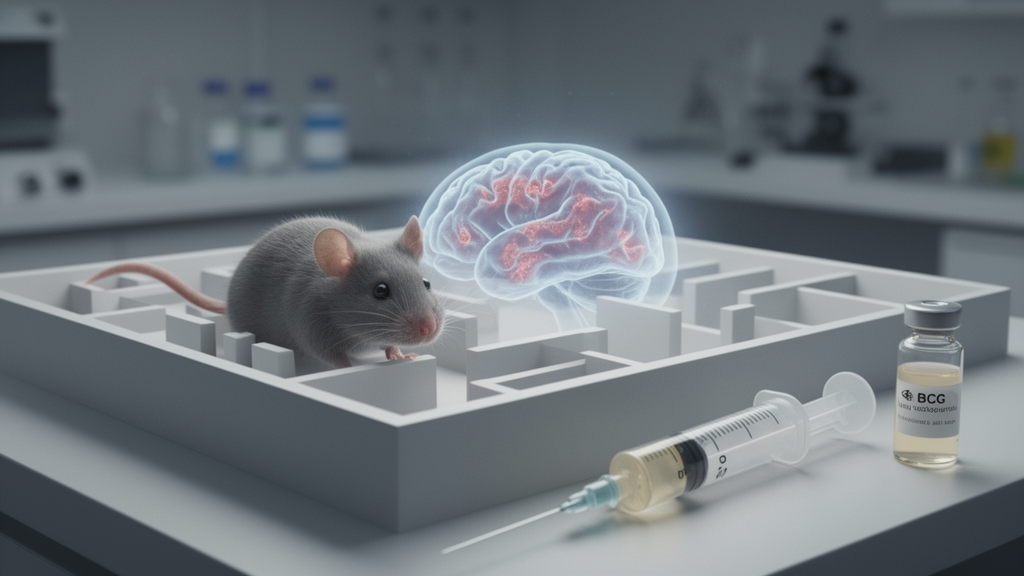
The weakened tuberculosis vaccine bacillus Calmette–Guérin reduced tau-related brain pathology, sustained inflammation, brain atrophy and memory impairment in a controlled study of mice with dementia-like symptoms, according to investigators at Johns Hopkins Medicine. Published in Science Advances, the experiment found that mice given BCG at three months of age were about five times more likely than untreated animals to show signs of reduced tau deposition when assessed eight to nine months later. They were also four times less likely to exhibit markers of persistent immune activation. These findings provide mechanistic clues about an association observed in people, but they do not show that BCG prevents dementia in humans.
For the experimental study, the researchers divided mice with tau pathology into groups that received BCG or a saline injection. An additional comparison group comprised age-matched mice without dementia symptoms that also received saline. The diseased mice were characterized by tau pathology, in which the tau protein clumps into neurofibrillary tangles associated with late stages of Alzheimer’s disease and related dementias. The controlled allocation and healthy comparison group allowed the investigators to compare vaccinated animals with untreated counterparts while considering abnormalities associated with the disease model.
BCG is a live, weakened vaccine made from an altered strain of the bacterium Mycobacterium bovis. It is widely used to prevent tuberculosis and is also used as an immunotherapy for non-muscle-invasive bladder cancer. The Johns Hopkins team investigated the vaccine because earlier observational studies had linked BCG treatment with a lower incidence of dementia, while earlier animal research had reported improved cognition in mouse models featuring amyloid pathology, which represents an earlier disease stage marked by plaque formation. The new experiment focused on a model involving tau accumulation and was described by the investigators as the first study of BCG and dementia in mice with tau pathology, including how immune cells might contribute to clearing neurofibrillary tangles.
Several complementary assessments were used to evaluate the mice. Brain imaging assessed tau deposits and signs of brain atrophy, while an object-recognition test evaluated memory and the ability to identify familiar objects. The researchers also examined indicators of neuroinflammation, including sustained immune-cell activation, and measured the expression of genes linked to Alzheimer’s disease, cell death and inflammation. These assessments were conducted eight to nine months after BCG or saline was administered at three months of age. The use of structural, behavioral, inflammatory and gene-expression measures showed that the reported differences were not confined to one type of endpoint.
Among the mice receiving BCG, investigators observed signs consistent with reduced tau pathology. Animals in this group also displayed lower markers of sustained inflammation, which the investigators interpreted as consistent with immune cells having responded to tau and then entered a stable or protective state. Imaging showed that vaccinated mice were less likely to have signs of brain atrophy, and they performed better on tasks involving memory and object recognition than untreated mice with dementia symptoms. The BCG group was also more likely to live longer. Within this mouse model, vaccination was therefore associated with changes across pathological, functional and survival outcomes.
Gene-expression analysis provided a further measure of the biological response. Untreated mice with dementia symptoms activated 716 genes associated with Alzheimer’s disease, cell death and neuroinflammation. After BCG vaccination, all but nine of those genes were normalized, with expression returning to levels resembling those of the comparison group without dementia. This broad shift occurred alongside lower tau burden and reduced markers of sustained inflammation. The results are consistent with a substantial change in the disease-associated molecular response, although the study’s overall findings do not establish the detailed causal sequence connecting each immune measurement to the structural and behavioral outcomes.
The researchers’ leading mechanistic explanation is trained immunity. This term describes an expanded response by innate immune system cells, including monocytes and macrophages, after an initial stimulus. These cells are the usual first responders to threats such as bacteria and viruses, and after an initial stimulus they can respond differently to subsequent threats. William Bishai, M.D., Ph.D., co-director of the Johns Hopkins Center for Tuberculosis Research, said the findings point to early clues that aspects of trained immunity may drive the response to BCG. The investigators proposed that myeloid cells in the central nervous system and brain may use information from BCG to recognize and help the body respond to plaques and tangles characteristic of Alzheimer’s disease and related dementias.
The proposed mechanism remains under investigation. Bishai said BCG appears to reduce the degree of hyperinflammation in the brain and may do so through a trained immune-cell mechanism, while noting that other characteristics of trained immunity were being studied in the laboratory. The experiment did not establish the detailed causal link between reduced inflammation and improved memory or identify the specific cellular and molecular changes responsible for every observed benefit. Its mechanistic contribution is therefore the identification of an immune response associated with lower pathology and better performance in a tau-pathology mouse model, rather than a complete account of how BCG might affect neurodegeneration. The result also extends, rather than replaces, findings previously reported in amyloid mouse models.
Human evidence cited in the paper remains observational and cannot demonstrate cause and effect. Several previous studies associated BCG used as an immunotherapy for non-muscle-invasive bladder cancer with a 12% to 78% reduction in dementia risk over follow-up periods ranging from three to 15 years. Separate observational research linked shingles vaccination with a 20% reduction in dementia incidence. Such population-level findings prompted the laboratory work, which study author Barbara Slusher, Ph.D., M.A.S., described as translational science working in reverse: researchers began with an intriguing observation in people and returned to the laboratory to investigate why it might occur. The mouse experiment was supported by the National Institutes of Health, and the authors reported no competing or conflicting interests.
The investigators emphasized that substantial questions remain before any human therapeutic application can be assessed, including who might benefit, when treatment would need to be administered and whether the effect could be reproduced safely in people at risk for dementia. Identifying protective immune changes may, they said, support the development of more targeted approaches to preventing Alzheimer’s disease. For now, the study is an animal experiment showing that BCG altered tau-associated pathology, inflammation, brain atrophy and memory-related performance in a particular mouse model. It offers a testable explanation for continued investigation of trained immunity, but the observational human associations and the experimental mouse results do not establish that BCG reduces dementia risk or is safe and effective as a preventive treatment in people.
Subject of Research: Experimental study of BCG vaccination, trained immunity, tau pathology and cognition in a mouse model of dementia
Article Title: Study advances mechanistic insight into tuberculosis vaccine’s link to reduced dementia risk
Article References: Study advances mechanistic insight into tuberculosis vaccine’s link to reduced dementia risk. Original publication (Bibliographic details unavailable.)
Image Credits: AI Generated
DOI: Not provided
Keywords: BCG vaccine, tau pathology, dementia, Alzheimer’s disease, trained immunity, neuroinflammation, mouse model, cognition, brain atrophy, myeloid cells, advances, mechanistic
Cite Scienmag News
Cassandra Pierce. (October 26, 2026). BCG vaccine reduces tau pathology and improves memory in dementia-model mice. Scienmag. https://scienmag.com/bcg-vaccine-reduces-tau-pathology-and-improves-memory-in-dementia-model-mice/
Cassandra Pierce. "BCG vaccine reduces tau pathology and improves memory in dementia-model mice." Scienmag, 26 October 2026, https://scienmag.com/bcg-vaccine-reduces-tau-pathology-and-improves-memory-in-dementia-model-mice/. Accessed 26 October 2026.
Cassandra Pierce. "BCG vaccine reduces tau pathology and improves memory in dementia-model mice." Scienmag. October 26, 2026. https://scienmag.com/bcg-vaccine-reduces-tau-pathology-and-improves-memory-in-dementia-model-mice/


