


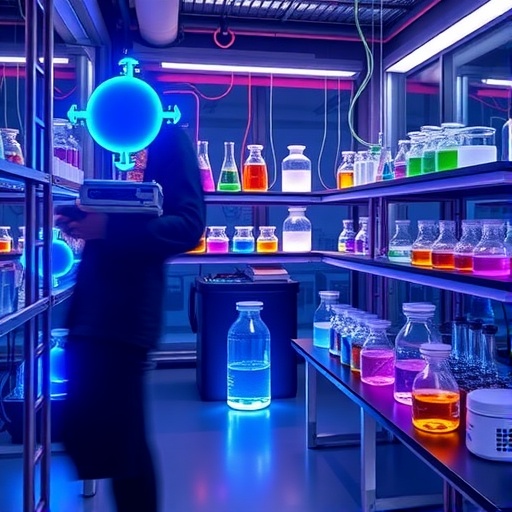
In a striking leap forward for chemical manufacturing, researchers have unveiled Flex-Cat, a groundbreaking autonomous chemistry laboratory engineered to revolutionize the discovery of catalysts—substances pivotal in accelerating chemical reactions. Unlike traditional methods, which rely heavily on painstaking trial and error and expert intuition, Flex-Cat employs a sophisticated integration of robotics, high-pressure reactors, automated analytical tools, and artificial intelligence to navigate a vast landscape of chemical possibilities with unprecedented speed and precision.
Catalysts, often hailed as the hidden engines within the chemical industry, are essential in converting raw materials into vital compounds that form the backbone of pharmaceuticals, plastics, fuels, and a myriad of specialty chemicals. However, identifying not only the optimal catalytic substances but also the precise operational parameters such as temperature, pressure, and reactant concentrations poses a formidable scientific challenge. The multidimensional experimental space is immense, rendering conventional discovery processes slow, resource-intensive, and vulnerable to human bias.
Flex-Cat addresses this challenge by orchestrating an autonomous experimental workflow capable of synthesizing catalyst candidates, conducting high-pressure hydroformylation reactions, performing immediate product analyses, and utilizing machine learning algorithms to dynamically determine the most promising subsequent experiments. Hydroformylation was chosen as the pilot reaction due to its industrial significance; it transforms simple chemical feedstocks into aldehydes, versatile intermediates crucial for manufacturing plastics, surfactants, solvents, and other everyday products.
A critical hurdle in hydroformylation lies in controlling the selectivity towards distinct aldehyde isomers—molecules identical in atomic composition but differing structurally, thereby exhibiting diverse chemical properties and applications. Through AI-guided experimentation, Flex-Cat autonomously optimizes both catalyst design and reaction conditions to selectively increase the yield of targeted isomeric products. This capability has immense implications for industrial chemistry, where fine-tuning product distributions can enhance process efficiency and tailor material properties.
Throughout the study, Flex-Cat executed 680 meticulously designed experiments employing sixteen chemically diverse phosphorus-based ligands that modify the behavior of the rhodium catalyst central to the hydroformylation reaction. The autonomous system conducted three focused optimization campaigns: one aimed at maximizing branched aldehyde output, another targeting the linear aldehyde product, and a third dedicated to discovering catalysts with tunable selectivity responsive to reaction conditions.
The outcomes were remarkable. Flex-Cat discovered catalyst-condition combinations that increased catalytic activity by a factor exceeding 2.5, significantly broadened the spectrum of achievable product selectivity, and identified ligands capable of actuation—meaning the same catalyst could be effectively “programmed” to switch between product types by adjusting environmental parameters. This demonstrates a new paradigm in catalytic control akin to a chemical dimmer switch, enabling unprecedented flexibility in product synthesis.
Beyond mere optimization, the platform generated rich datasets elucidating the interplay between ligand molecular structure and product selectivity. This dataset-driven insight allows chemists to decode the underlying mechanistic principles, fostering rational design of catalysts with customized performance profiles. The ability to map complex catalytic systems autonomously not only accelerates discovery but also transforms how chemists conceive catalyst development and industrial process design.
Flex-Cat’s significance extends beyond academic curiosity to industrial application. By accelerating catalyst identification and unveiling tunable catalytic systems, it paves the way for more efficient, adaptable chemical manufacturing processes. This fusion of robotics and AI-driven chemical science is poised to disrupt traditional development timelines, lowering costs and enabling greener, more sustainable production suited to the evolving demands of global markets.
The research team behind Flex-Cat includes notable contributors from North Carolina State University and the University of North Carolina at Chapel Hill, with support from Eastman Chemical Company. Their combined expertise in chemical engineering, catalysis, and data science has culminated in a system that not only expedites experimentation but enriches fundamental understanding of catalyst behavior under realistic process conditions.
Researchers emphasize that the broader impact of Flex-Cat lies in its generalizable framework for managing intricate reaction spaces, rapidly pinpointing optimal catalyst regions, and generating actionable knowledge to guide future innovations. This approach transcends the search for a single “best” catalyst by furnishing flexible, tunable solutions adaptable to varying industrial needs, thereby catalyzing the evolution of smart chemical manufacturing.
As this autonomous lab continues to evolve, it promises to redefine the frontiers of homogeneous catalysis. By bridging experimental chemistry with cutting-edge machine learning and automation, Flex-Cat embodies the future of chemical discovery—one where human insight is amplified through collaboration with intelligent, self-driving laboratories pushing boundaries at the speed of innovation.
Keywords
Autonomous chemistry lab, catalyst discovery, hydroformylation, phosphorus-based ligands, rhodium catalyst, artificial intelligence, robotics, chemical process optimization, selectivity control, industrial catalysis, data-driven chemistry, programmable catalysts
Cite Scienmag News
Bethany Barker. (June 24, 2026). Autonomous Chemistry Lab Uncovers Catalysts for On-Demand Product Switching. Scienmag. https://scienmag.com/autonomous-chemistry-lab-uncovers-catalysts-for-on-demand-product-switching/
Bethany Barker. "Autonomous Chemistry Lab Uncovers Catalysts for On-Demand Product Switching." Scienmag, 24 June 2026, https://scienmag.com/autonomous-chemistry-lab-uncovers-catalysts-for-on-demand-product-switching/. Accessed 3 September 2026.
Bethany Barker. "Autonomous Chemistry Lab Uncovers Catalysts for On-Demand Product Switching." Scienmag. June 24, 2026. https://scienmag.com/autonomous-chemistry-lab-uncovers-catalysts-for-on-demand-product-switching/


