


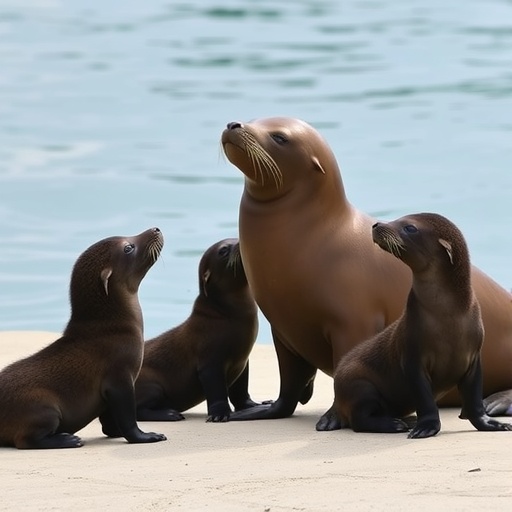
In a remarkable breakthrough, researchers from Adelaide University and the South Australian Research and Development Institute (SARDI) have uncovered compelling evidence demonstrating that Australian sea lion pups acquire foraging behaviors through direct social learning from their mothers. This discovery represents the first documented case of maternal transmission of foraging knowledge in otariids, the family of pinnipeds comprising sea lions and fur seals, challenging previous assumptions in marine mammal behavioral ecology.
Social transmission of foraging strategies has been well documented in select marine mammals such as sea otters and bottlenose dolphins, as well as in terrestrial species like chimpanzees that utilize culturally inherited tools to extract food. Nonetheless, such complex social learning processes had not been observed in otariids before, positioning this research at the forefront of understanding marine mammal social cognition and its ecological consequences.
To elucidate these behavioral dynamics, the research team employed innovative biotelemetry methods combining body-mounted cameras and advanced tracking devices affixed to a female Australian sea lion. Observations were made during a meticulously recorded eight-hour foraging expedition involving the mother and her dependent pup, yielding unprecedented insights into the nuances of their joint foraging behaviors.
The data revealed that mother-pup pairs exhibited distinctly different diving patterns and habitat use compared to maternal solo foraging trips. When accompanied by pups, female sea lions initiated shorter-duration dives primarily targeting macroalgae-dominated reef ecosystems and meadows. Conversely, solo mothers embarked on deeper dives to more invertebrate-rich reef zones, indicating a strategic modification of foraging tactics contingent upon the presence of offspring.
Interestingly, the researchers documented a stark contrast in prey capture attempts: only three attempts in the joint mother-pup excursions contrasted with a striking 172 attempts during solo mother foraging trips. This observation suggests that maternal foraging adaptation not only facilitates observational learning opportunities for the pup but also may reflect an energy conservation trade-off or risk aversion while teaching.
Nathan Angelakis, lead researcher affiliated with Adelaide University’s Southern Seas Ecology Laboratories and SARDI Aquatic Sciences, emphasized the ecological significance of these findings. He indicates that social transmission mechanisms are critical for the acquisition of specialized and sophisticated foraging behaviors, which are essential for juvenile survival and effective resource exploitation in dynamic marine environments.
Uniquely, Australian sea lions exhibit an incredibly protracted and asynchronous reproductive cycle lasting approximately eighteen months—substantially longer than the annual, synchronous breeding cycles typically observed in other otariids. This extended maternal investment window potentially provides a temporal framework conducive to the gradual, multi-stage learning process intrinsic to complex foraging behavior transmission.
The asynchronous and aseasonal reproductive patterns mean different colonies undergo breeding at staggered intervals rather than simultaneous events dictated by environmental seasonality. This characteristic may also influence social dynamics, population structure, and spatial foraging strategies, thereby adding layers of complexity to conservation management considerations.
Angelakis further posited that the extended period of maternal care allows female sea lions the opportunity to actively demonstrate effective foraging techniques in situ, enhancing the pup’s skill development and promoting behavioral adaptability necessary for survival in often unpredictable marine habitats.
This revelation holds profound conservation implications, particularly given the species’ vulnerability and interactions with anthropogenic pressures. Understanding whether mother-pup joint foraging aligns with increased exposure to apex predator risk, such as white sharks, or encounters with fisheries activities could shape future management strategies aimed at mitigating mortality risks during critical early life stages.
Furthermore, quantifying the energetic costs incurred by mothers engaging in such dual-purpose foraging—balancing their own nutritional needs while facilitating pup learning—is critical to comprehending broader population dynamics, reproductive success, and species resilience under changing ocean conditions.
Published in the Australian Journal of Zoology, this pioneering study not only enriches our comprehension of Australian sea lion ecology but also exemplifies the significance of integrating behavioral ecology with conservation efforts. The nuanced intersection of social learning mechanisms and life history traits uncovered by this research offers a vital lens through which to address the sustainability challenges facing marine mammal populations globally.
As climate change, habitat degradation, and fishing pressures intensify, fostering an in-depth understanding of species-specific behavioral adaptations like those unveiled here becomes paramount. Continued technological innovation in animal-borne monitoring holds promise for revealing further complexities of marine mammal social structures, ultimately guiding more informed and effective conservation policies.
The insights afforded by this study underscore the intricate relationships between mother and offspring in the wild, highlighting social learning as an instrumental evolutionary strategy shaping survival outcomes in Australian sea lions—a species emblematic of Australia’s unique marine biodiversity.
Web References: https://doi.org/10.1071/ZO25050
References: Angelakis, N. et al. (2024). Australian Journal of Zoology, DOI: 10.1071/ZO25050
Cite Scienmag News
Violet Maxwell. (February 19, 2026). Australian Sea Lion Pups Mimic Their Mothers’ Behavior. Scienmag. https://scienmag.com/australian-sea-lion-pups-mimic-their-mothers-behavior/
Violet Maxwell. "Australian Sea Lion Pups Mimic Their Mothers’ Behavior." Scienmag, 19 February 2026, https://scienmag.com/australian-sea-lion-pups-mimic-their-mothers-behavior/. Accessed 3 September 2026.
Violet Maxwell. "Australian Sea Lion Pups Mimic Their Mothers’ Behavior." Scienmag. February 19, 2026. https://scienmag.com/australian-sea-lion-pups-mimic-their-mothers-behavior/


