Wednesday, October 28, 2026
Science
No Result
View All Result
  • Login
  • HOME
  • SCIENCE NEWS
  • CONTACT US
  • HOME
  • SCIENCE NEWS
  • CONTACT US
No Result
View All Result
Scienmag
No Result
View All Result
Home Science News Chemistry

Atomically dispersed platinum catalyst resists sintering at high loadings

October 28, 2026
in Chemistry
Bethany Barker
By Bethany Barker Scienmag Editorial Profile - Catalysis
Reading Time: 2 mins read
0
Atomically dispersed platinum catalyst resists sintering at high loadings

Atomically dispersed platinum catalyst resists sintering at high loadings

65
SHARES
587
VIEWS
Share on FacebookShare on Twitter
ADVERTISEMENT

Chemists have developed a way to pack unusually large amounts of platinum into a catalyst while keeping every metal atom individually dispersed, a combination that has long eluded materials scientists. The new material, described in Nature Synthesis, retains its structure even under the harsh reducing conditions that normally destroy finely dispersed catalysts.

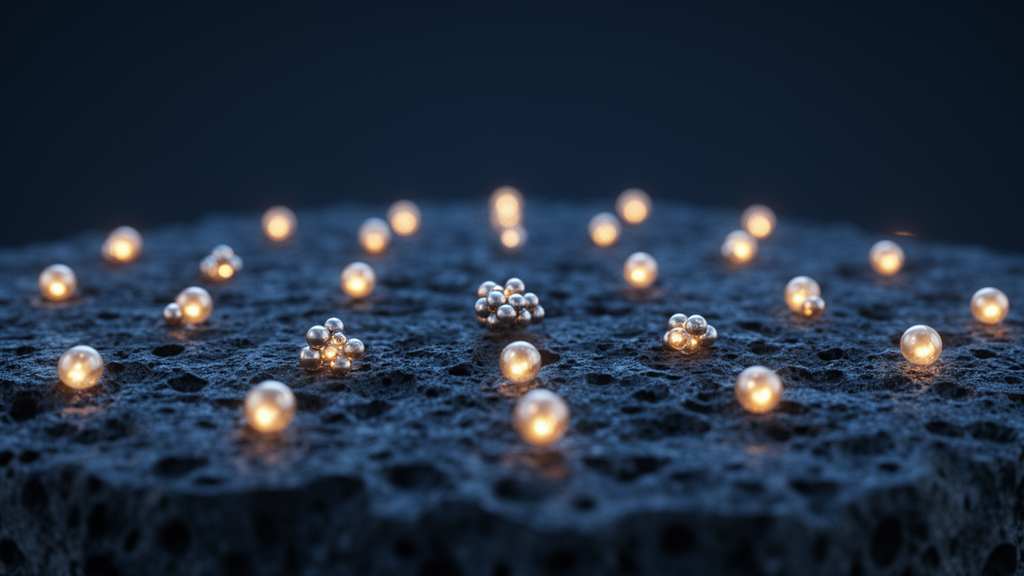
The strategy, called reticular coordination, uses a metal–organic framework as a molecular scaffold. Platinum atoms are anchored one at a time onto cerium-oxo clusters within the framework. When the material is then calcined, the framework converts into a ceria-based support, PtRC/CeOx, in which the platinum is atomically dispersed at a loading of 14.9 weight percent.

High loadings above 10 weight percent are generally difficult to reconcile with atomic dispersion, because densely packed metal atoms tend to migrate and fuse into larger particles, a process known as sintering.

In the new catalyst, the ceria lattice itself confines the platinum. When the material was treated at temperatures above 300 degrees Celsius under hydrogen, the isolated platinum species did not undergo uncontrolled sintering. Instead, their migration was suppressed after limited restructuring into flat, strongly confined ultrasmall clusters.

The researchers tested the treated material in proton exchange membrane water electrolysers. Using a platinum loading of 0.15 milligrams per square centimetre, the catalyst showed a degradation rate of 25 microvolts per hour.

For comparison, a commercial 40 weight percent platinum-on-carbon catalyst degraded at 106 microvolts per hour while operating at a higher platinum loading of 0.40 milligrams per square centimetre. The new catalyst also retained its structural integrity after 500 hours of operation at a current density of 1 ampere per square centimetre.

The reticular coordination approach was not limited to platinum. According to the reported figures, the strategy could be extended to other precious metals, suggesting a general route for anchoring single atoms of catalytically valuable elements onto oxide supports.

The work addresses a fundamental challenge in catalyst design: maximizing the utilization of scarce and expensive precious metals.

The resulting lattice confinement appears to be the key to durability, holding the platinum in place even when the catalyst is subjected to high temperatures and strongly reducing atmospheres.

The reported electrolyser results, obtained over hundreds of hours of continuous operation, indicate that the confined platinum clusters remain stable under the demanding conditions of water electrolysis, where catalyst degradation is a major obstacle to long-term hydrogen production.

Subject of Research: A reticular coordination strategy for highly loaded, sintering-resistant atomically dispersed platinum catalysts in ceria

Article Title: Durable, highly loaded atomically dispersed catalysts via a reticular coordination strategy

Article References: Jung, Y., Moon, J., Shim, J., Hwang, S., Bang, S.-U., Heo, S., Ahn, H., Yoo, S., Shin, D., Chun, S. E., Bootharaju, M. S., Ryu, J., Kim, D. H., Cho, S.-P., Sung, Y.-E., Kim, M., Hyeon, T., & Lee, B.-H. (2026). Durable, highly loaded atomically dispersed catalysts via a reticular coordination strategy. Nature Synthesis. https://doi.org/10.1038/s44160-026-01204-3

Image Credits: AI Generated

DOI: 10.1038/s44160-026-01204-3

Keywords: platinum, single-atom catalysts, ceria, metal-organic frameworks, sintering, reticular coordination, electrocatalysis, water electrolysis, catalyst stability, precious metals, Durable, highly

Cite Scienmag News

Bethany Barker. (October 28, 2026). Atomically dispersed platinum catalyst resists sintering at high loadings. Scienmag. https://scienmag.com/atomically-dispersed-platinum-catalyst-resists-sintering-at-high-loadings/

Bethany Barker. "Atomically dispersed platinum catalyst resists sintering at high loadings." Scienmag, 28 October 2026, https://scienmag.com/atomically-dispersed-platinum-catalyst-resists-sintering-at-high-loadings/. Accessed 28 October 2026.

Bethany Barker. "Atomically dispersed platinum catalyst resists sintering at high loadings." Scienmag. October 28, 2026. https://scienmag.com/atomically-dispersed-platinum-catalyst-resists-sintering-at-high-loadings/
Tags: advanced catalyst fabrication methodsatomically dispersed platinum catalystcatalyst stabilityceriaceria-based catalyst supportcerium-oxo clusters for platinum anchoringdurableElectrocatalysishigh platinum loading catalysthigh-temperature stability of platinum catalystshighlymetal-organic framework for catalyst designmetal-organic frameworksplatinumplatinum atom confinement techniquesplatinum catalyst for water electrolysisprecious metalsreticular coordinationreticular coordination strategySingle-atom catalystssinteringsintering-resistant platinum catalystultrasmall platinum clusterswater electrolysis
Share26Tweet16
Previous Post

RNA-Binding Protein hnRNPC Drives Cerebellar Growth by Guarding Mtf2 Splicing

Next Post

Alcohol Drinking Patterns Leave Distinct Protein Fingerprints in Blood Plasma

Related Posts

Myo-Inositol Boosts Doxorubicin-Induced Apoptosis in Breast Cancer Cells in Vitro
Chemistry

Myo-Inositol Boosts Doxorubicin-Induced Apoptosis in Breast Cancer Cells in Vitro

October 28, 2026
Research report: Unsupervised learning-based analysis of degradation behavior in filler-containing amine-cured epoxy formulations
Chemistry

Research report: Unsupervised learning-based analysis of degradation behavior in filler-containing amine-cured epoxy formulations

October 28, 2026
Tomato leaves discarded after harvest yield rutin-rich extract that lingers in skin layers
Chemistry

Tomato leaves discarded after harvest yield rutin-rich extract that lingers in skin layers

October 28, 2026
Nitrate Health Risk Assessments Riddled with Methodological Errors, Study Warns
Earth Science

Nitrate Health Risk Assessments Riddled with Methodological Errors, Study Warns

October 28, 2026
3D Printed Colour Routers Could Let Camera Sensors Use Three Times More Light
Chemistry

3D Printed Colour Routers Could Let Camera Sensors Use Three Times More Light

October 28, 2026
Soft Fish Protein Gels Built from Interlocking Molecular Networks
Chemistry

Soft Fish Protein Gels Built from Interlocking Molecular Networks

October 28, 2026
Next Post
Alcohol Drinking Patterns Leave Distinct Protein Fingerprints in Blood Plasma

Alcohol Drinking Patterns Leave Distinct Protein Fingerprints in Blood Plasma

  • Mothers who receive childcare support from maternal grandparents show more optimized

    Mothers who receive childcare support from maternal grandparents show more parental warmth, finds NTU Singapore study

    27656 shares
    Share 11059 Tweet 6912
  • University of Seville Breaks 120-Year-Old Mystery, Revises a Key Einstein Concept

    1061 shares
    Share 424 Tweet 265
  • Bee body mass, pathogens and local climate influence heat tolerance

    682 shares
    Share 273 Tweet 171
  • Researchers record first-ever images and data of a shark experiencing a boat strike

    546 shares
    Share 218 Tweet 137
  • Groundbreaking Clinical Trial Reveals Lubiprostone Enhances Kidney Function

    531 shares
    Share 212 Tweet 133
Science

Embark on a thrilling journey of discovery with Scienmag.com—your ultimate source for cutting-edge breakthroughs. Immerse yourself in a world where curiosity knows no limits and tomorrow’s possibilities become today’s reality!

RECENT NEWS

  • Home hospice nurses describe becoming the family’s last piece of driftwood
  • Ultrasound radiomics model shows promise for predicting spontaneous preterm birth
  • Remote Monitoring Shows Feasibility in Peritoneal Dialysis Pilot Study
  • Dark Triad Traits and Toxic Behavior Linked in Argentine League of Legends Players

Categories

  • Agriculture
  • Anthropology
  • Archaeology
  • Athmospheric
  • Biology
  • Biotechnology
  • Blog
  • Bussines
  • Cancer
  • Chemistry
  • Climate
  • Earth Science
  • Editorial Policy
  • Marine
  • Mathematics
  • Medicine
  • Pediatry
  • Policy
  • Psychology & Psychiatry
  • Science Education
  • Science News
  • Social Science
  • Space
  • Technology and Engineering

Subscribe to Blog via Email

Enter your email address to subscribe to this blog and receive notifications of new posts by email.

Join 5,151 other subscribers

© 2025 Scienmag - Science Magazine

Welcome Back!

Login to your account below

Forgotten Password?

Retrieve your password

Please enter your username or email address to reset your password.

Log In
No Result
View All Result
  • HOME
  • SCIENCE NEWS
  • CONTACT US

© 2025 Scienmag - Science Magazine

Discover more from Science

Subscribe now to keep reading and get access to the full archive.

Continue reading