
Thursday, October 29, 2026
Science
No Result
View All Result
  • Login
  • HOME
  • SCIENCE NEWS
  • CONTACT US
  • HOME
  • SCIENCE NEWS
  • CONTACT US
No Result
View All Result
Scienmag
No Result
View All Result
Home Science News Medicine

Remote Monitoring Shows Feasibility in Peritoneal Dialysis Pilot Study

October 28, 2026
in Medicine
Jerry Hayes
By Jerry Hayes Scienmag Editorial Profile - Nephrology
Reading Time: 3 mins read
0
Remote Monitoring Shows Feasibility in Peritoneal Dialysis Pilot Study

Remote Monitoring Shows Feasibility in Peritoneal Dialysis Pilot Study

65
SHARES
587
VIEWS
Share on FacebookShare on Twitter
ADVERTISEMENT

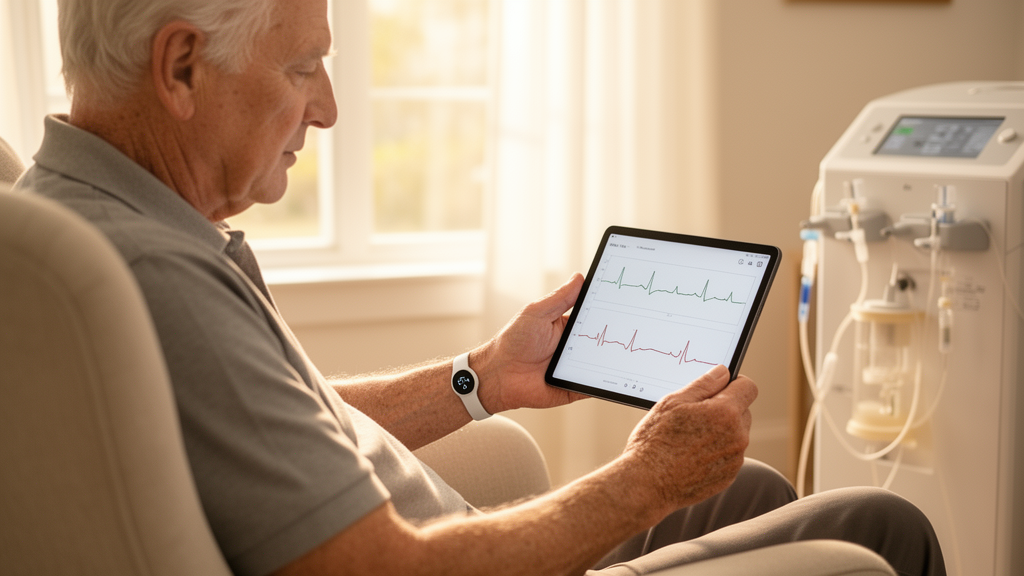
While remote patient monitoring is increasingly used in automated peritoneal dialysis, evidence for its use in CAPD, where patients manually perform exchanges rather than relying on a cycler, has remained limited.

The study followed 15 adults receiving stable CAPD between July and November 2025, with January to June 2025 serving as a historical reference period. Daily clinical and treatment data were transmitted through the MyPD application and the Sharesource CAPD portal. The primary outcomes were feasibility, the daily-report transmission rate, and safety, while secondary exploratory outcomes included blood pressure, deviation from target weight, time to outpatient assessment, healthcare utilization, complication management, and patient satisfaction.

All 15 participants completed follow-up. The daily-report transmission rate reached 97% according to platform reports, with non-receipt reflecting technical problems or omitted patient submissions. No clinical harm attributed to remote monitoring was reported, and no technique failures or transfers to haemodialysis occurred during the observation period.

Satisfaction ratings were favourable. All participants completed the satisfaction assessment, and the reported mean score was 4.6 out of a possible 5, with a standard deviation of 0.4. The researchers noted that the cohort was small and digitally selected, which may limit how broadly these satisfaction findings apply.

Clinical comparisons were descriptive and relied on aggregate data. Historical cohort-level home blood pressure was 138 plus or minus 10 over 82 plus or minus 7 mmHg, compared with 131 plus or minus 7 over 77 plus or minus 5 mmHg during the final observation month. Because only aggregate data were used, paired analysis was not possible, and the authors stressed that these comparisons remain exploratory.

Fluid-related events, early peritonitis, and constipation-related drainage problems were reported in seven, two, and four participants respectively, comprising 13 distinct patients in total. The study did not attribute these complications to the remote monitoring workflow itself.

Healthcare utilization showed no statistically significant differences. Unscheduled visits numbered 25 per 90 patient-months historically and 15 per 75 patient-months during remote monitoring, an incidence-rate ratio of 0.72 with a 95% confidence interval of 0.35 to 1.42 and a p-value of 0.344. Hospitalizations numbered four per 90 and one per 75 patient-months, an incidence-rate ratio of 0.30 with a 95% confidence interval of 0.01 to 3.03 and a p-value of 0.385. The authors emphasized that sparse healthcare events produced imprecise estimates.

The study’s conclusions were carefully qualified. The workflow was feasible, with a high reported daily-report transmission rate and favourable satisfaction ratings in this small, digitally selected cohort. However, the absence of reported remote-monitoring-related clinical harm does not establish safety, and the uncontrolled design precludes causal inference. Clinical imaging was exploratory, and healthcare-event rates were compared using exact Poisson methods.

The authors called for larger controlled multicentre studies to confirm their findings. For now, the pilot study offers an early signal that a CAPD-adapted remote monitoring workflow can be implemented with high transmission rates and positive patient ratings, while leaving open the question of whether such monitoring improves clinical outcomes or reduces healthcare utilization.

Subject of Research: Feasibility and clinical associations of remote patient monitoring in continuous ambulatory peritoneal dialysis

Article Title: Feasibility and clinical associations of remote monitoring in continuous ambulatory peritoneal dialysis: a prospective single-centre observational pilot study

Article References: Argentino, G., Sirico, M. L., Cascella, J., Viscido, F., Carpini, V. D., Vigorito, L., Amich, P., & Camocardi, A. (2026). Feasibility and clinical associations of remote monitoring in continuous ambulatory peritoneal dialysis: a prospective single-centre observational pilot study. BMC Nephrology. https://doi.org/10.1186/s12882-026-05475-y

Image Credits: AI Generated

DOI: 10.1186/s12882-026-05475-y

Keywords: peritoneal dialysis, remote patient monitoring, CAPD, nephrology, dialysis technology, telemedicine, patient satisfaction, blood pressure, healthcare utilization, pilot study, kidney disease, MyPD

Cite Scienmag News

Jerry Hayes. (October 28, 2026). Remote Monitoring Shows Feasibility in Peritoneal Dialysis Pilot Study. Scienmag. https://scienmag.com/remote-monitoring-shows-feasibility-in-peritoneal-dialysis-pilot-study/

Jerry Hayes. "Remote Monitoring Shows Feasibility in Peritoneal Dialysis Pilot Study." Scienmag, 28 October 2026, https://scienmag.com/remote-monitoring-shows-feasibility-in-peritoneal-dialysis-pilot-study/. Accessed 29 October 2026.

Jerry Hayes. "Remote Monitoring Shows Feasibility in Peritoneal Dialysis Pilot Study." Scienmag. October 28, 2026. https://scienmag.com/remote-monitoring-shows-feasibility-in-peritoneal-dialysis-pilot-study/

Tags: automated versus manual dialysis monitoringblood pressureCAPDCAPD patient data transmissiondialysis technologydialysis treatment adherencedigital health in chronic kidney diseasehealthcare utilizationimpact of remote monitoring on healthcare utilizationkidney diseaseMyPDMyPD application in dialysisnephrologyoutpatient assessment in CAPDpatient satisfactionpatient satisfaction with remote dialysisperitoneal dialysisPeritoneal dialysis remote monitoring feasibilitypilot studyremote patient monitoringremote patient safety in dialysisSharesource CAPD portaltechnical challenges in remote monitoringtelemedicine
Share26Tweet16
Previous Post

Dark Triad Traits and Toxic Behavior Linked in Argentine League of Legends Players

Next Post

Ultrasound radiomics model shows promise for predicting spontaneous preterm birth

Related Posts

Serum miRNA-29b and miRNA-99b show no clear link to stroke in young adults
Medicine

Serum miRNA-29b and miRNA-99b show no clear link to stroke in young adults

October 29, 2026
Research report: Short-term outcomes associated with oral prednisolone versus posterior sub-Tenon triamcinolone acetonide in acute ocular Vogt-Koyanagi-Harada disease
Medicine

Research report: Short-term outcomes associated with oral prednisolone versus posterior sub-Tenon triamcinolone acetonide in acute ocular Vogt-Koyanagi-Harada disease

October 29, 2026
Cyprus Ties NICE Kidney Guideline to Better CKD Care in First Year
Medicine

Cyprus Ties NICE Kidney Guideline to Better CKD Care in First Year

October 29, 2026
Sleep disturbance profiles differ across early-stage Alzheimer’s, frontotemporal dementia and Lewy body disease
Medicine

Sleep disturbance profiles differ across early-stage Alzheimer’s, frontotemporal dementia and Lewy body disease

October 29, 2026
Matching, weighting or stratification? Large-scale propensity score methods put to the test
Medicine

Matching, weighting or stratification? Large-scale propensity score methods put to the test

October 29, 2026
Early-life factors may flag infants at risk of atopic dermatitis
Medicine

Early-life factors may flag infants at risk of atopic dermatitis

October 29, 2026
Next Post
Ultrasound radiomics model shows promise for predicting spontaneous preterm birth

Ultrasound radiomics model shows promise for predicting spontaneous preterm birth

  • Mothers who receive childcare support from maternal grandparents show more optimized

    Mothers who receive childcare support from maternal grandparents show more parental warmth, finds NTU Singapore study

    27656 shares
    Share 11059 Tweet 6912
  • University of Seville Breaks 120-Year-Old Mystery, Revises a Key Einstein Concept

    1061 shares
    Share 424 Tweet 265
  • Bee body mass, pathogens and local climate influence heat tolerance

    682 shares
    Share 273 Tweet 171
  • Researchers record first-ever images and data of a shark experiencing a boat strike

    546 shares
    Share 218 Tweet 137
  • Groundbreaking Clinical Trial Reveals Lubiprostone Enhances Kidney Function

    531 shares
    Share 212 Tweet 133
Science

Embark on a thrilling journey of discovery with Scienmag.com—your ultimate source for cutting-edge breakthroughs. Immerse yourself in a world where curiosity knows no limits and tomorrow’s possibilities become today’s reality!

RECENT NEWS

  • Serum miRNA-29b and miRNA-99b show no clear link to stroke in young adults
  • Research report: Short-term outcomes associated with oral prednisolone versus posterior sub-Tenon triamcinolone acetonide in acute ocular Vogt-Koyanagi-Harada disease
  • Cyprus Ties NICE Kidney Guideline to Better CKD Care in First Year
  • Sleep disturbance profiles differ across early-stage Alzheimer’s, frontotemporal dementia and Lewy body disease

Categories

  • Agriculture
  • Anthropology
  • Archaeology
  • Athmospheric
  • Biology
  • Biotechnology
  • Blog
  • Bussines
  • Cancer
  • Chemistry
  • Climate
  • Earth Science
  • Editorial Policy
  • Marine
  • Mathematics
  • Medicine
  • Pediatry
  • Policy
  • Psychology & Psychiatry
  • Science Education
  • Science News
  • Social Science
  • Space
  • Technology and Engineering

Subscribe to Blog via Email

Enter your email address to subscribe to this blog and receive notifications of new posts by email.

Join 5,151 other subscribers

© 2025 Scienmag - Science Magazine

Welcome Back!

Login to your account below

Forgotten Password?

Retrieve your password

Please enter your username or email address to reset your password.

Log In
No Result
View All Result
  • HOME
  • SCIENCE NEWS
  • CONTACT US

© 2025 Scienmag - Science Magazine

Discover more from Science

Subscribe now to keep reading and get access to the full archive.

Continue reading