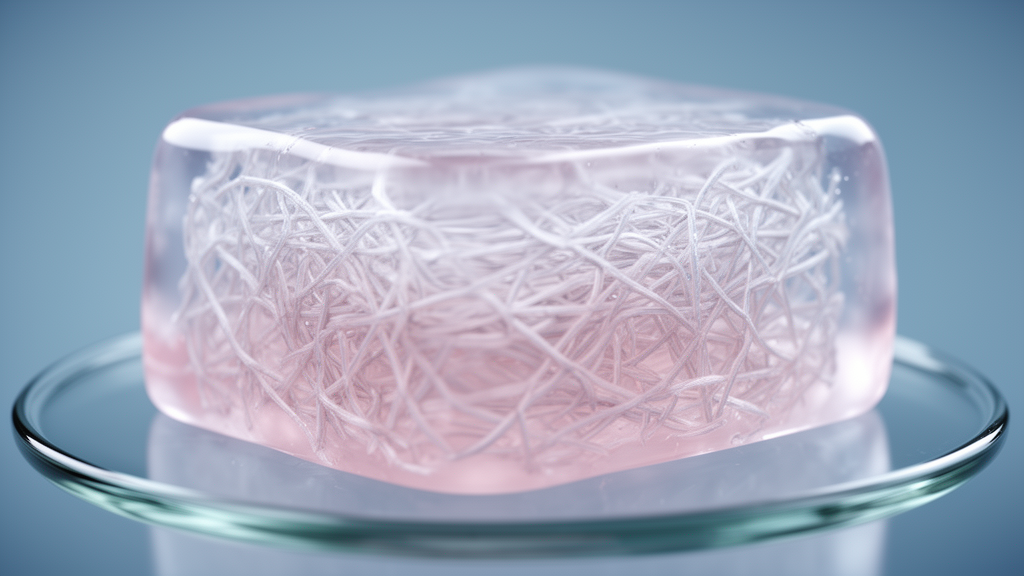
Food scientists have engineered a soft, solid edible gel from silver carp myofibrillar protein by persuading two molecular networks to weave through one another rather than stack on top of each other. The work, published in Food Chemistry: X, describes an interpenetrating polymer network, or IPN, in which a calcium-crosslinked sodium alginate network and a heat-formed network of myofibrillar protein and ovalbumin become molecularly entangled without covalent bonds between them. The resulting gel holds more than 95 percent of its water under centrifugation, contains 94 to 97 percent moisture, and is markedly softer than a commercial surimi product used for comparison.
The motivation is textural. Traditional fish protein gels tend to be springy and chewy, which suits surimi products but not people who have difficulty chewing or swallowing. The researchers, based at a team working with silver carp surimi, wanted a solid-like gel with high moisture and water-holding capacity that could break down easily in the mouth, moving beyond what they describe as the traditional trade-off between hardness and water retention in protein gels. Interpenetrating polymer networks, well known in biomedical materials science, have seen relatively limited use in food, and the authors position edible IPNs built from natural raw materials as a promising route to precisely designed textures.
The preparation was deliberately simple. Myofibrillar protein was extracted from silver carp surimi by repeated salt washing, then adjusted to about 80 milligrams per gram, a concentration below which no protein gel forms. Ovalbumin was added at a protein ratio confirmed by preliminary experiments to favor softening, and the mixture was diluted to 40 milligrams per gram of myofibrillar protein. A 2 percent sodium alginate or gellan gum solution was stirred in at three levels, giving polysaccharide-to-protein ratios of 40:3, 40:5 and 40:7, and calcium chloride was added at 2 millimoles per gram of polysaccharide. Heating at 95 degrees Celsius for 15 minutes set the gels.
Not every formulation succeeded as an IPN. The gellan gum series, called MG, never interpenetrated with the protein: confocal microscopy showed separated polysaccharide and protein phases with no regular network, and the gels stiffened as gellan gum content rose, apparently because gel properties were dominated by gellan gum aggregation rather than true interpenetration. The sodium alginate series, called MA, behaved differently. The lowest alginate level, MA-1, showed a uniform orange overlap of protein and polysaccharide fluorescence, indicating complete interpenetration, and the authors identified it as the most successful formulation. Higher alginate contents produced increasingly irregular networks, with the polysaccharide apparently crosslinking with itself and inhibiting protein crosslinking.
Texture profile analysis confirmed the softening. Compared with a commercial surimi product, all the experimental gels showed significantly lower hardness, chewiness and gel strength. Among the alginate gels, hardness did not change significantly with polysaccharide content, suggesting the network had already reached its softest state at the lowest ratio. Notably, MA-1 matched the commercial product in springiness, cohesiveness and resilience despite its much lower hardness, a combination the authors attribute to the IPN structure, where high water retention diminishes hardness while the entangled network maintains stability.
Water behavior was central to these properties. The control gel, made from myofibrillar protein and ovalbumin alone, contained 91.35 percent moisture and held about 81 percent of its water under centrifugation. The IPN gels raised both figures substantially, with water retention above 95 percent. The authors attribute this to the polysaccharide network binding water strongly and to physical crosslinking points that limit water escape during heating and dehydration. Micro-infrared imaging showed that added alginate loosened the protein network, likely because the negative charge on alginate enhances electrostatic interactions and reduces thermal aggregation of the proteins, while the lowest alginate level actually strengthened the amide band signal, which the authors interpret as protection of protein amide groups during gelation.
Microscopy told a consistent structural story. Cryo-scanning electron microscopy revealed that the control gel formed a densely crosslinked but disordered network with uneven pores, whereas the alginate gels showed more ordered, better-connected networks with larger, more uniform pores. Atomic force microscopy found uniform granular contours of roughly half a micrometer in the alginate gels, a morphology associated with lower gel strength, in contrast to the smooth surface of the pure protein gel and the wrinkled, rigid morphology of the gellan gum samples. X-ray diffraction indicated that the alginate gels retained the same crystal form as the protein, suggesting the polysaccharide crosslinks with protein on the same plane rather than forming its own independent crystalline phase, consistent with genuine interpenetration.
Rheology added detail on how these gels fail. Under large amplitude oscillatory shear, the control gel began to lose its solid character at about 50 percent strain, while the alginate gels deformed significantly only near 100 percent strain, and MA-1 kept a linear elastic-viscous stress curve even as other gels distorted. All gels showed shear-thinning, and within a shear rate range of 30 to 100 per second the control and MA-1 had the lowest apparent viscosity, which the authors link to easier swallowing. Temperature ramp tests showed the storage modulus staying above the loss modulus throughout heating for the alginate gels, indicating the gels remain solid or semi-solid as they warm. Differential scanning calorimetry found that the control gel showed an endothermic transition near 80 degrees Celsius that the IPN gels lacked, consistent with a pre-gel structure formed at room temperature that holds water tightly during heating.
Molecular docking simulations offered a mechanistic, if preliminary, explanation. Whole-genome sequencing of silver carp flesh supplied protein sequences, and docking against ovalbumin identified alpha-actin and the low-temperature S1 heavy chain of myosin as the myofibrillar proteins with the strongest binding credibility to ovalbumin, with all interaction distances exceeding 4 angstroms, pointing to non-covalent binding. Arginine residues dominated the interfaces, accounting for 53.39 percent of interacting residue pairs, mostly paired with glutamate, histidine and lysine. Docking of the proteins with alginate suggested hydrogen bonding as the predominant interaction, with lysine as the primary binding residue, which the authors propose reduces protein self-association and prevents excessive aggregation. The authors caution that molecular simulation is a computational supplement that must be integrated with experimental findings and cannot stand alone as conclusive evidence.
On the practical question of whether the gel suits people with swallowing difficulties, the team submitted MA-1 to the International Dysphagia Diet Standardisation Initiative tests. The gel showed no adhesion in the spoon tilt test, held its shape on a fork without dripping, could be sliced and crushed easily with a fork, and did not return to its original shape after fork compression, showing visible cracks. Those results place it at Level 6, soft and bite-sized, meaning it should break down readily during oral processing. The authors frame the work as a demonstration that an appropriate sodium alginate ratio, combined with ovalbumin-modified myofibrillar protein and calcium crosslinking, yields a soft yet stable solid gel governed by hydrogen bonding, hydrophobic interactions and electrostatic forces, and they note that the mild preparation conditions could reduce energy use in gel product manufacturing.
Subject of Research: Interpenetrating polymer network gels made from silver carp myofibrillar protein, ovalbumin and sodium alginate for soft edible textures
Article Title: Interpenetrating polymer networks of sodium alginate and ovalbumin-modified myofibrillar protein: underlying mechanism for designed soft edible gels
Article References: Han, L., Yu, X., Wang, Y., & Dong, X. (2026). Interpenetrating polymer networks of sodium alginate and ovalbumin-modified myofibrillar protein: underlying mechanism for designed soft edible gels. Food Chemistry: X, 40, Article 104637. https://doi.org/10.1016/j.fochx.2026.104637
Image Credits: AI Generated
DOI: 10.1016/j.fochx.2026.104637
Keywords: interpenetrating polymer networks, sodium alginate, myofibrillar protein, ovalbumin, silver carp surimi, soft gels, dysphagia, IDDSI Level 6, water-holding capacity, rheology, molecular docking, food texture
Cite Scienmag News
Bethany Barker. (October 28, 2026). Soft Fish Protein Gels Built from Interlocking Molecular Networks. Scienmag. https://scienmag.com/soft-fish-protein-gels-built-from-interlocking-molecular-networks/
Bethany Barker. "Soft Fish Protein Gels Built from Interlocking Molecular Networks." Scienmag, 28 October 2026, https://scienmag.com/soft-fish-protein-gels-built-from-interlocking-molecular-networks/. Accessed 30 October 2026.
Bethany Barker. "Soft Fish Protein Gels Built from Interlocking Molecular Networks." Scienmag. October 28, 2026. https://scienmag.com/soft-fish-protein-gels-built-from-interlocking-molecular-networks/