


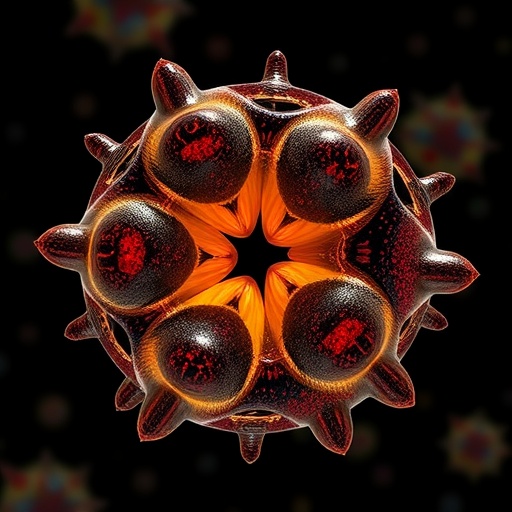
In a groundbreaking advance for synthetic biology, researchers have unveiled a mechanism for asymmetric division in multilamellar lipid-nucleotide droplets, mimicking the complex splitting behavior fundamental to living cells. This finding, reported by Meng, Jia, Qiu and colleagues in Nature, opens new horizons for the bottom-up creation of artificial cells capable of proliferating and differentiating without protein-based machinery.
The microscopic systems under study are liquid crystalline droplets with interiors crowded by biomolecules capable of selective sequestration and controlled interfacial wetting. Such protocells and chain-like networks have emerged as promising platforms for synthetic biology, offering a route to mimic cellular compartmentalization, molecular crowding, and chemical microenvironments. Yet, guided division—especially asymmetric splitting—remained elusive due to the lack of intrinsic regulatory mechanisms.
Previous approaches to protocell division primarily focused on symmetric fission of vesicles or droplets through external stimuli such as thermal gradients, chemical reactions, or wetting dynamics. These methods replicated some aspects of cellular division but lacked the capacity to generate progeny with distinct morphologies. Asymmetric division, where a single parent protocell bifurcates into two morphologically and functionally different offspring, represents a closer approximation to biological proliferation and differentiation.
Meng et al. have demonstrated that structured lipid-nucleotide multilamellar droplets can undergo spontaneous asymmetric splitting in the presence of specific biochemical effectors. By introducing alkaline phosphatase or multivalent metal cations, the parent droplet divides into two morphologically distinct progeny: a droplet and a vesicle. This division occurs without the need for reconstituted protein assemblies, highlighting that physical and chemical cues alone can orchestrate complex protocell behavior.
The key to this asymmetric division lies in the circumferential growth of a single caveola—a surface indentation—that forms along a pre-existing core–shell domain boundary within the multilamellar droplet. This domain boundary acts as a latent structural template that guides the remodeling of lipid-nucleotide interactions. Changes in nucleotide-counterion associations trigger molecular rearrangements at the lipid headgroup interface, driving the morphogenesis of distinct interfacial domains.
As the caveola enlarges, mechanical stresses generated at the domain interface facilitate membrane curvature and eventually lead to the bifurcation of the droplet into two components with different structural and functional characteristics. This process represents a remarkable example of emergent complexity driven purely by physicochemical self-organization.
Functionally, the asymmetric division transports biomolecules differentially between daughter protocells. The droplet progeny retains a molecularly crowded interior, suitable for biochemical reactions that require high local concentrations. Meanwhile, the vesicular offspring features a membranized architecture, providing compartmentalization reminiscent of natural cell membranes. Such morphological and functional heterogeneity is a critical step toward developing artificial cells capable of differentiation and functional specialization.
This research leverages advances in understanding lipid-nucleotide coacervates and liquid crystal mesophases to design protocells with programmable behaviors. The interplay of biochemical triggers with intrinsic molecular ordering enables spatiotemporal control over droplet morphology and division. This newly uncovered paradigm transcends the limitations of protein-dependent division mechanisms, allowing for synthetic systems that evolve using minimal components.
The implications of this work extend far beyond synthetic biology. Bottom-up assembly of proliferating artificial cells holds promise for drug delivery, biomaterials engineering, and understanding early life evolution where division likely preceded complex protein machinery. The ability to induce asymmetric splitting in protocells may provide insights into primordial cellular differentiation and the origins of biological complexity.
Future explorations might combine this physicochemical division mechanism with encapsulated enzymatic networks or genetic circuits to achieve autonomous growth and replication cycles. Integrating information-processing modules and metabolic pathways into these protocells could establish synthetic life forms that emulate natural cellular dynamics with unprecedented precision.
Moreover, the modularity inherent in lipid-nucleotide multilamellar droplets permits customization of biochemical environments, allowing researchers to tailor artificial cells for specific applications. Controlling asymmetric division provides a new dimension to designing protocell communities with emergent multicellularity and cooperative behavior.
In essence, the study by Meng et al. marks a pivotal moment in bottom-up synthetic biology. By elucidating a protein-independent mechanism for asymmetric protocell division driven by molecular crowding, interfacial chemistry, and domain dynamics, the work breaks ground toward creating synthetic cells that proliferate and evolve. This milestone fuels optimism for a future where artificial cells rival the complexity of their natural counterparts, enabling transformative advances in medicine, manufacturing, and fundamental biology.
Cite Scienmag News
Denise Maddox. (May 14, 2026). Asymmetric Division in Lipid-Nucleotide Droplets. Scienmag. https://scienmag.com/asymmetric-division-in-lipid-nucleotide-droplets/
Denise Maddox. "Asymmetric Division in Lipid-Nucleotide Droplets." Scienmag, 14 May 2026, https://scienmag.com/asymmetric-division-in-lipid-nucleotide-droplets/. Accessed 3 September 2026.
Denise Maddox. "Asymmetric Division in Lipid-Nucleotide Droplets." Scienmag. May 14, 2026. https://scienmag.com/asymmetric-division-in-lipid-nucleotide-droplets/


