


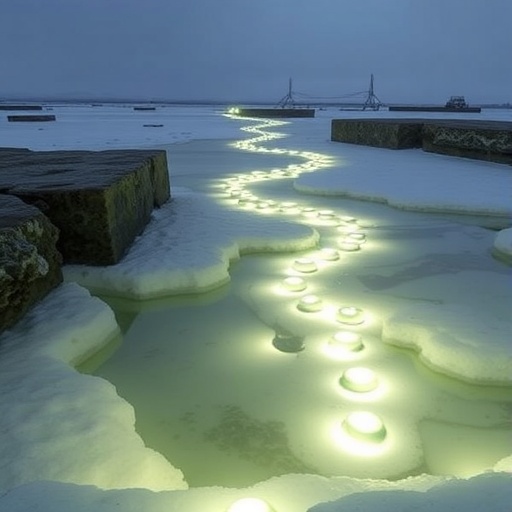
Scientists have uncovered compelling evidence highlighting the dynamic interplay between subglacial groundwater and gas hydrates off the northwest coast of Greenland. This newly published study in Nature Geoscience unravels how the flushing of subglacial groundwater during the last deglaciation period has sparked the dissolution of gas hydrates buried beneath the continental shelf. The findings offer fresh insight into the complexity of climate-cryosphere-ocean interactions and have significant implications for understanding methane release linked to historical ice sheet retreat.
At the heart of this investigation are two extensive seismic reflection surveys—Pitu and Anu—that together provide a broad and detailed snapshot of the subsurface geology beneath Melville Bay. The surveys cover nearly 10,000 square kilometers, employing state-of-the-art three-dimensional seismic acquisition and reprocessing workflows to achieve unprecedented spatial resolution. Such technological advancements allow researchers to resolve sedimentary units and fluid migration pathways with striking clarity at depths up to several kilometers below the seafloor.
The Pitu survey, conducted with an array of ten long streamers each containing hundreds of channels, was enhanced through a high-resolution data processing workflow. Techniques included noise attenuation, 3D deconvolution, and advanced migration algorithms optimized for tilted transverse isotropy environments. These refinements yielded data characterized by a dominant frequency of 45 Hz, enabling detailed characterization of sedimentary mega units and subtle stratigraphic horizons, even at depths corresponding to 1,500 milliseconds of two-way travel time.
Complementing the Pitu data, the Anu survey was acquired using a dual-vessel setup with six extensive streamers. The processing flow emphasized surface multiple elimination and Kirchhoff prestack time migration to extract high-quality reflection images. Although featuring slightly lower frequency content (30 Hz) and coarser crossline resolution at 50 meters, the Anu survey provided extensive lateral coverage, critical for understanding regional geological patterns and supporting the seismic-stratigraphic interpretation underpinning this study.
The seismic interpretation was anchored in a well-established stratigraphic framework developed from previous research on the northwest Greenland continental margin. This framework divides the subsurface into seven major seismic mega units overlying a Proterozoic basement, with the study focusing on units spanning the Neogene to the Quaternary period. Particularly notable is the definition of Mu-A, which encompasses a complex set of progradational units related to repeated glacial advance and retreat episodes since approximately 3.3 to 2.6 million years ago.
A pivotal stratigraphic subdivision within Mu-A, termed Mu-T, was identified as crucial for understanding subglacial groundwater flow. This near-horizontal horizon juxtaposes against more gently dipping strata below and acts as a potential confining layer influencing fluid migration. By leveraging detailed seismic-well ties utilizing data from IODP drill sites, the researchers were able to confirm lithological interpretations and gain velocity constraints, enhancing confidence in the seismic-derived geology and fluid flow models.
The new International Ocean Discovery Program drilling campaign (IODP Expedition 400) provided valuable ground-truth data through coring and borehole logging at three critical shelf sites within the Melville Bay Trough. These in situ measurements, including vertical seismic profiles and chemical analyses of interstitial waters and gas headspace, offered robust calibration points for interpreting seismic data and tracking fluid properties. The sediment recovered spans a range of depositional facies, providing physical evidence of past environmental conditions and gas hydrate occurrence.
Detailed analyses of porewater salinity and gas composition revealed clear signatures of subglacial groundwater influence. The extraction and measurement protocols involved precision cutting of core sections on deck, immediate sealing, and controlled heating to vaporize dissolved gases for chromatographic analysis. Such careful sample handling ensures accurate determination of methane concentrations and isotopic composition, which are vital for inferring hydrate stability and dissolution processes in the sediment column.
Critical to the study was modeling the gas hydrate stability zone (GHSZ), using a classical approach developed by Dickens and Quinby-Hunt to delineate temperature and pressure conditions favoring hydrate formation. This model incorporated site-specific parameters such as water depth, seafloor temperatures, and geothermal gradients. For this region, a geothermal gradient averaging 49 °C per kilometer was assumed, supported by bottom-simulating reflector mapping, while seafloor temperatures approximated 1.5 °C based on modern measurements.
To conservatively estimate paleo-GHSZ extents, the present-day seafloor temperatures were applied, acknowledging that glacial conditions would likely have led to even colder bottom water temperatures. Additionally, adjustments were made to account for the significant sea-level drop during the Last Glacial Maximum by subtracting 125 meters from the current water depth. This tactic ensures that the modeled thickness of hydrate stability under glacial freshwater input reflects minimum likely values, lending robustness to conclusions about hydrate behavior during deglaciation.
The hydrogeological conceptual framework posits that during ice sheet retreat, massive volumes of cold, low-salinity meltwater percolated subglacially, delivering freshwater into marine sediments previously saturated with seawater. This flushing process perturbed porewater chemistry and thermal gradients, directly impacting gas hydrate stability. The data and modeling indicate that this event triggered a phase of accelerated gas hydrate dissolution, releasing methane into surrounding sediments and potentially the water column.
Seismic evidence supports this hypothesis by revealing disrupted reflection patterns consistent with fluid escape fabrics and the presence of gas chimneys linked to zones where hydrates have dissociated. Furthermore, integration with borehole and geochemical data uncovers spatial concordance between hydrate dissociation signatures and intervals exhibiting freshened porewaters—an unambiguous hallmark of subglacial groundwater influence during and after deglaciation.
These findings have profound implications for our understanding of methane dynamics in polar continental margins. They suggest that ice sheet retreat can mechanically and geochemically destabilize sizeable gas hydrate reservoirs by injecting freshwater, thereby altering the conventional paradigm which mostly considers warming bottom waters as the primary driver of hydrate dissociation. Such processes might have contributed episodically to methane fluxes during past climate transitions, with potential lessons for future changes amid ongoing ice mass loss.
Moreover, this research highlights the interconnectedness of glacial hydrology, sedimentary geology, and greenhouse gas cycling, emphasizing the importance of integrating marine geophysics with ocean drilling and geochemical analyses. The multidisciplinary approach sets a new benchmark for studies on gas hydrate stability, offering a template to explore similar environments elsewhere, including other glaciated margins with concealed hydrate-bearing sediments.
In the context of current climate challenges, understanding triggers for methane release from gas hydrates is of heightened importance. Methane is a potent greenhouse gas, and its flux from marine sediments to the atmosphere remains a key unknown in climate modeling. The mechanisms unveiled here underscore that subglacial groundwater flushing represents a hitherto underappreciated factor that could modulate methane release during rapid ice margin changes.
In conclusion, this study enriches the scientific narrative about the fate of marine gas hydrates in glaciated continental margins. By combining advanced seismic imaging, direct sediment sampling, geochemical profiling, and thermodynamic modeling, the authors have illuminated a complex process where freshwater infiltration drives the breakdown of methane hydrates during ice retreat. Their results pave the way for future investigations into gas hydrate vulnerabilities in a warming world shaped by ever-shrinking ice sheets.
Cite Scienmag News
Violet Maxwell. (May 14, 2026). Subglacial Groundwater Unleashes Gas Hydrate Dissolution. Scienmag. https://scienmag.com/subglacial-groundwater-unleashes-gas-hydrate-dissolution/
Violet Maxwell. "Subglacial Groundwater Unleashes Gas Hydrate Dissolution." Scienmag, 14 May 2026, https://scienmag.com/subglacial-groundwater-unleashes-gas-hydrate-dissolution/. Accessed 4 September 2026.
Violet Maxwell. "Subglacial Groundwater Unleashes Gas Hydrate Dissolution." Scienmag. May 14, 2026. https://scienmag.com/subglacial-groundwater-unleashes-gas-hydrate-dissolution/


