


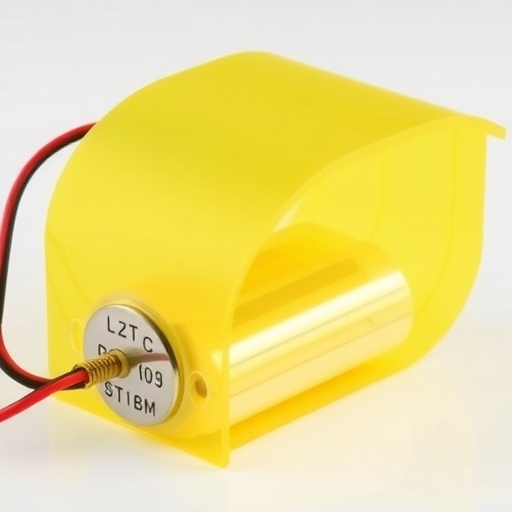
In a groundbreaking development poised to revolutionize energy storage technologies, researchers Park, D., Kim, H., and Kim, Y. have unveiled a novel class of flexible lithium supercapacitors featuring water-processable solid-state electrolytes. Published in the upcoming 2026 issue of npj Flexible Electronics, this study introduces an innovative electrolyte system rooted in aromatic acid-doped branched poly(ethylene imine) platforms, promising significant advancements in safety, flexibility, and device performance. This pioneering work addresses longstanding challenges plaguing conventional lithium-ion battery and supercapacitor technologies, particularly in the realm of wearable and flexible electronics.
The surge in demand for flexible energy storage solutions stems from the rapid proliferation of wearable devices, soft robotics, and flexible displays. However, traditional lithium-ion batteries, with their liquid electrolytes, pose severe safety hazards, including leakage and flammability, and suffer from mechanical rigidity, limiting their integration in flexible platforms. Solid-state electrolytes (SSEs) have emerged as a promising alternative due to their inherent safety and stability advantages, but they often encounter issues related to ionic conductivity and processability that impede their commercial adoption.
Against this backdrop, the research team drew inspiration from polymer chemistry and green processing techniques to engineer a new electrolyte matrix capable of marrying mechanical flexibility with outstanding electrochemical performance. Their approach leveraged the unique molecular architecture of branched poly(ethylene imine) (bPEI), a polymer known for its high density of amine groups, and strategically doped it with aromatic acids to enhance ionic transport pathways. This synergy not only optimizes lithium-ion mobility but also facilitates electrolyte fabrication through environmentally friendly water-based processing methods.
The doping of bPEI with aromatic acids imparts several critical functionalities. Aromatic acids bestow rigidity and electronic delocalization within the polymer matrix, which supports the formation of stable ion-conducting networks. This doping fundamentally alters the polymer’s microstructure, tailoring its free volume and facilitating the transport of lithium ions across the electrolyte. The resultant material exhibits a remarkable balance between mechanical robustness—allowing for bending and twisting—and ionic conductivity, which rivals that of traditional liquid electrolytes.
Water processability represents a significant leap forward in sustainable manufacturing of flexible energy devices. Conventional polymer electrolytes often require toxic organic solvents or complicated synthesis protocols, limiting scalability and environmental compatibility. The ability to process the new electrolyte in aqueous media simplifies fabrication, reduces costs, and enhances the potential for large-scale roll-to-roll manufacturing of flexible supercapacitors and batteries. This eco-friendly aspect aligns with global sustainability goals and strengthens the commercial viability of next-generation energy storage systems.
Electrochemical characterization of the newly developed supercapacitors revealed impressive performance metrics. The devices demonstrate high specific capacitance and excellent rate capability, maintaining stable charge-discharge cycles over extended periods. Crucially, the solid-state nature of the electrolyte effectively suppresses dendritic lithium growth, a major challenge that causes short circuits and catastrophic failure in lithium-metal batteries. This safety enhancement is particularly crucial for flexible applications where mechanical deformation could exacerbate dendrite formation.
Moreover, the mechanical testing underscored the electrolyte’s resilience under dynamic deformation. The supercapacitors sustain stable electrochemical performance even after multiple bending tests, mimicking real-world application conditions such as wearable textiles and foldable devices. The polymer matrix’s branched architecture absorbs mechanical stress, preventing microcracks and delamination that typically deteriorate device longevity. This robustness opens pathways to integrate lithium supercapacitors into versatile form factors previously inaccessible to rigid battery chemistries.
The theoretical underpinning for the enhanced ionic conductivity was explored through molecular dynamics simulations and spectroscopic analysis. These studies revealed that the aromatic acid dopants serve as both lithium-ion coordination centers and physical crosslinks within the bPEI network, creating continuous lithium-ion conduction pathways. This contrasts with typical polymer electrolytes where ionic clusters form isolated domains that impede charge transport. The design principle showcased here demonstrates how chemical tailoring at the molecular level can profoundly influence macroscopic device properties.
The researchers also explored the electrolyte’s thermal stability, a critical parameter for real-world deployment. Thermal gravimetric analysis and differential scanning calorimetry confirmed that these materials remain stable across a wide temperature range, preventing degradation under harsh operating conditions. This attribute is essential not only for flexible electronics subjected to varying ambient conditions but also for high-power applications where heat generation can impair battery life or pose safety risks.
Integration of the solid-state electrolyte within flexible device architectures leveraged straightforward fabrication techniques, including solution casting and layer-by-layer assembly. The compatibility with standard lithographic and printing methods underscores its adaptability to diverse manufacturing environments. The seamless assembly of the supercapacitor components ensures uniform electrolyte distribution, intimate electrode-electrolyte contact, and minimal interfacial resistance, which are paramount for optimal device efficiency.
The implications of this research extend beyond flexible energy storage. The design concept of aromatic acid-doped branched polyamines could be expanded to develop other functional polymer systems for energy conversion, including solid polymer electrolytes for fuel cells or electrochromic devices. The water-processable and environmentally benign processing methodology further positions this platform as a versatile candidate for green electronics manufacturing.
Looking forward, the study lays a robust foundation for incorporating additional functional dopants to tailor electrolyte properties for specific applications—such as enhanced ionic selectivity, improved mechanical strength, or self-healing capabilities. Coupling these materials with emerging electrode chemistries, including lithium metal or silicon-based anodes, may unlock unprecedented energy densities for flexible supercapacitors, tackling limitations inherent in current lithium-ion technology.
As wearable and flexible electronics become pervasive, the need for energy storage systems that are not only high-performing but also safe, scalable, and environmentally friendly grows exponentially. The work by Park and colleagues represents a major milestone in achieving this balance, demonstrating an elegant interplay of molecular design, green chemistry, and device engineering. Their innovative solid-state electrolyte platform heralds a new era in flexible lithium supercapacitors that could transform consumer electronics, healthcare devices, and beyond.
The prominence of this new electrolyte system is expected to catalyze further research efforts aimed at bridging the gap between laboratory prototypes and market-ready products. Industry stakeholders are particularly interested in its compatibility with existing manufacturing infrastructure and its potential to circumvent safety concerns associated with liquid electrolytes. This advancement is well aligned with the increasing regulatory emphasis on safe and sustainable battery technologies worldwide.
In conclusion, the introduction of aromatic acid-doped branched poly(ethylene imine) to create water-processable solid-state electrolytes marks a significant step toward flexible, safe, and durable lithium supercapacitors. The exemplary performance, coupled with environmentally conscious processing approaches, positions these materials at the forefront of next-generation energy storage innovation. As the digital age embraces flexibility and mobility, such breakthroughs are indispensable in powering our increasingly connected world.
Cite Scienmag News
Denise Maddox. (June 3, 2026). Flexible Lithium Supercapacitors Using Water-Based Electrolytes. Scienmag. https://scienmag.com/flexible-lithium-supercapacitors-using-water-based-electrolytes/
Denise Maddox. "Flexible Lithium Supercapacitors Using Water-Based Electrolytes." Scienmag, 3 June 2026, https://scienmag.com/flexible-lithium-supercapacitors-using-water-based-electrolytes/. Accessed 3 September 2026.
Denise Maddox. "Flexible Lithium Supercapacitors Using Water-Based Electrolytes." Scienmag. June 3, 2026. https://scienmag.com/flexible-lithium-supercapacitors-using-water-based-electrolytes/


