


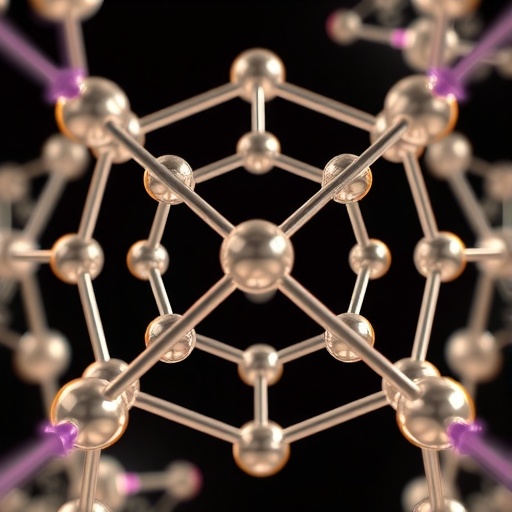
Metal–organic frameworks, or MOFs, are best known as highly ordered crystalline materials whose molecular building blocks assemble into repeating networks filled with nanoscale pores. Their rigid architecture can provide enormous internal surface areas, making MOFs attractive for gas storage, separation, catalysis, sensing and chemical processing. Yet the same order that gives crystalline MOFs their remarkable properties can also limit how easily they are reshaped. A new study by J. B. Weiß, L. Fritsch, M. Tricarico and colleagues suggests that a very different form of these materials—MOF glasses—can be reorganized through a process driven by ligand exchange in a liquid flux. Published in Nature Materials, the work presents a new way to think about how amorphous framework materials evolve at the molecular level.
The central idea is deceptively simple: chemical components inside a solid framework can be exchanged while the material is exposed to a liquid medium capable of transporting or activating them. In conventional ligand exchange, organic linkers connected to metal nodes are replaced by chemically related molecules. In a crystalline MOF, that transformation may be constrained by the framework’s ordered geometry. Every substitution must occur without destroying the repeating lattice, and the incoming ligand must fit into a structure that already exists. A glass, by contrast, lacks long-range periodic order. Its atoms and molecular fragments retain short-range connections, but those connections are arranged irregularly. That disorder may create additional pathways for chemical reorganization.
The study focuses on the role of “flux,” a term used in materials chemistry for a liquid or mobile phase that promotes transport and reaction during processing. A flux can reduce kinetic barriers, dissolve or mobilize selected components, and improve contact between reacting species. In the context of MOF glasses, it may function as more than a passive processing aid. The liquid environment can help ligands move through the disordered framework, exchange places with existing linkers, and alter the local coordination environment around metal centers. The result is a material that remains glassy while its chemical composition and internal connectivity are reconfigured.
That distinction is important because glass is not simply a poorly made crystal. In a crystalline MOF, the positions of metal nodes and ligands are repeated over long distances, producing sharp diffraction signatures and a well-defined topology. In a MOF glass, the long-range pattern has collapsed, often after heating or mechanical treatment, but the metal–ligand bonds can preserve a recognizable local network. Scientists therefore face a difficult challenge: how can they change the chemistry of an amorphous framework without causing it to crystallize, decompose or collapse into an unstructured residue? Flux-mediated exchange offers a possible answer by allowing chemical changes to occur under conditions that maintain the glassy state.
The reported restructuring is significant because ligand identity controls many of a MOF’s most important characteristics. Linkers determine pore size, chemical functionality, flexibility, hydrophobicity and the strength with which molecules interact inside the framework. Changing them can alter how a material absorbs gases, transports ions or catalyzes reactions. In a glass, however, these properties are influenced not only by composition but also by the distribution of local environments. Two regions containing the same metal and ligand types may behave differently if their bond angles, coordination numbers or free-volume pockets differ. Flux-mediated exchange could therefore produce materials with chemical gradients, mixed-linker environments or nonequilibrium structures that would be difficult to obtain through ordinary crystal synthesis.
The work also highlights a broader principle in materials science: disorder can become a source of synthetic freedom. Crystalline solids are often prized because their regularity makes their structures easier to characterize and their properties easier to predict. But that regularity can also lock chemical components into place. Amorphous materials contain a wider range of local configurations, and some of those configurations may be more reactive than their crystalline counterparts. If a flux can access these sites selectively, the glass may undergo a type of molecular remodeling rather than a simple uniform substitution. Such remodeling could explain why the material’s structure changes as exchange proceeds, rather than merely acquiring a new ligand composition while preserving its original arrangement.
Understanding this process requires techniques that can distinguish local bonding from overall order. Diffraction methods can reveal whether long-range crystallinity has appeared or disappeared, but they are less informative about the full range of short-range environments in an amorphous solid. Researchers studying MOF glasses may therefore combine diffraction with spectroscopy, thermal analysis, microscopy and measurements of porosity or chemical composition. Spectroscopic signatures can track metal–ligand bonds and identify exchanged linkers, while thermal measurements can show whether the glass transition or stability has changed. Together, these observations allow scientists to connect molecular exchange with the material’s macroscopic behavior.
The implications extend beyond one family of porous solids. Many advanced materials are difficult to modify after they have been formed because their components are trapped in rigid networks. A controlled liquid-mediated exchange process could provide a general strategy for editing such networks after fabrication. For MOF glasses, the approach may enable the preparation of compositions that are inaccessible by direct heating or conventional solution synthesis. It could also offer a route to recycle or upgrade framework materials, replacing linkers to tune performance instead of discarding the entire solid. Such possibilities remain dependent on controlling the reaction’s selectivity, depth and uniformity, but the conceptual advance is substantial: an amorphous framework can be treated as a chemically active architecture rather than a frozen end product.
The study arrives as researchers increasingly seek materials that combine the processability of polymers with the molecular precision of inorganic frameworks. MOF glasses are particularly intriguing because they may be shaped, joined or coated more easily than crystals while retaining some of the chemical design potential associated with MOFs. If flux-mediated ligand exchange can restructure these glasses predictably, it could open new routes to membranes, sensors, catalytic media and selective barriers whose properties are programmed after the initial material is made. The most exciting possibility is that the method could create spatially varied glasses, in which different regions carry different ligands or coordination environments. That kind of chemical patterning could give a single piece of material several functions at once.
The findings presented by Weiß, Fritsch, Tricarico and their colleagues ultimately challenge the assumption that a glassy framework is structurally static. Instead, the work portrays MOF glasses as dynamic molecular networks capable of internal revision when supplied with the right chemical environment. Flux-mediated ligand exchange appears to connect transport, reactivity and structural disorder in a single process, showing how a liquid phase can reorganize a solid without simply erasing it. As scientists learn to control that balance, MOF glasses could become platforms for designing porous materials that are not only assembled with precision, but also chemically rewritten on demand. That prospect makes the study a striking example of how disorder, once viewed mainly as a limitation, can become the key to a new generation of adaptable materials.
Cite Scienmag News
Denise Maddox. (August 25, 2026). Flux-driven ligand exchange reshapes metal–organic framework glasses. Scienmag. https://scienmag.com/flux-driven-ligand-exchange-reshapes-metal-organic-framework-glasses/
Denise Maddox. "Flux-driven ligand exchange reshapes metal–organic framework glasses." Scienmag, 25 August 2026, https://scienmag.com/flux-driven-ligand-exchange-reshapes-metal-organic-framework-glasses/. Accessed 4 September 2026.
Denise Maddox. "Flux-driven ligand exchange reshapes metal–organic framework glasses." Scienmag. August 25, 2026. https://scienmag.com/flux-driven-ligand-exchange-reshapes-metal-organic-framework-glasses/


