


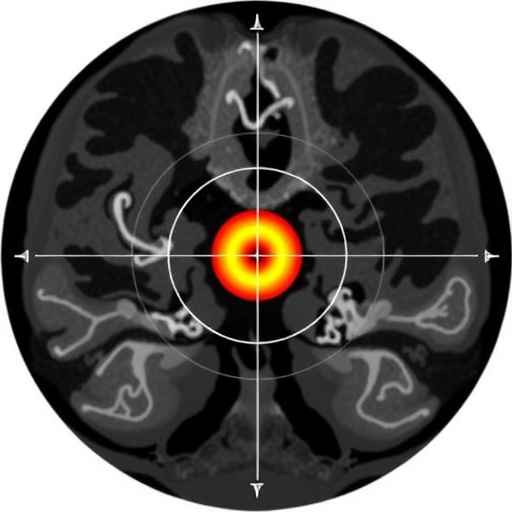
In the realm of radiosurgery, particularly Gamma Knife radiosurgery, precision and optimization of treatment plans are paramount for effective patient outcomes. A recent groundbreaking study published in the prestigious journal Neurosurgical Subspecialties addresses a persisting challenge in this field: the excessive number of isocenters used during inverse planning. The study sheds empirical light on a commonly held clinical assumption that the morphological irregularity of target tumors significantly drives this complexity. By focusing specifically on vestibular schwannoma cases, this retrospective cross-sectional investigation advances our understanding of how tumor shape intricacies directly impact radiosurgical planning.
Vestibular schwannomas, benign tumors located at the vestibulocochlear nerve, present a unique treatment challenge due to their often irregular and complex three-dimensional configurations. Traditional Gamma Knife planning systems, such as GammaPlan, typically require numerous isocenters to conform radiation dose precisely around these irregular shapes. However, the computational and clinical burden of managing excessive isocenters raises concerns about planning efficiency and treatment safety. This study’s principal aim was to dissect and quantify the factors behind this phenomenon, offering an evidence-based perspective on tumor morphology’s role in isocenter utilization.
The research team meticulously gathered treatment data from 280 consecutive patients diagnosed with vestibular schwannoma who underwent Gamma Knife radiosurgery throughout 2023. Each patient’s treatment plan, designed using the sophisticated GammaPlan system, served as a rich dataset for evaluating morphological irregularity. Central to this analysis were three distinct metrics: standard sphericity (SS), volume ratio sphericity (VRS), and the coefficient of variance of diameters (DCV). These parameters illuminated varying dimensions of tumor shape complexity, from gross geometric conformity to volumetric proportion and diameter variability.
Standard sphericity (SS) represents a classical geometrical measure quantifying how closely an object’s shape resembles a perfect sphere. In this study, the median SS of vestibular schwannomas was 0.85, with an interquartile range of 0.77 to 0.91, illustrating a generally near-spherical yet irregular tumor shape distribution across the cohort. Volume ratio sphericity (VRS), with an average of 0.46 ± 0.16, further enriched the morphological profile by comparing the tumor volume against a reference volume, encapsulating deviations from idealized forms. Meanwhile, the coefficient of variance of diameters (DCV), a simpler yet robust metric defined by variability in measured tumor diameters, ranged from 0.14 to 0.34, averaging at 0.22, suggesting varying degrees of shape irregularity.
The statistical robustness of the investigation emerged through multivariate analysis, revealing that tumor volume, acoustic neuroma consensus grading, and patient age significantly influenced the sphericity parameters. This finding underscores the multifactorial nature of tumor morphology, implicating biological and demographic factors as contributors to shape complexity. Crucially, the analysis demonstrated strong correlations between these sphericity metrics and key radiosurgical planning parameters such as isocenter count, beam-on time, and treatment conformity, confirming the clinical relevance of tumor shape irregularity.
Among the sphericity measures, the study found the coefficient of variance of diameters (DCV) to exhibit the highest consistency and correlation with the standard sphericity (SS) metric, outperforming volume ratio sphericity (VRS). This highlights DCV’s utility as a straightforward, computationally less intensive, yet reliable quantitative descriptor of tumor morphological irregularity. Consequently, DCV is proposed as a practical proxy for assessing shape complexity during planning optimization, potentially simplifying clinical workflows.
The research implications extend beyond mere morphological description; incorporating these quantitative irregularity measures into the Gamma Knife planning paradigm could revolutionize future treatment strategies. By predicting the complexity of isocenter deployment based on tumor shape metrics, clinicians and planners can better anticipate planning challenges, optimize isocenter allocation, and reduce overall treatment time. This not only enhances plan quality but also improves patient throughput and comfort, especially for intricate vestibular schwannoma cases.
Moreover, the study advocates for integrating morphological irregularity parameters into routine Gamma Knife plan evaluation protocols. Traditional planning metrics such as prescription dose and homogeneity index, while essential, do not fully capture the nuanced influence of tumor shape on planning complexity. Augmenting these tools with quantitative sphericity and diameter variance measurements could provide a more holistic assessment framework, balancing dosimetric quality with geometric considerations.
This research represents a paradigm shift in Gamma Knife radiosurgery planning—moving from a predominantly dosimetry-focused approach to one enriched by morphological analytics. It underscores the necessity for advanced imaging and computational methods to characterize tumor shapes with precision and translate these insights into actionable planning improvements. The study’s robust dataset and methodological rigor set a new standard for future investigations aiming to refine stereotactic radiosurgical techniques.
Ultimately, the authors conclude that the coefficient of variance of diameters (DCV) offers a promising, accessible metric to gauge target irregularity. Its strong agreement with established sphericity measures and applicability within existing GammaPlan infrastructures support its potential adoption in clinical practice. Using DCV as a planning parameter could streamline isocenter optimization, reduce planning workload, and enhance therapeutic precision.
In light of these findings, ongoing advancements in radiosurgery treatment planning are increasingly likely to emphasize morphological analytics, blending geometric quantification with advanced dose modeling. This evolution holds promise for elevating Gamma Knife radiosurgery outcomes, particularly in challenging cases involving irregularly shaped tumors like vestibular schwannomas. As the technology and software continue to advance, clinicians and physicists must embrace these innovative parameters to harness the full potential of precision radiotherapy.
The full study is accessible in the Neurosurgical Subspecialties journal, emphasizing its relevance to neurosurgeons, radiation oncologists, and medical physicists dedicated to stereotactic radiosurgery. This research not only informs clinical practice but also invites further scholarly inquiry into the interplay between tumor morphology and treatment planning intricacies in radiosurgical oncology.
News Publication Date: 4-Mar-2026
Web References: http://dx.doi.org/10.14218/NSSS.2025.00036
Cite Scienmag News
Nathaniel Bowman. (April 20, 2026). Assessing Target Irregularity as a Key Factor in Gamma Knife Treatment Planning. Scienmag. https://scienmag.com/assessing-target-irregularity-as-a-key-factor-in-gamma-knife-treatment-planning/
Nathaniel Bowman. "Assessing Target Irregularity as a Key Factor in Gamma Knife Treatment Planning." Scienmag, 20 April 2026, https://scienmag.com/assessing-target-irregularity-as-a-key-factor-in-gamma-knife-treatment-planning/. Accessed 3 September 2026.
Nathaniel Bowman. "Assessing Target Irregularity as a Key Factor in Gamma Knife Treatment Planning." Scienmag. April 20, 2026. https://scienmag.com/assessing-target-irregularity-as-a-key-factor-in-gamma-knife-treatment-planning/


