


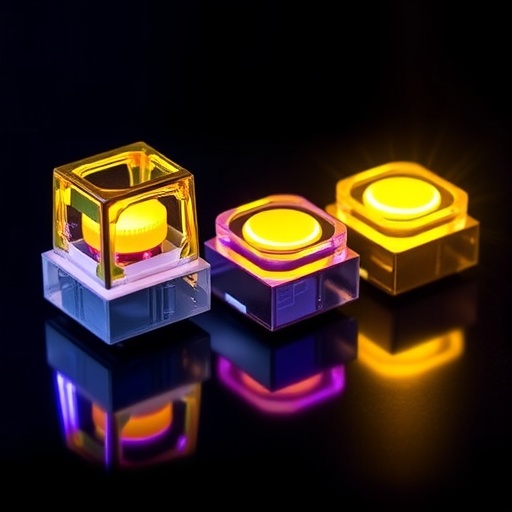
In a remarkable advancement poised to redefine the landscape of optoelectronic devices, researchers have unveiled a pioneering method that significantly enhances the performance of thermally-evaporated light-emitting diodes (LEDs). This breakthrough centers on a novel, one-step vapor purification technique that promises to address longstanding challenges in the fabrication of high-efficiency LEDs, heralding a new era for lighting and display technologies.
The core of this innovation lies in the application of an exceedingly refined vapor purification process during the thermal evaporation stage of LED fabrication. Thermal evaporation, a widely used method for depositing thin films of organic semiconductor materials, has traditionally faced limitations related to material purity and film uniformity. Impurities and contaminants in the evaporated materials tend to create defect sites that degrade the optoelectronic properties of the resulting LEDs. The newly developed one-step vapor purification method effectively mitigates these issues by removing impurities from the vapor phase before film deposition, thereby enabling the formation of purer and more uniform organic layers.
This meticulous purification approach stands apart from conventional multi-step cleaning or post-deposition treatments, which often add complexity, cost, and processing time. Instead, by integrating purification directly into the vapor phase, the researchers streamline the fabrication workflow, enhancing reproducibility and scalability—a critical consideration for industrial adoption. Such an elegant yet powerful approach could accelerate the transition of cutting-edge organic LED technologies from laboratory prototypes to mass-market applications with superior performance benchmarks.
Central to the success of this research is the substantial improvement in key LED performance metrics. Devices crafted using the one-step vapor purification exhibited notable increases in external quantum efficiency (EQE), luminous efficiency, and operational stability compared to those fabricated through traditional thermal evaporation methods. Each of these metrics plays a crucial role in determining the practical viability of LEDs, influencing energy consumption, brightness, and device longevity. The breakthroughs reported suggest that by refining the purity of evaporated materials at the source, one can unlock higher efficiencies without compromising device robustness.
The elucidation of the purification mechanism reveals that volatile impurities with lower boiling points are selectively removed during the vapor phase process, thereby ensuring that only high-purity molecular species contribute to film formation. This selective removal mitigates trap states and non-radiative recombination centers within the organic layers, which are typically responsible for efficiency losses and device degradation. Additionally, the resulting films demonstrate enhanced morphological uniformity, a factor critical in achieving consistent electrical and optical properties over large device areas.
Further investigations into the device physics underpinning these high-performance LEDs reveal improved charge carrier balance and reduced leakage currents, factors attributed to the pristine organic layers enabled by the vapor purification step. Achieving an optimal balance between electron and hole transport is vital for maximizing radiative recombination and hence the luminous output of LEDs. The suppression of leakage currents also contributes to improved power efficiency and thermal management, allowing devices to operate at higher brightness levels without accelerated degradation.
One of the most compelling aspects of this study is the broad applicability of the one-step purification method across various organic semiconductor materials used in light-emitting devices. The researchers demonstrated the efficacy of their technique with diverse emissive materials including phosphorescent and thermally activated delayed fluorescence (TADF) compounds, which are known for their high internal quantum efficiencies. This flexibility suggests that the technique could serve as a universal enhancement strategy in the organic electronics field, transcending individual material systems.
The implications of this advancement extend beyond conventional LED applications. Improved thermal evaporation processes with built-in purification could profoundly impact the manufacture of organic lasers, photodetectors, and even next-generation quantum light sources. Each of these device categories demands thin films of exceptional purity and precision, qualities inherently promoted by the novel method. This could catalyze a wave of innovations in the broader photonics and optoelectronics industries.
Operational stability, a perennial challenge for organic LEDs, sees significant enhancement with the new purification method. Longer device lifetimes and resistance to photodegradation were reported, which is critical for commercial lighting and display applications where longevity directly translates to consumer value and environmental sustainability. By effectively removing impurities that serve as degradation initiation points, the vapor purification step helps sustain consistent performance over extended periods.
The integration of this purification technique into existing vapor deposition systems is also an encouraging development from a manufacturing perspective. The one-step nature of the process requires minimal equipment modification, suggesting a smooth pathway toward industrial-scale roll-to-roll or batch production lines. Innovators and manufacturers alike could leverage this technique to produce higher-quality devices with minimal disruption or cost increases.
In the context of the broader field of organic electronics, this research marks a substantial stride toward overcoming the intrinsic material and process-related limitations that have hindered device efficiency and consistency. Through the judicious application of chemistry and materials science fundamentals to the vapor deposition phase, the researchers have carved out a new frontier in device engineering that blends simplicity with profound efficacy.
Moreover, the reported work underscores the potency of re-examining established fabrication methods with fresh perspectives. While thermal evaporation has been a cornerstone technique for decades, the infusion of advanced purification within its core process transforms its utility and unlocks new performance regimes previously thought unattainable without complex material syntheses or multi-step fabrication routines.
Looking forward, this one-step vapor purification technique could usher in an era of brighter, more energy-efficient, and longer-lasting organic LEDs that find their way into ubiquitous applications, spanning from flexible displays and smart wearable devices to sustainable lighting solutions. The environmental and economic benefits of such advances reinforce the critical role that fundamental process innovations play in realizing transformative technologies.
As the team continues to refine their approach, scaling the process for large-area devices and exploring compatibility with emerging material systems will be key areas of focus. Multi-disciplinary collaborations integrating process engineering, materials chemistry, and device physics are expected to accelerate these developments, bringing the promise of ultrahigh-performance LEDs closer to fruition.
In sum, this trailblazing research redefines the boundaries of what is achievable with thermal evaporation techniques in organic optoelectronics. By harnessing a one-step vapor purification approach, the authors provide a compelling blueprint for elevating device quality and performance in a manner that is both efficient and readily integrable into current manufacturing paradigms. The resulting impact on the future design and deployment of light-emitting technologies could be immense, inspiring widespread re-evaluation of process strategies across the field.
Cite Scienmag News
Denise Maddox. (April 20, 2026). High-Performance LEDs Achieved with One-Step Vapor Purification. Scienmag. https://scienmag.com/high-performance-leds-achieved-with-one-step-vapor-purification/
Denise Maddox. "High-Performance LEDs Achieved with One-Step Vapor Purification." Scienmag, 20 April 2026, https://scienmag.com/high-performance-leds-achieved-with-one-step-vapor-purification/. Accessed 6 September 2026.
Denise Maddox. "High-Performance LEDs Achieved with One-Step Vapor Purification." Scienmag. April 20, 2026. https://scienmag.com/high-performance-leds-achieved-with-one-step-vapor-purification/


