


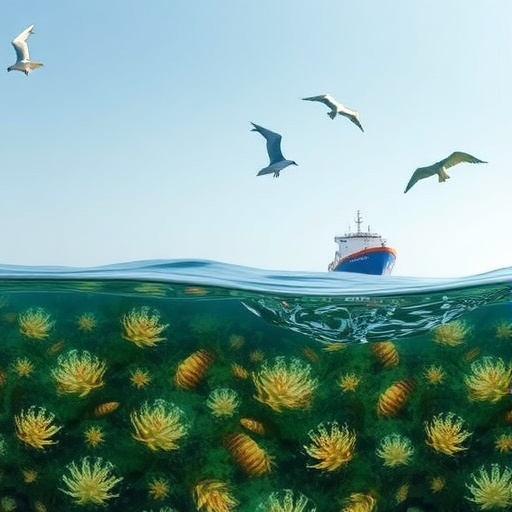
Global shipping may be creating a biological invasion problem faster than ballast-water regulations can contain it, according to a new study that links projected growth in maritime trade with the performance of treatment systems designed to stop organisms from crossing oceans. Ships routinely take in seawater to maintain stability when they are lightly loaded and discharge it when cargo is added or removed. That water can carry plankton, larvae, bacteria and other living organisms from one coast to another. If released into a suitable environment, some may survive, reproduce and become invasive species, altering food webs, damaging fisheries and imposing costly pressures on coastal economies.
The study, published in Nature Sustainability, combines machine-learning projections of future shipping with a global model of biological introduction risk. Its central finding is stark: even widespread use of ballast-water treatment may not be enough to offset the ecological consequences of expanding maritime activity. Depending on how shipping grows and how effectively vessels comply with treatment requirements, future introduction risk could range from 94 percent to 900 percent of the 2018 baseline. In the most extreme scenario represented by the analysis, the risk is therefore projected to be nine times higher than it was in 2018, despite the presence of international controls.
Ballast water is an unintended consequence of the physics of ship operation. A vessel needs to remain stable, properly trimmed and sufficiently submerged as its cargo load changes. Operators pump seawater into dedicated tanks when necessary and later discharge it in another port. The water is not simply a passive fluid: it contains a moving biological sample of the source ecosystem. Organisms released into a new region face unfamiliar temperatures, salinity, predators and competitors, but a fraction may possess the traits needed to establish. Once established, non-indigenous populations can spread through connected waterways and become difficult or impossible to remove.
International ballast-water management rules were created to reduce this pathway. Modern systems may use filters to remove larger organisms, ultraviolet radiation to damage cells and genetic material, chemical disinfectants to inactivate biological material, or combinations of these approaches. Their purpose is not necessarily to make discharged water biologically sterile, which can be technically difficult, but to lower the abundance and viability of organisms to regulated levels. The effectiveness of that process depends on engineering performance, maintenance, operating conditions and compliance. A system that performs well in controlled tests may encounter very different water quality, organism densities or flow rates during real-world voyages.
The researchers’ approach treats invasion risk as the outcome of two interacting trends rather than as a fixed property of individual ships. The first is the changing scale and geography of maritime traffic. Using machine-learning projections under Shared Socioeconomic Pathways—standardized scenarios used to explore possible future social, economic and environmental conditions—the analysis estimates how shipping activity could change. The second is the biological filter imposed by ballast-water management. The model explicitly represents both compliance and treatment efficacy, allowing the researchers to examine what happens when ships meet requirements consistently, when treatment performance varies, or when systems fail to remove enough viable organisms.
That integration matters because shipping growth can increase risk even if the probability of an invasion from any single discharge remains unchanged. More voyages mean more opportunities for organisms to move between regions. More ballast-water exchanges also expand the number of ecological pairings that can occur, potentially connecting source communities with recipient environments that were previously isolated. The risk is not determined simply by the volume of water discharged. It also reflects where ships travel, how frequently routes operate, whether environmental conditions are suitable for establishment and whether organisms survive treatment and the journey. A rapidly intensifying network can therefore amplify risk through the sheer number of connections it creates.
The projected range—from 94 percent to 900 percent of the 2018 baseline—captures the sensitivity of the outcome to both socioeconomic growth and regulatory performance. A value near the lower end does not mean that biological invasions disappear; it indicates that future risk could remain close to the baseline under relatively favorable combinations of shipping development and ballast-water control. At the upper end, shipping expansion overwhelms partial or inconsistent protection. The contrast shows why counting the number of vessels equipped with treatment systems is an incomplete measure of environmental safety. What matters is whether those systems operate effectively across the global fleet and whether their performance remains reliable as maritime traffic increases.
The result also highlights a technical distinction between adoption and efficacy. A treatment system can be installed on a ship but still provide less protection than expected if it is poorly maintained, operated outside its design conditions or used inconsistently. Filters may be affected by clogging or by the physical characteristics of the water being processed. Disinfection performance can depend on exposure time, water clarity and the sensitivity of the organisms present. The source material does not assign a single failure mechanism to the projected risks, but by modeling efficacy and compliance explicitly, the study demonstrates why implementation in name alone cannot be assumed to deliver uniform reductions in invasion risk.
The implications extend beyond shipping regulation. Ballast-water management is often framed as a technological challenge: develop treatment systems, install them aboard vessels and verify that they meet a standard. The study instead presents it as a moving governance problem in which environmental protection must keep pace with a changing transportation system. As trade routes expand, treatment requirements may need stronger oversight, more consistent enforcement and continued optimization based on evidence from operating vessels. Monitoring could also help identify where treatment performance is weakest and where growing traffic is creating new biological connections. Such measures would not eliminate invasion risk, but they could reduce the gap between regulatory expectations and what ships actually discharge.
The researchers’ broader warning is that the ecological costs of global commerce cannot be assessed by looking at economic expansion alone. Maritime trade links markets, but it also links ecosystems, and each new connection can transport organisms with consequences that persist long after a ship leaves port. The study does not suggest that shipping growth makes ballast-water management futile. Instead, it shows that the protection provided by current measures depends on maintaining high efficacy and compliance while traffic continues to increase. Without adaptive governance and sustained attention to real-world treatment performance, the biological map of the oceans may become increasingly shaped by the routes of global trade.
Cite Scienmag News
Patricia Pace. (August 29, 2026). Assessing Invasive Species Risks Amid Shipping Growth and Ballast Water Management. Scienmag. https://scienmag.com/assessing-invasive-species-risks-amid-shipping-growth-and-ballast-water-management/
Patricia Pace. "Assessing Invasive Species Risks Amid Shipping Growth and Ballast Water Management." Scienmag, 29 August 2026, https://scienmag.com/assessing-invasive-species-risks-amid-shipping-growth-and-ballast-water-management/. Accessed 3 September 2026.
Patricia Pace. "Assessing Invasive Species Risks Amid Shipping Growth and Ballast Water Management." Scienmag. August 29, 2026. https://scienmag.com/assessing-invasive-species-risks-amid-shipping-growth-and-ballast-water-management/


