


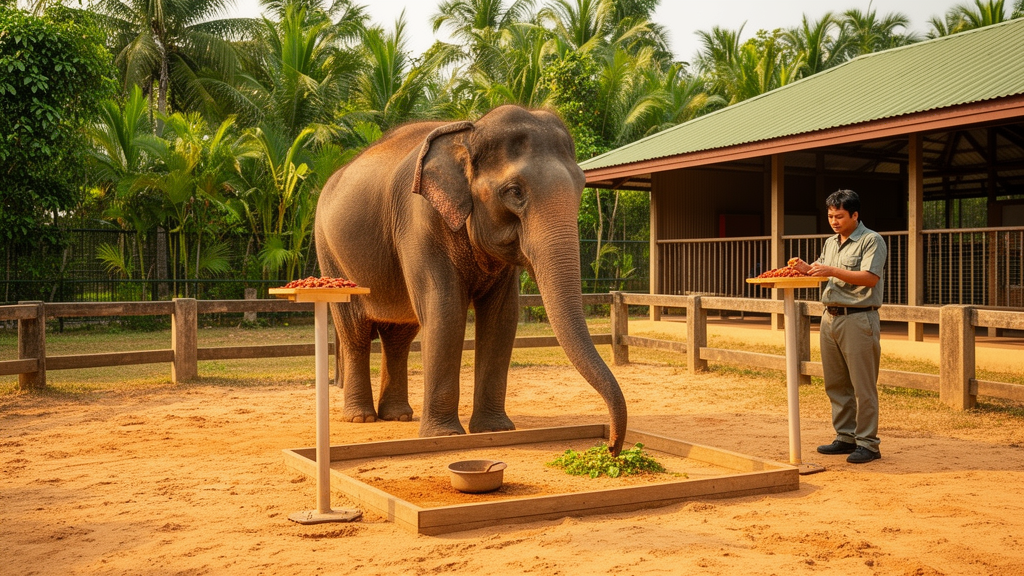
Asian elephants can suppress an immediate but ineffective response and instead use a more effective route to obtain food, according to an experimental detour study conducted at the National Elephant Institute in Thailand. Sixteen Asian elephants were tested in an experiment that the researchers describe as the first demonstration of this form of inhibitory control in the species. The results were published in PLOS One on September 9, 2026, under the title “Asian elephants (Elephas maximus) demonstrate inhibitory control in a detour task.”
For the detour task, the researchers presented the elephants with a transparent box containing small holes through which the animals could see and smell fruit inside. An opening on the side of the box provided access to the food, while the transparent surface allowed the elephants to perceive a tempting but ineffective route directly toward the reward. During familiarization trials, the animals entered the side opening to gain access to the fruit, giving them prior experience with the effective approach. In later test trials, the elephants generally resisted reaching directly for the food and used the taught side route instead. Their performance therefore showed that they could inhibit an unproductive response even when the reward was plainly visible and its odor was detectable through the barrier.
The researchers then rotated the box, changing the relationship between the openings and the food. At first, the elephants succumbed to the impulse to reach for the position where the effective opening had been during familiarization. They then corrected their behavior, indicating that they could stop using a previously effective method when it no longer worked. This response required the animals to abandon an established approach as well as avoid reaching directly through the transparent barrier. Together, the two situations tested whether elephants could suppress competing impulses when the most immediate or previously successful action was no longer the best way to obtain the reward.
Adjustment to the rotated box was slower among older elephants. The researchers identified age-related cognitive decline as one possible explanation, but they also emphasized that further study would be required to determine whether the pattern reflects a genuine age effect. The study involved 16 Asian elephants at one institution in Thailand, and the supplied report does not state that every individual completed every phase or provide detailed task-completion figures. Consequently, the results support a measured conclusion about the tested group: the elephants generally demonstrated inhibitory control in this detour task. The experiment did not establish how the capacity applies to every individual elephant, every context or other dimensions of cognition.
Hope and colleagues said the demonstrated ability may be important to elephants’ social interactions or to other cognitive abilities, including problem-solving. Those broader implications were not directly tested in the reported experiment. Understanding how elephants respond to barriers may also inform the development of more effective methods for avoiding human-elephant conflict, but the study did not evaluate a conflict-mitigation intervention. The authors proposed that inhibitory control could be a key component of the problem-solving and social behavior associated with elephants, while distinguishing the experimental observation from those possible applications. The work was peer-reviewed and published as PLOS One volume 21, issue 9, article e0356549, with a canonical DOI of 10.1371/journal.pone.0356549.
Subject of Research: Experimental evidence of inhibitory control in 16 Asian elephants performing a detour task in Thailand
Article Title: Clever elephants can think before they act
Article References: Clever elephants can think before they act. Original publication (Bibliographic details unavailable.)
Image Credits: AI Generated
DOI: Not provided
Keywords: Asian elephants, inhibitory control, detour task, elephant cognition, decision-making, animal behavior, impulse control, Thailand, experimental study, Clever, elephants, think
Cite Scienmag News
Drew Townsend. (October 26, 2026). Asian Elephants Demonstrate Inhibitory Control in Thailand Experiment. Scienmag. https://scienmag.com/asian-elephants-demonstrate-inhibitory-control-in-thailand-experiment/
Drew Townsend. "Asian Elephants Demonstrate Inhibitory Control in Thailand Experiment." Scienmag, 26 October 2026, https://scienmag.com/asian-elephants-demonstrate-inhibitory-control-in-thailand-experiment/. Accessed 26 October 2026.
Drew Townsend. "Asian Elephants Demonstrate Inhibitory Control in Thailand Experiment." Scienmag. October 26, 2026. https://scienmag.com/asian-elephants-demonstrate-inhibitory-control-in-thailand-experiment/


