


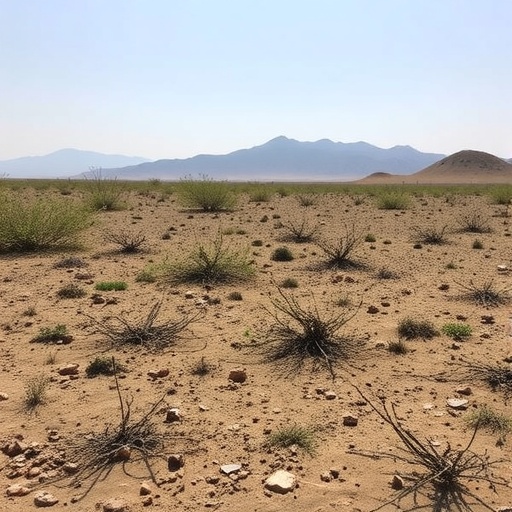
In the face of escalating global climate change, understanding how aridity influences terrestrial ecosystems is a critical scientific endeavor. Research led by Li, Feng, Sáez-Sandino, and colleagues marks a significant advance in this pursuit by elucidating how variations in soil elemental ratios—modulated by aridity—dramatically reshape microbial functional traits within soils across diverse biomes. Published recently in Nature Communications, their study offers an unprecedented global perspective on the elemental dynamics driving microbial ecosystem functions, providing vital insights into the nexus between soil chemistry and microbial ecology under changing climatic conditions.
At its core, the research addresses how aridity—not merely rainfall deficit but a complex climatic parameter encompassing temperature and moisture constraints—alters the elemental stoichiometry of soils worldwide. Specifically, the team measured ratios of key soil elements such as carbon (C), nitrogen (N), phosphorus (P), and other micronutrients that serve as fundamental building blocks and energy currency for microbial communities. These elemental ratios are not static; they fluctuate substantially with increasing aridity, which in turn orchestrates shifts in microbial metabolic capabilities, life strategies, and their overall ecosystem functionality.
One of the pivotal findings of the study is that aridity leads to a pronounced reconfiguration of soil elemental ratios, notably elevating carbon-to-nitrogen and carbon-to-phosphorus ratios in drier biomes. This stoichiometric imbalance poses a challenge for microbial communities that rely on balanced nutrient supplies to perform critical functions such as organic matter decomposition, nitrogen fixation, and nutrient cycling. The researchers highlight how these imbalances trigger an adaptive response in microbial communities, selecting for taxa with functional traits suited to nutrient-limited and water-scarce conditions.
Diving deeper into microbial functional traits, the study reveals that aridity-associated elemental shifts favor communities with enhanced resource-use efficiency and greater resilience to stress. Microbes in arid soils tend to exhibit traits such as slower growth rates, increased capacity for substrate uptake under nutrient limitation, and the ability to produce extracellular enzymes that liberate scarce nutrients from complex organic compounds. These microbial adaptations suggest a strategic realignment in energy investment, prioritizing survival and maintenance over rapid proliferation.
Importantly, the researchers employed an integrative methodological approach combining field sampling from various biomes—ranging from humid tropical rainforests to hyper-arid deserts—with advanced metagenomic and bioinformatic analyses. This comprehensive dataset enabled a robust correlation of soil elemental profiles with metagenome-inferred microbial functional gene repertoires, allowing the team to map functional trait distributions in direct relation to soil chemistry. The global scale of this approach is unprecedented, providing a unifying framework that links soil geochemistry and microbial ecology.
Underlying the study’s significance is the implication that aridity-driven shifts in soil elemental stoichiometry and microbial traits can alter fundamental ecosystem processes, including carbon sequestration and nutrient cycling. As microbes mediate soil organic matter turnover, any alteration in their functionality can cascade through ecosystems, influencing plant productivity, nutrient availability, and ultimately the resilience of entire biomes to environmental stress. This mechanistic understanding offers new predictive power for modeling ecological responses under varying climates.
The work also challenges prior assumptions that microbial communities are solely shaped by vegetation type or climatic variables independently; rather, the soil’s elemental makeup emerges as a crucial intermediary modulated by aridity that finely tunes microbial functionality. This highlights the importance of considering biogeochemical feedbacks in ecological models that forecast ecosystem trajectories in the Anthropocene.
From a molecular standpoint, the study sheds light on gene families that increase in abundance under arid conditions—particularly those involved in nutrient acquisition, stress response, and energy metabolism. Genes linked to nitrogen fixation and phosphorus scavenging were notably enriched in drier soils, reflecting microbial strategies to overcome nutrient deficiencies exacerbated by aridity. These patterns illustrate an eco-evolutionary consequence where functional gene pools dynamically respond to elemental limitations driven by environmental stress.
The ecological ramifications extend into the domain of biogeochemical cycles. Soil microbes drive fluxes of critical greenhouse gases such as carbon dioxide, methane, and nitrous oxide; modifications in microbial function tied to elemental stoichiometry may thus influence atmospheric gas exchanges. The study’s findings suggest that aridity, through reshaping soil chemistry and microbial traits, could indirectly modulate climate feedback loops, potentially reinforcing or mitigating warming trends depending on the net effects on microbial metabolism.
An intriguing aspect revealed by the research is the spatial heterogeneity within and between biomes. Despite overarching trends in elemental ratios and microbial responses, localized soil conditions and microclimatic factors introduce complexity, producing diverse microbial assemblages with distinct functionalities. This variability underscores the necessity for high-resolution investigations that integrate soil geochemistry, microbiology, and climate analytics to unravel ecosystem resilience under fluctuating aridity.
The authors further discuss the broader implications for land management and restoration ecology. Enhanced understanding of how soil elemental stoichiometry governs microbial functional traits informs strategies for rehabilitating degraded arid and semi-arid landscapes. By targeting elemental limitations or engineering microbial communities with desirable functional capacities, interventions may bolster ecosystem productivity and stability in water-scarce environments.
Moreover, this research sets a foundation for future studies to explore how anthropogenic influences—such as land use changes, fertilization practices, and pollution—interact with climate-induced aridity to influence soil elemental dynamics and microbial ecology. Given the accelerating pace of global environmental change, such integrative perspectives are essential to design sustainable ecosystems that can endure under combined climatic and anthropogenic pressures.
In conclusion, the work of Li and colleagues presents a paradigm shift in our comprehension of how soil elemental stoichiometry driven by aridity governs microbial functional traits at a global scale. It furnishes a critical link between climate variables, geochemical soil properties, microbial ecology, and ecosystem function, representing a vital step toward predicting biotic responses to future climate scenarios. The interdisciplinary nature and global scope of this study render it a landmark contribution that will likely stimulate novel research avenues and practical applications in environmental science.
This compelling investigation underscores the intricate interplay between elemental resources and microbial life in shaping the resilience and functionality of Earth’s terrestrial ecosystems amidst changing climates. As the world grapples with increasing aridity in many regions, insights from this research could pave the way for innovative strategies to preserve ecosystem services fundamental to human well-being and planetary health.
Cite Scienmag News
Morgan Morrow. (June 20, 2026). Aridity Alters Soil Elements, Microbial Functions Globally. Scienmag. https://scienmag.com/aridity-alters-soil-elements-microbial-functions-globally/
Morgan Morrow. "Aridity Alters Soil Elements, Microbial Functions Globally." Scienmag, 20 June 2026, https://scienmag.com/aridity-alters-soil-elements-microbial-functions-globally/. Accessed 4 September 2026.
Morgan Morrow. "Aridity Alters Soil Elements, Microbial Functions Globally." Scienmag. June 20, 2026. https://scienmag.com/aridity-alters-soil-elements-microbial-functions-globally/


