


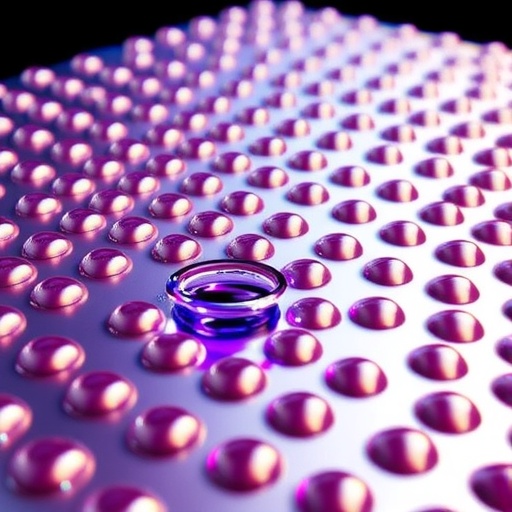
A nanoscale coating that deliberately uses tiny surface “defects” to make water droplets appear faster and leave the surface sooner has delivered a dramatic increase in condensation heat transfer, according to researchers at the Korea Advanced Institute of Science and Technology (KAIST). Tested on copper tubes used in condenser systems, the surface reached a maximum condensation heat-transfer coefficient of approximately 88 kW·m⁻²·K⁻¹—up to 5.5 times higher than the performance of a conventional copper surface covered by a continuous water film. The advance could help reduce energy losses in power plants, improve desalination and atmospheric water-harvesting systems, and accelerate cooling in electronic devices.
The technology addresses one of the most persistent challenges in condensation engineering: getting water to form on a surface without allowing it to remain there long enough to create an insulating layer. When water vapor encounters a cooler surface, it can condense as a continuous film or as separate droplets. Filmwise condensation is common on ordinary metals, but the resulting layer of liquid water creates thermal resistance between the vapor and the surface. Heat must pass through that layer before reaching the metal, which slows the transfer process. Dropwise condensation is much more effective because individual droplets expose fresh areas of the surface as they grow, merge, and detach. Repeated renewal of the surface allows heat to move more efficiently.
The difficulty is that the conditions that encourage droplets to form are often the same conditions that stop them from moving. A rough or highly textured surface provides numerous microscopic locations where vapor molecules can begin forming liquid nuclei. However, once droplets appear, they can become trapped within grooves, pores, or raised structures. A smoother surface allows droplets to slide or roll away more easily, but it typically offers fewer nucleation sites, reducing the number of droplets that form in the first place. This creates a fundamental trade-off between nucleation—the birth of new droplets—and mobility, or the ability of existing droplets to detach. The KAIST team set out to separate these two functions rather than forcing a single surface structure to perform both.
The joint research team was led by Youngsuk Nam of KAIST’s Department of Mechanical Engineering and Sung Gap Im of the Department of Chemical and Biomolecular Engineering. Their approach uses initiated chemical vapor deposition, or iCVD, to place an ultrathin polymer film onto a copper surface. In iCVD, gaseous chemical precursors are delivered to a substrate, where they react and form a polymer coating without requiring the surface to be immersed in a liquid solution. Because the process can produce highly uniform films with carefully controlled thickness, it is suitable for coating curved and complex components such as the copper tubes found in real heat exchangers.
The researchers discovered that reducing the thickness of the polymer film changed its morphology in a way that improved condensation. Very thin films developed dense nanoscale polymer aggregates—small clusters or particles that had previously been treated as imperfections to be removed. Instead of harming the coating, these aggregates created a large population of local sites where water vapor could begin to condense. Experiments showed that approximately three times more droplets formed on the thin films than on thicker polymer coatings. At the nanoscale, these aggregates can alter the local surface energy and geometry, lowering the barrier required for vapor molecules to organize into liquid water. More nucleation sites mean that condensation can begin across a greater fraction of the surface.
Increasing the number of droplets, however, would not be enough if those droplets remained attached. To solve the second half of the problem, the team introduced a heat-treatment step after depositing the polymer. Thermal treatment modified the coating and reduced the force holding water droplets to the surface. As a result, droplets were able to detach before growing excessively large. This division of labor was central to the design: film thickness controlled how readily droplets formed, while heat treatment controlled how readily they departed. Rather than seeking one ideal surface roughness or one universal level of water repellency, the researchers tuned nucleation and removal independently through the coating’s structure and post-processing conditions.
The effect resembles a continuously renewing conveyor belt for heat transfer. As soon as a droplet leaves, the exposed site becomes available for another droplet to form. Rapid cycles of nucleation, growth, and detachment prevent the surface from becoming covered by a thick liquid layer. Small droplets also have a shorter path through which heat must travel, and their removal repeatedly brings fresh copper and polymer-coated area into contact with the vapor. In practical terms, the surface remains active instead of becoming insulated by accumulated water. The researchers’ observations show why nanoscale features that appear insignificant under conventional imaging can have a major influence on the macroscale performance of a condenser.
To test whether the concept could move beyond laboratory-scale flat samples, the team coated copper tubes similar to those used in commercial condenser systems. The coated tubes achieved a peak condensation heat-transfer coefficient of about 88 kW·m⁻²·K⁻¹. Compared with a conventional copper surface operating with filmwise condensation, the improvement reached approximately 5.5-fold. The performance was also more than 50 percent higher than that of a conventional hydrophobic coating, a category of surface treatment commonly used to encourage dropwise condensation. These results suggest that simply making a surface water-repellent is not necessarily the most effective strategy. A carefully engineered combination of nanoscale nucleation sites and low droplet adhesion can outperform coatings designed primarily around smoothness or hydrophobicity.
The implications extend across several technologies that depend on the controlled movement of heat and water. In fossil-fuel and nuclear power stations, condensers convert steam back into liquid water after it passes through turbines; more efficient condensation could help reduce the energy required for this cycle and improve overall plant performance. In desalination systems, faster condensation can increase the rate at which purified water is collected from vapor generated from seawater. Similar principles could benefit devices that harvest water from humid air. Electronics and data-processing equipment may also gain from coatings that remove condensed liquid quickly while maintaining efficient heat flow, although practical deployment will require long-term testing under repeated thermal cycling, contamination, vibration, and industrial operating conditions.
The KAIST researchers describe the work as a new surface-design strategy built around controlled imperfection. Jun Soo Kim of the Department of Mechanical Engineering and Minjeong Kang of the Department of Chemical and Biomolecular Engineering were first authors of the study. The findings were published in Nature Communications, where the researchers presented the relationship between polymer-film morphology and condensation performance. Because iCVD can create extremely thin and conformal coatings on complex geometries, the approach may be adaptable to heat exchangers and other devices that cannot easily be treated using conventional coating methods. The team’s broader message is that defects are not always obstacles to eliminate: when their size, density, and interaction with water are understood, they can become functional features that make droplets form quickly, escape efficiently, and keep heat moving.
Web References: https://doi.org/10.1038/s41467-026-75621-5
References: Nature Communications, DOI: 10.1038/s41467-026-75621-5
Keywords
Condensation heat transfer, dropwise condensation, polymer coatings, initiated chemical vapor deposition, iCVD, nucleation, droplet detachment, copper heat exchangers, thermal management, desalination, water harvesting, electronic cooling
Cite Scienmag News
Denise Maddox. (August 23, 2026). KAIST Surface Defects Boost Droplet Formation, Removal, and Heat Transfer by 5.5-Fold. Scienmag. https://scienmag.com/kaist-surface-defects-boost-droplet-formation-removal-and-heat-transfer-by-5-5-fold/
Denise Maddox. "KAIST Surface Defects Boost Droplet Formation, Removal, and Heat Transfer by 5.5-Fold." Scienmag, 23 August 2026, https://scienmag.com/kaist-surface-defects-boost-droplet-formation-removal-and-heat-transfer-by-5-5-fold/. Accessed 3 September 2026.
Denise Maddox. "KAIST Surface Defects Boost Droplet Formation, Removal, and Heat Transfer by 5.5-Fold." Scienmag. August 23, 2026. https://scienmag.com/kaist-surface-defects-boost-droplet-formation-removal-and-heat-transfer-by-5-5-fold/


