


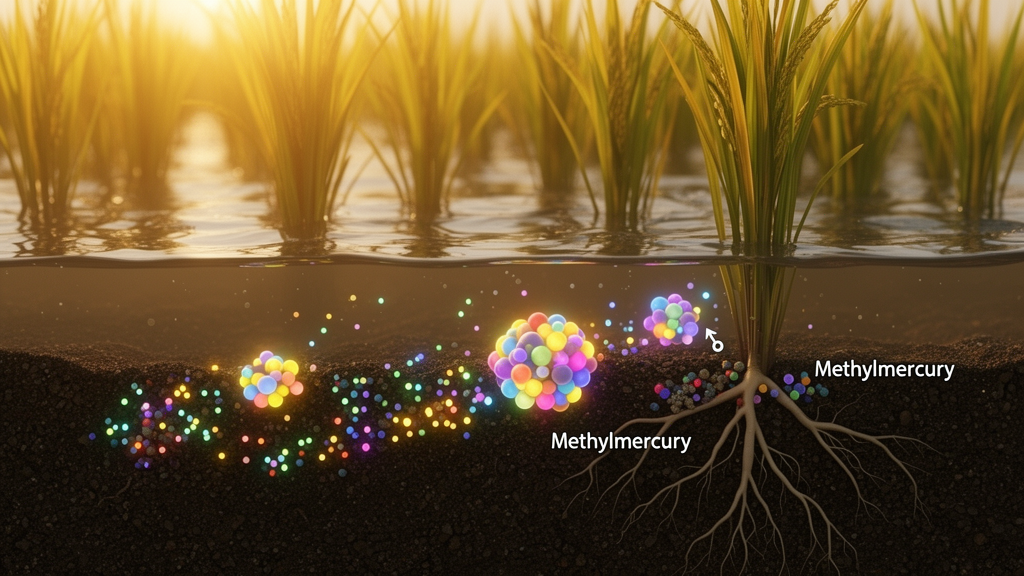
Antibiotic residues in agricultural soils may be quietly amplifying one of the food chain’s most insidious neurotoxins. A study published in Nature Communications reports that fluoroquinolone antibiotics, a widely used class of drugs, enhance the production of methylmercury in paddy soils by selectively reshaping the metabolic activity of microbial communities.
The researchers tested 40 paddy soils collected from China’s major rice-growing regions. When fluoroquinolones were added at a concentration of 10 milligrams per kilogram of soil, methylmercury content rose by 2.9 percent to 19.7 percent after 21 days of incubation. Methylmercury is the neurotoxic organic form of mercury that accumulates in food webs, and rice paddies are recognized environments where mercury methylation can occur.
Through metabolic inhibition experiments and microcosm studies, the team determined that the increase stemmed primarily from stimulated microbial mercury methylation rather than from suppressed breakdown of existing methylmercury. Sulfate-reducing bacteria dominated the process: when sulfate reduction was inhibited, fluoroquinolone-induced mercury methylation decreased by 31 percent to 75 percent.
Integrated microbiome analysis and functional prediction, based on soil microbial communities and metagenomic analyses of enriched sulfate-reducing bacterial consortia, identified bacteria carrying the hgcA gene as the key methylators.
Notably, the antibiotics did not significantly change the abundance or community structure of the methylating microbes. Instead, fluoroquinolone exposure selectively suppressed competing microbial groups while promoting metabolically active, antibiotic-tolerant sulfate-reducing bacteria, particularly those using the reductive acetyl-CoA pathway. This shift in metabolic activity, rather than a shift in who was present, elevated mercury methylation activity.
The findings suggest that widespread antibiotic contamination could amplify mercury risks in soils through tolerant microbial communities, potentially representing what the authors describe as a hidden yet critical link between emerging contaminants, heavy metals, and food safety.
The study is an open-access article published on 27 October 2026, shared early as a peer-reviewed, accepted version subject to further edits. The work was led by Hailong Li and Huan Zhong, with a large team of co-authors from multiple institutions.
Antibiotic residues are now widespread in agricultural soils, yet their influence on microbe-mediated mercury transformations had been poorly understood. By demonstrating that a common pharmaceutical pollutant can tip the metabolic balance of soil microbes toward greater methylmercury synthesis, the study adds a new dimension to concerns about how chemical pollution interacts in combination, with antibiotics and heavy metals jointly shaping risks in the environments that produce the world’s food.
Subject of Research: How antibiotic contamination stimulates microbial methylmercury synthesis in rice paddy soils
Article Title: Antibiotic contamination stimulates microbial methylmercury synthesis in rice paddies
Article References: Li, H., Li, X., Zhang, X., Tang, W., Liu, J., Yu, R.-Q., Rensing, C., Luo, Y., Wang, X., Xia, J., Yang, Y.-N., Hu, Y., Zhao, H.-R., Liu, Y., Wu, M., Li, C., Xiao, L., & Zhong, H. (2026). Antibiotic contamination stimulates microbial methylmercury synthesis in rice paddies. Nature Communications. https://doi.org/10.1038/s41467-026-79083-7
Image Credits: AI Generated
DOI: 10.1038/s41467-026-79083-7
Keywords: methylmercury, fluoroquinolone antibiotics, rice paddies, sulfate-reducing bacteria, mercury methylation, soil microbiome, hgcA gene, food safety, heavy metals, antibiotic contamination, paddy soils, microbial ecology
Cite Scienmag News
Morgan Morrow. (October 27, 2026). Antibiotics in rice paddies boost microbial production of toxic methylmercury. Scienmag. https://scienmag.com/antibiotics-in-rice-paddies-boost-microbial-production-of-toxic-methylmercury/
Morgan Morrow. "Antibiotics in rice paddies boost microbial production of toxic methylmercury." Scienmag, 27 October 2026, https://scienmag.com/antibiotics-in-rice-paddies-boost-microbial-production-of-toxic-methylmercury/. Accessed 27 October 2026.
Morgan Morrow. "Antibiotics in rice paddies boost microbial production of toxic methylmercury." Scienmag. October 27, 2026. https://scienmag.com/antibiotics-in-rice-paddies-boost-microbial-production-of-toxic-methylmercury/


