


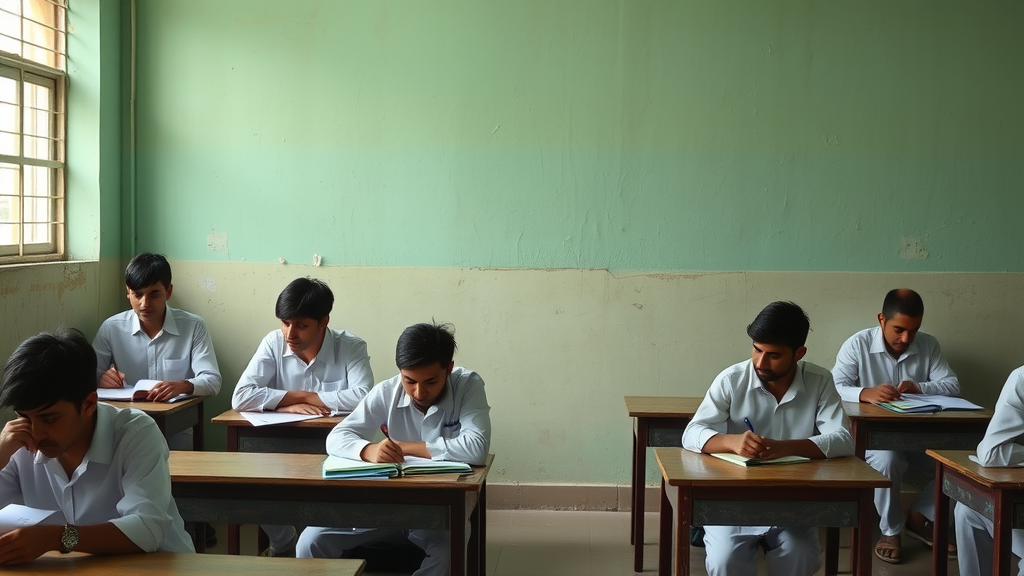
At a university admissions counter in Pakistan, a staff member recently posed a question that has come to haunt an entire academic discipline: what has happened to anthropology? The query, raised as enrollment numbers slid year after year, was echoed in classrooms by students asking what career a degree in the field could actually deliver. Those encounters form the starting point of a new study published in the International Journal of Anthropology and Ethnology, which argues that anthropology’s troubles in Pakistan are not the product of a single policy decision or sudden collapse, but of a gradual, cumulative erosion the author calls slow epistemic exclusion. The discipline, the study contends, remains formally present in universities and examination syllabi while progressively losing the resources, recognition and institutional pathways it needs to sustain itself.
The study’s author, Inayat Ali, who holds positions at Shifa Tameer-e-Millat University in Islamabad and the University of Vienna, approaches the problem through an unusual methodological lens: an anthropology of anthropology. Rather than surveying attitudes from a distance, Ali draws on continuous participant observation across several Pakistani universities between 2021 and 2026, working at admissions counters, teaching in classrooms, and taking part in departmental, curriculum and program development. He supplements this with purposively gathered narratives from undergraduate students between 2022 and 2024, years of informal conversations with students, faculty and aspirants to Pakistan’s Central Superior Services examination, cohort comparisons with a neighboring program, and a documentary review of curricula, program descriptions and policy documents. The result is an ethnography of academic life in which disciplinary value is made and unmade in the most ordinary settings imaginable.
The study’s central analytical device is the local term scope, a word students, families and staff use to judge whether a degree is worth pursuing by weighing anticipated employment, prestige, mobility and institutional recognition. At the admissions counter, anthropology appeared markedly smaller and more vulnerable to attrition than neighboring programs, including a newly established public health degree. Crucially, the pattern could not be explained as a general retreat from the social sciences, since sociology, behavioral sciences and communication attracted stronger and more sustained participation. What looked administratively like a difference in cohort size was experienced ethnographically as a difference in disciplinary futures: some fields promised dependable trajectories, while anthropology was associated with uncertainty.
That uncertainty acquired concrete institutional form in August 2026, when the syndicate of the University of Peshawar approved a proposal to merge its departments of sociology, gender studies and social anthropology into a single unit, reportedly citing enrollment trends, faculty-to-student ratios, salary expenditure and per-student costs. The significance of the case, Ali argues, lies in what it reveals about the conditions under which academic units now survive. An established disciplinary presence dating back to 1978 and 1979 did not guarantee institutional autonomy. A department can become vulnerable when viability is measured through enrollment, resource efficiency and perceived relevance, and marginality can emerge not through explicit rejection of a discipline but through cumulative decisions about where students, resources and recognition are concentrated.
Student narratives collected in the study identify where those decisions appear to be made. Government bodies and planning agencies are repeatedly named as actors that formulate policy without drawing on anthropological research, while university administrations are blamed for emphasizing classroom theory while providing little encouragement for practical training, fieldwork or real-world application. Ali treats these recurring institutional nouns not as a list of culprits but as students’ maps of authority, pointing to the places where judgments about what knowledge a policy, budget, appointment or curriculum requires are actually made. Drawing on Michel Foucault’s account of power and knowledge and Pierre Bourdieu’s concept of the academic field, the study frames anthropology’s marginality as relational, produced through its weak position within a hierarchy that privileges technocratic, economic and quantitative expertise.
The concept of slow epistemic exclusion borrows its temporal logic from Rob Nixon’s notion of slow violence, directing attention to harms that unfold gradually, accumulate across time, and escape recognition as discrete events. Anthropology’s situation fits this pattern precisely. The discipline remains on prospectuses, in classrooms and within examination syllabi, yet the conditions that make it intellectually and professionally reproducible are steadily narrowed: staffing thinners, fieldwork funding dries up, mentoring contracts, and pathways into policy institutions stay weak. Ali also situates this domestic decline within a global division of intellectual labor, invoking Syed Farid Alatas’s concept of academic dependency, in which metropolitan institutions disproportionately shape theory and recognition while scholars in the Global South are positioned chiefly as producers of local data.
The study traces how this hierarchy is absorbed and reproduced through student talk. The phrase ivory tower circulated among interlocutors as a shorthand for distance: anthropologists, in this view, linger in universities behind hard concepts while policymakers favor economists and data-based disciplines. Ali argues that what looks like impracticality is better understood as weak institutional translation, an interrupted movement of knowledge between classroom, field and policy office. A parallel dynamic plays out in conversations about the Central Superior Services examination, where anthropology has been a 100-mark optional subject since the revised CE-2016 framework. Aspirants long described it as a high-scoring subject, but after the 2025 results some branded it risky, with one aspirant expressing relief at having avoided it for the 2026 attempt. Ali emphasizes that no official subject-level pass-rate data exist to confirm any national trend; rather, high-scoring functions as a reputational category assembled from peer stories, coaching advice and anticipations of examiner behavior, capable of attracting and repelling candidates with equal speed.
Faculty experience adds a further layer. Limited research funding, bureaucratic pressure, insecure employment and institutional inertia narrowed the time available for long-term ethnography and mentoring, while university metrics normalized images of productivity aligned with technology, markets and administration. Ali cautions that faculty politics, a common local explanation for departmental trouble, should itself be read as a category shaped by scarce appointments, promotions and grants rather than mere interpersonal conflict. Renewal, he argues, therefore cannot stop at curricular reform. Curricula should connect classical theory to contemporary problems in public health, climate adaptation, migration, education and governance; field schools, supervised internships and community-based research should become credit-bearing components of training; and faculty development must be understood as building collective capacity for mentorship, multilingual publication and collaboration.
The study also insists on historical context. Before 1947, ethnographic knowledge about the territories that became Pakistan was largely produced within British Indian administrative projects such as censuses, gazetteers and caste compendia, constituting anthropology for governance rather than an autonomous tradition. Institutional development after independence was late and uneven: a decisive moment came at Quaid-i-Azam University in the 1970s, with the first small cohort beginning in 1975 and MPhil training in 1980, followed by social anthropology at the University of Peshawar in 1978 and 1979 and gradual expansion to other public universities. Pakistani anthropologists, Ali notes, have continued to produce significant work on kinship, religion and healing, multispecies relations, education and gender, public health and syndemics, and bureaucracy, yet this scholarship circulates unevenly, constrained by funding, English-language hierarchies and the recurrent positioning of local scholars as data providers rather than theory-makers.
Pakistan’s case, the study concludes, offers a broader lesson: a discipline can remain formally institutionalized while becoming progressively marginalized through everyday practices of valuation, from prospectuses and course design to examination gossip and questions about employment. The future of anthropology in Pakistan will depend not on declarations of usefulness but on whether students encounter the field as a viable intellectual and professional practice, whether faculty can sustain fieldwork and mentorship, and whether public institutions can engage anthropological knowledge without reducing it to technocratic procedure. The question of scope, Ali suggests, cannot be answered once and for all; it must be continually reworked through the institutional relationships that determine how anthropology is taught, practiced, valued and understood.
Subject of Research: The institutional decline and disciplinary value of anthropology in Pakistan's universities
Article Title: Anthropology at a critical juncture in Pakistan: slow epistemic exclusion, disciplinary value, and futures beyond the ivory tower
Article References: Ali, I. (2026). Anthropology at a critical juncture in Pakistan: slow epistemic exclusion, disciplinary value, and futures beyond the ivory tower. International Journal of Anthropology and Ethnology, 10(1), Article 14. https://doi.org/10.1186/s41257-026-00162-0
Image Credits: AI Generated
DOI: 10.1186/s41257-026-00162-0
Keywords: anthropology, Pakistan, higher education, slow epistemic exclusion, academic dependency, disciplinary value, Central Superior Services, applied anthropology, enrollment decline, ivory tower, decolonization, Global South
Cite Scienmag News
Courtney Benton. (September 20, 2026). Anthropology’s Slow Fade in Pakistan Traced Through Classrooms, Careers and Exam Halls. Scienmag. https://scienmag.com/anthropologys-slow-fade-in-pakistan-traced-through-classrooms-careers-and-exam-halls/
Courtney Benton. "Anthropology’s Slow Fade in Pakistan Traced Through Classrooms, Careers and Exam Halls." Scienmag, 20 September 2026, https://scienmag.com/anthropologys-slow-fade-in-pakistan-traced-through-classrooms-careers-and-exam-halls/. Accessed 4 October 2026.
Courtney Benton. "Anthropology’s Slow Fade in Pakistan Traced Through Classrooms, Careers and Exam Halls." Scienmag. September 20, 2026. https://scienmag.com/anthropologys-slow-fade-in-pakistan-traced-through-classrooms-careers-and-exam-halls/


