


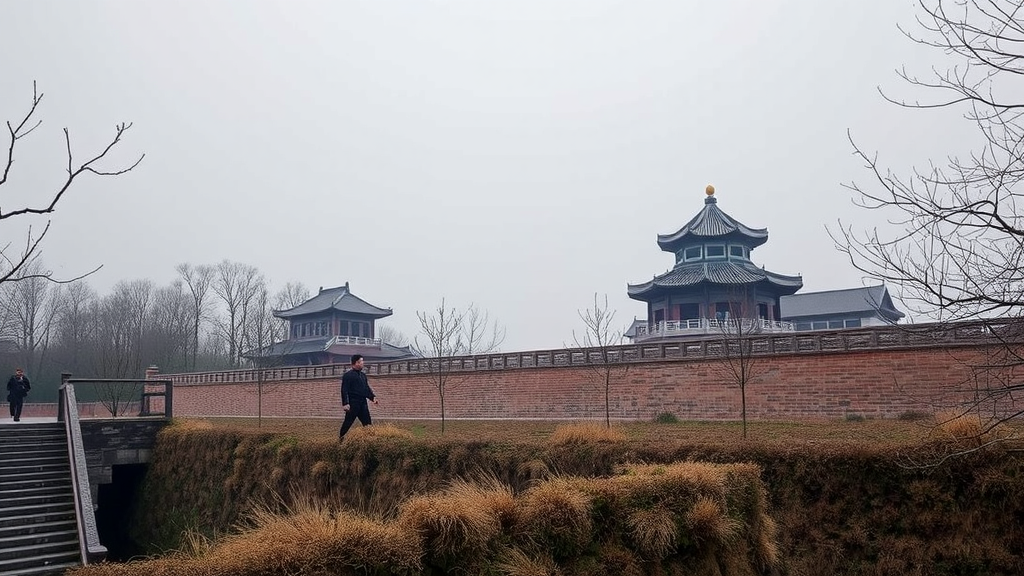
In the timber-framed dwellings that have defined the Huizhou region of Anhui Province for centuries, fire has always been the most patient of enemies. These multi-storey houses, with their closed brick exteriors, their timber columns and floors, and their characteristic internal courtyards known as skywells, evolved as a response to climate, clan life and defensive needs, but not to the demands of modern fire engineering. Now researchers examining how retrofits to these historic structures alter their vulnerability to fire have traced, in detail, the evolution of the critical mechanisms that lead to flashover, the sudden and catastrophic transition at which every combustible surface in a room ignites almost simultaneously. The findings carry consequences far beyond Huizhou, because the partition walls and skywells that protect these buildings in one fire scenario may hasten disaster in another.
Flashover is the dividing line between a fire that can be escaped and suppressed and one that consumes the building. In the fire dynamics of enclosed spaces, hot gases accumulate beneath the ceiling, radiate heat downward, and progressively heat all exposed combustible materials. When the upper layer reaches temperatures in the range of roughly 500 to 600 degrees Celsius, or when the heat flux radiated to the floor exceeds approximately 20 kilowatts per square metre, ignition of items throughout the compartment becomes essentially inevitable. In modern buildings, engineers estimate this threshold using decades of compartment-fire experiments. In ancient dwellings, where timber members are massive, ventilation is asymmetric, and ceiling geometries vary from flat smoke lobbies to tall skywell shafts, the standard correlations were never validated, and this is precisely the gap the new work set out to fill.
The study focused on the two most distinctive features of Huizhou vernacular architecture as they are modified during contemporary retrofitting: the partition walls, typically brick or timber panels that subdivide the open halls into rooms and separate storeys, and the skywell, the open vertical courtyard that draws daylight and air into the deep interior of the house. Both features are frequently altered in conservation projects, with additional partitions inserted to create usable rooms and skywells glazed or partially covered to improve thermal comfort. Each change, the researchers found, redistributes airflows and heat in ways that fundamentally reshape when and how flashover occurs.
Using computational fluid dynamics modelling of fire-driven flows, calibrated against the geometry and material properties of representative Huizhou dwellings, the team simulated fire growth in compartments with varying partition configurations and skywell conditions. The simulations tracked the temperature of the hot upper layer, the oxygen concentration, the velocities of air entering and exiting the openings, and the radiative feedback onto the timber surfaces. Across dozens of scenarios, a consistent picture emerged: the timing of flashover is governed by a competition between the rate at which the fire entrains fresh air through the skywell and the rate at which the growing smoke layer is confined by partition walls.
In the original, relatively open configurations, the skywell behaved as a natural chimney. Buoyant gases rose through the vertical shaft and vented to the atmosphere, while cooler air was drawn in at lower levels. This stack-effect ventilation slowed the growth of the upper layer and delayed the onset of flashover, in some scenarios pushing the critical moment well beyond the time available for occupants of a single room to escape. The traditional courtyard house, in this sense, embodies an intuitive, if unintentional, fire-safety design: the same opening that admits light and rain also bleeds away the heat that drives flashover.
The insertion of partition walls changed that calculus dramatically. Because the walls subdivide the interior into smaller, more tightly bounded compartments, the smoke layer within each room reaches ceiling-level confinement much sooner, and the volume of hot gas needed to reach critical temperatures shrinks accordingly. The simulations showed that fires in partitioned rooms could achieve flashover conditions in a markedly shorter time than equivalent fires in open halls, because radiative feedback is concentrated in a smaller enclosure and the combustible timber linings of the room are exposed sooner to intense heating. Yet the walls also play a protective role at the scale of the whole building: once a partitioned room flashed over, the walls acted as thermal barriers, delaying fire spread to adjacent compartments and to the timber structural frame. The trade-off is stark and counterintuitive: retrofitting partitions makes the first room burn faster but may buy the rest of the house critical minutes.
Skywell retrofitting produced the opposite asymmetry. When the courtyard was glazed or covered, the chimney effect was suppressed. Smoke and hot gases that would previously have escaped accumulated instead beneath the new covering, heated it, and spread laterally along the upper storeys of the dwelling. In several scenarios the covering itself, if combustible, became an additional fuel and radiation source. The simulations indicated that covering the skywell could transform a configuration in which flashover remained localized into one in which the entire hall complex approached critical conditions, with the upper layer spilling across partition tops and igniting timber galleries on multiple floors. For conservation authorities weighing the comfort benefits of closing skywells against fire risk, the result offers a quantitative argument for restraint, or at least for ventilated designs that preserve some smoke exhaust capacity.
The researchers distilled these observations into a description of how the critical mechanisms evolve through the fire. In the early growth phase, ventilation dominates: open skywells limit upper-layer development, while partitions do little to impede the initial plume. In the middle phase, confinement dominates: partitions accelerate compartment-level flashover by shrinking the hot-gas volume, while a covered skywell accelerates building-level hazard by trapping effluent. In the late phase, the roles reverse: partitions slow inter-compartment spread and the remaining ventilation paths determine whether the fire becomes ventilation-limited or continues to grow. Flashover, in other words, is not a single threshold but a cascade whose controlling mechanism shifts as geometry and ventilation conditions change, and any retrofit that alters geometry shifts the cascade.
For heritage fire engineering, the practical implications are immediate. The study suggests that retrofit guidelines for vernacular timber dwellings should treat partitions and skywells as a coupled ventilation-fuel system rather than as independent design elements. Inserting partitions without ensuring that each new compartment retains adequate smoke exhaust, for example through high-level vents connected to the skywell shaft, could compress escape times in a way that existing evacuation assumptions do not capture. Conversely, preserving or restoring skywell ventilation may be one of the most effective passive fire protections available in these buildings, requiring no intervention on historic fabric. The work also underscores the value of fire dynamics simulation as a conservation tool, allowing authorities to test candidate retrofits numerically before committing to changes that cannot easily be undone in protected structures.
Beyond Huizhou, the findings speak to a global problem. Vernacular timber architecture across southern China, Japan, the Himalayas and much of Europe shares the same basic ingredients: combustible frames, deep plans, internal courtyards and centuries of accumulated retrofits. Fire remains one of the leading causes of loss of built heritage worldwide, and the pace of climate-driven heatwaves and densifying historic centres is only increasing the exposure. What the Huizhou study demonstrates is that heritage fire safety cannot be imported wholesale from modern codes, because the physics of these buildings is distinctive. It must instead be derived from the buildings themselves, in which the very features that give them their identity may hold the key to their survival, provided that identity is not erased by well-intentioned but fire-illiterate renovation.
Subject of Research: Flashover critical mechanisms under partition-wall and skywell retrofitting in Huizhou ancient dwellings
Article Title: Evolution of flashover critical mechanisms under partition-wall and skywell retrofitting in Huizhou ancient dwellings
Article References: Wu, Y., Li, L., Chen, S., & Zhao, M. (2026). Evolution of flashover critical mechanisms under partition-wall and skywell retrofitting in Huizhou ancient dwellings. npj Heritage Science. https://doi.org/10.1038/s40494-026-03005-5
Image Credits: AI Generated
DOI: 10.1038/s40494-026-03005-5
Keywords: flashover, Huizhou ancient dwellings, fire safety, heritage buildings, partition walls, skywell, timber structures, retrofitting, fire dynamics simulation, cultural heritage, Evolution, critical
Cite Scienmag News
Courtney Benton. (September 22, 2026). Flashover Uncovered: How Ancient Huizhou Walls and Skywells Reshape Fire Survival. Scienmag. https://scienmag.com/flashover-uncovered-how-ancient-huizhou-walls-and-skywells-reshape-fire-survival/
Courtney Benton. "Flashover Uncovered: How Ancient Huizhou Walls and Skywells Reshape Fire Survival." Scienmag, 22 September 2026, https://scienmag.com/flashover-uncovered-how-ancient-huizhou-walls-and-skywells-reshape-fire-survival/. Accessed 5 October 2026.
Courtney Benton. "Flashover Uncovered: How Ancient Huizhou Walls and Skywells Reshape Fire Survival." Scienmag. September 22, 2026. https://scienmag.com/flashover-uncovered-how-ancient-huizhou-walls-and-skywells-reshape-fire-survival/


