


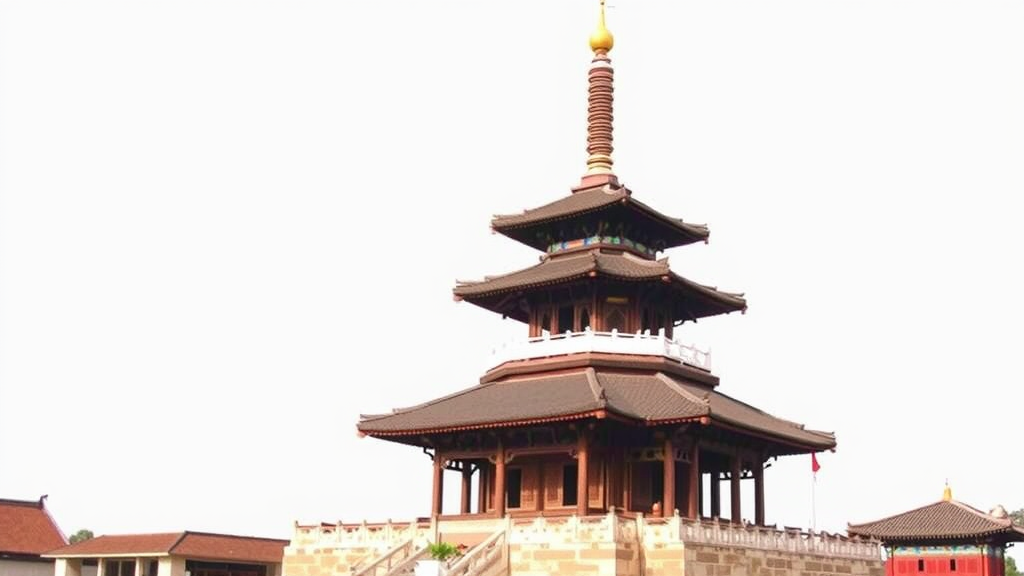
Ancient masonry pagodas, with their slender silhouettes and tiered roofs, have stood against centuries of earthquakes across East Asia, yet many of these treasured structures remain surprisingly vulnerable to the very ground motions they have historically survived. A newly published study in the journal Heritage introduces a simplified analytical method that engineers and conservators can use to predict when an earthquake will push a hollow-core polygonal masonry pagoda past the point of bending failure. The approach promises to give heritage managers a practical, fast, and physically grounded tool for assessing seismic risk in some of the world’s most irreplaceable cultural landmarks, without demanding the computational expense of detailed numerical simulation.
Hollow-core polygonal pagodas, typically built of brick or stone in polygonal cross-sections such as hexagonal or octagonal forms, represent a distinctive structural typology that developed over more than a thousand years. Unlike solid masonry towers, these pagodas contain a central vertical void that reduces weight and, in many historical designs, housed stairways or reliquary chambers. The walls behave as thin, curved shells arranged in a polygonal geometry, and this configuration gives the structures a characteristic stiffness and stress distribution under lateral loading. When an earthquake strikes, the ground shaking induces bending moments that grow with height, and the masonry, which is strong in compression but weak in tension, can crack along horizontal or stepped joints long before any visible collapse occurs.
The core innovation of the new research lies in translating this complex three-dimensional problem into a tractable analytical formulation. Instead of modeling every brick and mortar joint, the method treats the pagoda cross-section as an equivalent polygonal hollow section whose bending capacity is governed by the masonry’s limited tensile strength. The authors derive closed-form expressions for the bending moment at which cracking initiates on the tension face and for the progressive reduction in stiffness that follows as the cracked zone spreads around the polygonal perimeter. Because the equations rely only on basic section geometry, material properties, and the distribution of self-weight, they can be evaluated with a spreadsheet or a short script, making the method accessible to practitioners who lack access to specialized finite-element software.
Central to the formulation is the recognition that bending failure in these structures is intimately linked to axial load. The weight of the overlying masonry above any given level compresses the walls and partially suppresses tensile cracking, so the bending resistance of the section increases with the magnitude of the compressive force, up to a limit set by crushing. Near the top of a pagoda, where the axial load is small, the section has little capacity to resist bending, which explains why upper tiers and the slender crowns of these towers are so frequently damaged in earthquakes. The simplified method captures this height-dependent vulnerability explicitly, allowing conservators to identify the critical stories of a specific pagoda where seismic demands are most likely to exceed capacity.
The polygonal geometry introduces further subtleties that the method addresses directly. In a circular hollow section, bending stress flows smoothly around the perimeter, but in a polygonal section the abrupt changes in wall direction at each corner concentrate stresses and alter the location of the neutral axis as cracking progresses. The analytical model accounts for the discrete geometry of the polygon by integrating the contribution of each flat wall segment to the section’s moment of inertia and to the cracking moment. This means the method can distinguish, for example, between a hexagonal and an octagonal plan of similar overall size, reflecting the historical observation that section shape influences both stiffness and the pattern of earthquake damage in surviving pagodas.
To validate the approach, the researchers compared their analytical predictions against established benchmarks for masonry behavior under combined axial load and bending. The simplified formulation reproduced the expected capacity trends, including the increase in cracking moment with axial compression and the sharp loss of flexural rigidity once the tensile strength of the masonry is exceeded. Because the method is deliberately conservative in its treatment of material strength, it tends to err on the side of safety, which is a desirable property for heritage assessment where the consequences of underestimating vulnerability are effectively irreversible. The authors emphasize that the model is intended as a first-line screening tool rather than a replacement for refined analysis of individual monuments, but that its transparency makes it uniquely valuable in that screening role.
The practical implications extend well beyond academic interest. Many of the most celebrated pagodas in China, Japan, and Korea are designated cultural properties subject to strict conservation requirements, and seismic safety evaluations are routinely demanded after significant earthquakes or as part of ongoing preservation planning. Full nonlinear finite-element modeling of a historic pagoda requires detailed surveys, material testing, and considerable expert effort, resources that are often unavailable for the hundreds of lesser-known structures scattered across seismically active regions. A simplified analytical method that needs only geometry, an estimate of masonry strength, and a design-level seismic demand offers a way to triage this large inventory, directing expensive detailed studies toward the structures that the screening analysis flags as most at risk.
The method also supports retrofit decision-making. Once the critical sections and stories of a pagoda are identified analytically, engineers can explore targeted interventions, such as confining bands of compatible reinforcement, grouting of degraded mortar joints, or减轻 of upper-tier mass, and then re-evaluate the bending capacity with the same closed-form equations to gauge the benefit of each measure. This iterative, low-cost loop between assessment and design is particularly important in heritage contexts, where interventions must be minimally invasive, reversible where possible, and justified with clear evidence of need. A tool that makes the mechanics of bending failure explicit, rather than hiding them inside a black-box simulation, is well suited to the interdisciplinary dialogue between engineers, archaeologists, and conservators that effective preservation demands.
Beyond its immediate engineering use, the study contributes to a broader scientific conversation about the seismic resilience of unreinforced masonry heritage. Researchers in earthquake engineering have increasingly recognized that simplified, mechanics-based models play an essential complementary role alongside high-fidelity simulation, because they reveal the governing physical parameters, support rapid parametric study, and facilitate the interpretation of observed damage patterns after real events. For hollow-core polygonal pagodas, the new work identifies axial load level, wall thickness, polygonal geometry, and masonry tensile strength as the dominant parameters controlling bending failure, providing a compact framework that future studies of aftershock vulnerability, soil-structure interaction, or cumulative damage can build upon.
As climate-driven hazard assessments and urban expansion place growing pressure on historic building stocks, tools that combine rigor with accessibility are likely to become increasingly important to the heritage sector. The simplified analytical method for earthquake-induced bending failure of hollow-core polygonal masonry pagodas offers exactly that combination: rooted in the mechanics of masonry, calibrated against recognized behavior, and simple enough for everyday professional use. For the custodians of these centuries-old towers, the study transforms an intimidating structural problem into a set of calculable quantities, bringing modern earthquake science to bear on some of humanity’s most enduring, and most endangered, architectural achievements.
Subject of Research: Simplified analytical prediction of earthquake-induced bending failure in hollow-core polygonal masonry pagodas
Article Title: A simplified analytical method for earthquake-induced bending failure of hollow-core polygonal masonry pagodas
Article References: Lu, W., Xiang, L., Wang, Y., & Li, D. (2026). A simplified analytical method for earthquake-induced bending failure of hollow-core polygonal masonry pagodas. npj Heritage Science. https://doi.org/10.1038/s40494-026-03000-w
Image Credits: AI Generated
DOI: 10.1038/s40494-026-03000-w
Keywords: masonry pagodas, seismic vulnerability, bending failure, heritage conservation, earthquake engineering, hollow-core sections, polygonal masonry, analytical modeling, structural assessment, unreinforced masonry, retrofit planning, cultural heritage
Cite Scienmag News
Violet Maxwell. (September 22, 2026). Simplified Analytical Method Predicts Earthquake Bending Failure in Hollow-Core Masonry Pagodas. Scienmag. https://scienmag.com/simplified-analytical-method-predicts-earthquake-bending-failure-in-hollow-core-masonry-pagodas/
Violet Maxwell. "Simplified Analytical Method Predicts Earthquake Bending Failure in Hollow-Core Masonry Pagodas." Scienmag, 22 September 2026, https://scienmag.com/simplified-analytical-method-predicts-earthquake-bending-failure-in-hollow-core-masonry-pagodas/. Accessed 5 October 2026.
Violet Maxwell. "Simplified Analytical Method Predicts Earthquake Bending Failure in Hollow-Core Masonry Pagodas." Scienmag. September 22, 2026. https://scienmag.com/simplified-analytical-method-predicts-earthquake-bending-failure-in-hollow-core-masonry-pagodas/


