


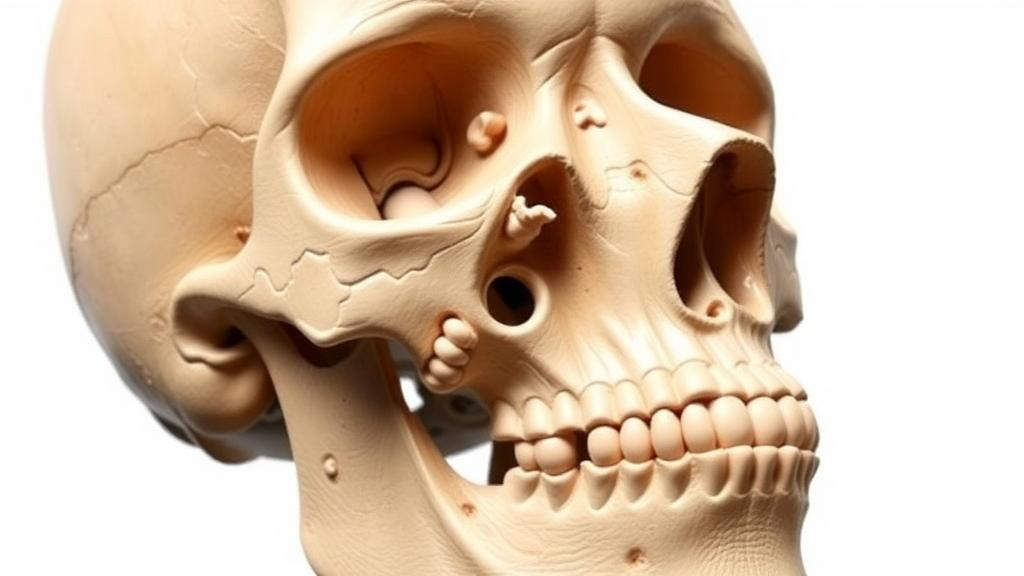
When investigators recover a human skull with no name attached, one of the most haunting questions is what that person looked like in life. Forensic facial reconstruction, the practice of sculpting a face onto skeletal remains, is often the final option when DNA, dental records, and fingerprints have all failed. Yet the nose, the single most defining feature of the central face, is also the most elusive. On a dried skull, all that remains of the nose is a partial nasal bridge, a small anterior nasal spine, and a large hollowed cavity. Everything that made the nose recognizably human, the cartilage, the soft tissue, the tip that family members would have known instantly, has long since vanished. A new study published in the International Journal of Legal Medicine by Swarnjeet Singh and Ruma Purkait of the University of Allahabad tackles this problem head-on, proposing a combined morphological and metric method for reconstructing the nose in three dimensions.
The research, conducted on computed tomography images of 409 living individuals, 226 males and 183 females, represents one of the largest datasets assembled for this purpose in a North Indian population. The choice of imaging modality matters enormously. Unlike studies based on cadavers, where soft tissue shrinks and distorts after death, CT scans capture the true relationship between the bony framework and the overlying soft tissues in living people. The authors measured seventeen metrical parameters, spanning soft tissue depths, linear distances, and angles, and then constructed regression models to predict the various dimensions of the external nose from measurements that can be taken directly on a skull.
The logic of regression-based prediction is central to the method. In forensic facial approximation, an artist or anthropologist needs to know, for example, how far the tip of the nose, the pronasale, projects forward from a given bony landmark, or how wide the nostrils will be relative to the width of the nasal aperture. Traditional guidelines, some dating back to the pioneering work of Mikhail Gerasimov in the mid-twentieth century, offered rough anatomical rules of thumb. Subsequent decades brought a wave of proposed relationships between hard and soft tissue dimensions, tested and debated in populations from Scotland to Brazil, Korea, and Japan. The persistent problem is population specificity: nasal form varies substantially across human groups, shaped in part by climatic adaptation, and a prediction equation derived from one population may mislead when applied to another.
By building their models from CT data of living North Indian adults, Singh and Purkait provide equations tailored to the population most likely to be encountered in their medico-legal context. The seventeen parameters include soft tissue depths at key landmarks, which allow the reconstruction artist to place the nasal tip, the alar margins, and the bridge with quantified confidence rather than guesswork. Regression analysis, when its assumptions are properly tested, offers a defensible statistical bridge between what the skull preserves and what the living face displayed. Each predicted dimension narrows the space of possible noses, and by extension, the space of possible identities.
But metrics alone cannot capture everything that makes a face recognizable. The study therefore went beyond measurement, cataloguing forty morphological attributes of the nose, features such as the shape of the bridge, the form of the tip, and the character of the nostrils, to identify which nasal features occur most frequently in the studied population and, crucially, which bony traits tend to accompany which soft tissue traits. This dual approach yields two distinct working methods, each suited to a different state of the recovered skull.
The first method, called the most frequent nasal features method, is designed for the worst-case scenario: a skull in which the fragile nasal bones are missing entirely. In such cases, the reconstruction relies on the population-level frequency of nasal features, essentially building a statistically typical nose consistent with the surviving anatomy of the midface. The second method, the characteristic association method, applies when the nasal bones are partially broken or intact. Here the reconstruction becomes more individualized, because specific configurations of the bony nose are associated with characteristic configurations of the soft tissue nose. A particular shape of the nasal aperture or bridge, in other words, carries information about the overlying soft form that a fully denuded skull cannot provide.
The workflow that emerges from the study is a hybrid one. The nasal framework is first constructed using the metrical parameters, establishing the quantitative skeleton of the soft nose: its projection, width, and height, anchored to the bony landmarks. The reconstruction is then refined morphologically, adjusting the shape of the tip, the alae, and the contour of the bridge to match the most probable features or the characteristic associations indicated by the bone. This layering of quantitative prediction and morphological judgment is designed to increase the likelihood that the reconstructed face resembles the antemortem face, which is the ultimate measure of success in facial approximation.
The significance of the work lies partly in its scale and partly in its pragmatism. Previous systematic reviews of nasal prediction techniques have catalogued dozens of methods, from simple proportion rules to three-dimensional statistical shape models derived from cone-beam CT. Many were tested on small samples or on populations far removed from the case at hand. Studies in Korean, Japanese, Brazilian, and Turkish populations have each produced population-specific databases of facial soft tissue thickness and nasal dimensions, underscoring that no single universal formula exists. The Indian subcontinent, with its enormous population and substantial medico-legal caseload, has been comparatively underrepresented, and the new study adds a substantial, ethically approved dataset to the global record.
The method also reflects a broader shift in forensic anthropology from two-dimensional profile estimation toward fully three-dimensional reconstruction. Early techniques predicted nose projection in profile only, leaving the artist to improvise the width and the shape of the tip. Three-dimensional imaging now allows every dimension to be modeled simultaneously, and the resulting reconstructions can be rendered digitally, compared against missing-persons photographs, and adjusted iteratively. The authors’ combination of seventeen metrical predictors with forty morphological attributes is an attempt to systematize what has long been an art guided by incomplete science, giving practitioners a repeatable protocol rather than a set of divergent personal heuristics.
For the families of missing persons, the stakes of this technical work are profoundly human. A reconstructed face displayed in the media may be the last realistic chance that someone recognizes a lost relative, and the nose sits at the center of that recognition. By quantifying the relationship between the skull and the soft tissue nose in a large living sample, and by offering clear decision rules for skulls in different states of preservation, Singh and Purkait have given forensic practitioners a more rigorous toolkit for turning anonymous remains back into a person with a face, a name, and, ultimately, an identity.
Subject of Research: Forensic facial reconstruction of the nose from skull measurements
Article Title: A proposed morphological and metric method for three-dimensional nasal reconstruction
Article References: Singh, S., & Purkait, R. (2026). A proposed morphological and metric method for three-dimensional nasal reconstruction. International Journal of Legal Medicine. https://doi.org/10.1007/s00414-026-03959-y
Image Credits: AI Generated
DOI: 10.1007/s00414-026-03959-y
Keywords: forensic anthropology, facial reconstruction, nose prediction, computed tomography, regression models, soft tissue depth, nasal aperture, morphological traits, North Indian population, International Journal of Legal Medicine, proposed, morphological
Cite Scienmag News
Ophelia Keating. (October 5, 2026). Rebuilding the Nose from Bone: New 3D Method Aims to Sharpen Forensic Facial Reconstruction. Scienmag. https://scienmag.com/rebuilding-the-nose-from-bone-new-3d-method-aims-to-sharpen-forensic-facial-reconstruction/
Ophelia Keating. "Rebuilding the Nose from Bone: New 3D Method Aims to Sharpen Forensic Facial Reconstruction." Scienmag, 5 October 2026, https://scienmag.com/rebuilding-the-nose-from-bone-new-3d-method-aims-to-sharpen-forensic-facial-reconstruction/. Accessed 5 October 2026.
Ophelia Keating. "Rebuilding the Nose from Bone: New 3D Method Aims to Sharpen Forensic Facial Reconstruction." Scienmag. October 5, 2026. https://scienmag.com/rebuilding-the-nose-from-bone-new-3d-method-aims-to-sharpen-forensic-facial-reconstruction/


