


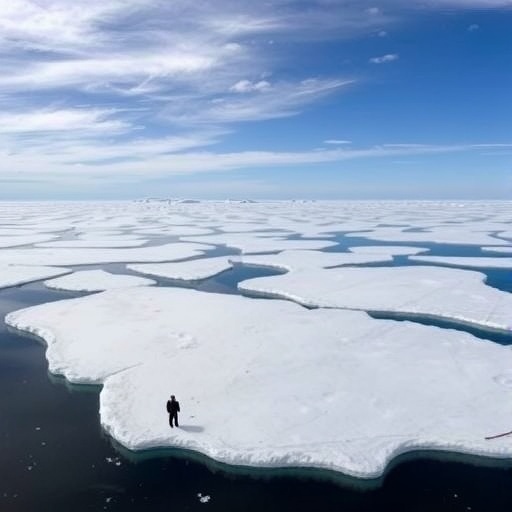
In the enigmatic and rapidly evolving ecosystems of the Southern Ocean, phytoplankton serve as foundational pillars sustaining marine food webs and influencing global biogeochemical cycles. Recent advances leveraging machine learning have illuminated profound restructuring within Antarctic phytoplankton assemblages in response to dynamic sea-ice conditions. A comprehensive study synthesizing extensive in situ pigment data with satellite observations reveals intricate shifts in phytoplankton community composition that may redefine ecosystem function under changing climate regimes.
Phytoplankton classification and quantification remain challenging due to their microscopic scale and diverse taxonomic groups. In this study, an extensive dataset comprising nearly 15,000 in situ pigment samples was employed to differentiate seven key phytoplankton groups, including diatoms, haptophytes, cryptophytes, green algae, dinoflagellates, pelagophytes, and Synechococcus. The majority of samples were concentrated during the austral summer months, aligning with periods of maximal biological productivity and satellite data availability.
The spatial coverage of the dataset was hemispheric in scope, yet exhibited regional disparities. Approximately 44% of samples were derived from the Antarctic Shelf, with a marked concentration in the Ross Sea and West Antarctic Peninsula. Conversely, the Weddell Sea was notably undersampled, highlighting persistent observational gaps in critical regions of the Southern Ocean. By filtering samples to exclude depths below the mixed layer and focusing on peak summer periods, the analysis ensured relevance to surface photic zones where phytoplankton thrive.
To decode the complex relationship between environmental drivers and phytoplankton distributions, a suite of random-forest machine learning models was developed. This nonparametric algorithm was chosen for its ability to handle nonlinear interactions and multivariate predictors, providing robust and interpretable outputs. Models were trained on the in situ pigment data paired with environmental variables sampled at a high spatial (9-km) and monthly temporal resolution.
The environmental predictors integrated into the models encompassed a carefully curated set of satellite-derived and model-simulated parameters. Sea surface temperature (SST), sea ice concentration (SIC), and sea surface salinity (SSS) were sourced from reputable space agency datasets, complemented by biogeochemical variables including nutrient concentrations (phosphate, nitrate), surface ocean iron, alkalinity, and partial pressure of CO2, derived from the ECCO-Darwin coupled biophysical simulation. This hybrid data assimilation framework offers comprehensive coverage where direct measurements are sparse or impractical.
Model training incorporated rigorous validation protocols including K-fold cross-validation stratified by research voyages to avoid data leakage. Performance metrics revealed high predictive fidelity for several dominant functional groups—particularly diatoms, haptophytes, and cryptophytes—demonstrating strong correlations (R² values) alongside low prediction errors (MAE and RMSE). However, taxa such as Synechococcus and dinoflagellates exhibited comparatively weaker model performance, attributable largely to their limited presence within the high-latitude Southern Ocean.
To interrogate model robustness, three complementary uncertainty quantification techniques were employed. A perturbation sensitivity analysis introduced controlled noise into predictor variables, revealing robust model predictions even under substantial input variability up to one standard deviation. This indicates the models’ low susceptibility to measurement errors or environmental fluctuations. Additional assessments involved training models with different random seeds to evaluate intrinsic stochasticity, and bootstrapping procedures to generate confidence intervals around trend estimates, underpinning the statistical reliability of derived biogeochemical trends.
An important consideration in remote sensing-based biogeochemical studies is the influence of sea ice on data confidence, especially regarding optical products such as photosynthetically active radiation (PAR), which were excluded due to their high uncertainty near coastal and seasonally ice-covered regions. Instead, the study relied on alternative environmental proxies that maintain consistency across varying sea-ice conditions, ensuring model applicability across spatial and temporal gradients.
Upon generating spatially and temporally continuous maps of phytoplankton group chlorophyll-a concentrations from 1997 through 2023, seasonal climatologies and anomalies were derived. Applying a seasonal trend decomposition via LOESS smoothing techniques, researchers identified significant reorganization patterns aligned with shifts in sea-ice cover and oceanographic variables. These trends were statistically validated using nonparametric methods resistant to outliers, such as the Mann–Kendall test with autocorrelation adjustments, enhancing confidence in observed ecological trajectories.
Notably, the reshaping of phytoplankton communities was linked to modifications in regional environmental drivers, including sea surface temperature warming, alterations in sea ice extent and duration, and nutrient dynamics influenced by ocean circulation shifts. Diatoms, typically prevalent in nutrient-rich, colder waters, demonstrated shifts in phenology and biomass corresponding to altered sea-ice break-up timing. Haptophytes and cryptophytes displayed complex responses influenced by both physical forcing and nutrient availability.
The integrated analysis, which leverages ensemble modeling outputs to reduce prediction uncertainties, represents a pioneering effort to characterize intra-annual and decadal phytoplankton dynamics at unprecedented resolution in the Southern Ocean. Such insights are critical, as phytoplankton community composition directly impacts higher trophic levels, carbon export efficiency, and the broader marine ecosystem resilience under climate change scenarios.
Underlying this work is the ECCO-Darwin model’s mechanistic representation of ocean biogeochemistry, assimilating vast observational datasets via an adjoint optimization technique. This approach fine-tunes physical and chemical state variables to produce internally consistent and observationally constrained fields, facilitating their use as predictors in machine learning frameworks. The combined use of physical data synthesis and biogeochemical modeling epitomizes modern Earth system science techniques to unravel complex ecological interactions.
Attention to data quality and spatial coherence was ensured via interpolation to a uniform 9-km grid, with careful masking to restrict predictions to environmental parameter ranges encountered during model training. This methodological rigor prevents spurious extrapolations, particularly across heterogeneous Antarctic ice regimes where environmental extremes prevail. Additionally, persistent multiyear ice zones were excluded from trend analyses unless supported by sufficient data longevity.
This study’s methodological innovations and comprehensive data integration set a new benchmark in Antarctic phytoplankton research. By harnessing the strengths of machine learning, satellite remote sensing, and advanced biogeochemical modeling, it illuminates how foundational marine communities are responding to and potentially mediating ongoing climate change impacts. The elucidation of phytoplankton responses holds significant implications for understanding Southern Ocean carbon cycling feedbacks and for predicting ecosystem shifts under future environmental conditions.
Such work underscores the necessity for continued and expanded oceanographic sampling campaigns, especially in underrepresented regions like the Weddell Sea, and the development of enhanced satellite observations capable of resolving biological and chemical ocean components with higher accuracy under ice-influenced conditions. Future research building upon these methods may incorporate emerging technologies such as autonomous sampling platforms and hyperspectral sensors to refine models and extend predictive capabilities.
In conclusion, the Southern Ocean’s microscopic yet mighty phytoplankton are exhibiting a notable reorganization tied closely to shifting sea-ice regimes and environmental forcing. This restructuring is not merely a biological curiosity but carries profound ramifications for global climate processes and marine food webs. As climate change accelerates, such integrative, data-driven approaches will be indispensable for anticipating and managing marine ecosystem transformations. The coupling of machine learning with sophisticated biogeochemical modeling heralds a new frontier in ocean science, promising deeper understanding and more accurate projections than ever before.
Cite Scienmag News
Sloane Callahan. (August 3, 2025). Antarctic Phytoplankton Shift with Changing Sea Ice. Scienmag. https://scienmag.com/antarctic-phytoplankton-shift-with-changing-sea-ice/
Sloane Callahan. "Antarctic Phytoplankton Shift with Changing Sea Ice." Scienmag, 3 August 2025, https://scienmag.com/antarctic-phytoplankton-shift-with-changing-sea-ice/. Accessed 3 September 2026.
Sloane Callahan. "Antarctic Phytoplankton Shift with Changing Sea Ice." Scienmag. August 3, 2025. https://scienmag.com/antarctic-phytoplankton-shift-with-changing-sea-ice/


