


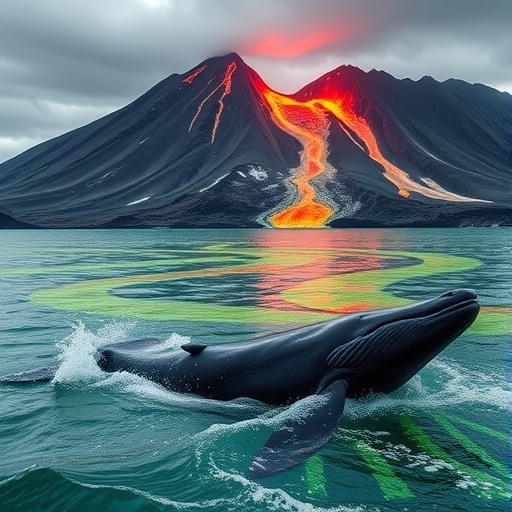
In a groundbreaking interdisciplinary study that redefines our understanding of volcanic impacts on Earth’s climate system, a team of researchers from the University of Arizona has unravelled the intricate link between Andean volcanism, marine ecosystem dynamics, and global cooling during the Late Miocene Epoch. This epoch, spanning from approximately 7 to 5.4 million years ago, witnessed dramatic geological and climatic shifts that not only shaped contemporary ecosystems but also drove pronounced atmospheric and oceanic changes.
At the epicenter of this research lies Cerro Ballena, or “Whale Hill,” nestled in Chile’s Atacama Desert. Discovered accidentally in 2010 during highway construction, this extraordinary fossil site boasts over 40 exquisitely preserved marine mammal specimens, ranging from whales to porpoises, dating back some 6 to 9 million years. The rapid and dense burial of these creatures in a confined locality puzzled paleontologists who sought to understand the environmental forces behind such a mass mortality event.
Parallel investigative efforts revealed broader global patterns: during the Late Miocene, significant volcanic activity in the Andes coincided with cooler sea surface temperatures and a notable increase in whale body sizes. Geologically, this era was marked by tectonic forces driving the uplift and formation of the Andean mountain range, which in turn initiated prodigious volcanic eruptions. The volcanic output was massive, ejecting vast quantities of nutrient-rich ash into the atmosphere and subsequently into ocean basins.
Volcanic ash is rich in bioessential nutrients such as phosphorus, iron, and silicon, all of which play vital roles in stimulating marine primary productivity. The team’s comprehensive approach, integrating climate models, geochemical measurements, and paleontological data, demonstrated that volcanic ash served as a significant fertilizer, particularly seeding the Southern Ocean with iron. This nutrient pulse catalyzed a bloom in microscopic marine algae—especially diatoms—single-celled algae known for their intricate silicate exoskeletons and global abundance.
This surge in primary productivity had cascading ecological effects. Enhanced algal growth not only increased the biological uptake of carbon dioxide—thereby facilitating its sequestration in deep ocean sediments—but also reshaped marine food webs. Larger, nutrient-enriched phytoplankton populations supported more extensive trophic structures, potentially enabling whales and other marine mammals to evolve toward larger body sizes, congruent with fossil evidence from Cerro Ballena.
Intriguingly, the nutrient enrichment came with a dark side. In regions such as Cerro Ballena, expansive algal blooms generated toxic conditions detrimental to marine megafauna, potentially culminating in the rapid deaths reflected in the fossil record. Moreover, these massive blooms likely acted as natural carbon sinks, drawing down greenhouse gases and contributing to a net cooling effect during a time when Earth’s climate was trending colder.
This study challenges the conventional paradigm that volcanic activity primarily contributes to warming via carbon dioxide emissions. Instead, it reveals that sustained large-scale volcanism, through indirect biological pathways, can exert a potent counterbalancing climatic influence. The volcanic ash-driven primary productivity and resulting carbon drawdown introduce a hitherto underappreciated mechanism by which volcanism can mediate global climate dynamics.
“Volcanism was long viewed in isolation as a greenhouse gas source,” explains Barbara Carrapa, lead author and geosciences professor. “Our research highlights the crucial role of volcanic nutrients fertilizing the ocean, fundamentally altering marine ecosystems and triggering feedbacks that helped cool the planet.” The intricate feedback loops involve enhanced phytoplankton photosynthesis drawing CO2 from the atmosphere, followed by sequestration in ocean sediments—processes that modulate long-term climate variability.
The synthesis of geological data, fossil records, and sophisticated climate simulations allowed the team to reconstruct a coherent narrative of this period’s Earth system behavior. Using computational models, they experimented with scenarios simulating intensified Andean volcanic activity, revealing pronounced boosts in ocean productivity and widespread cooling effects on a global scale. This pioneering approach illuminates how even localized geological phenomena can ripple across planetary climate and biosphere systems.
Kaustubh Thirumalai, associate professor and study co-author, emphasizes the Late Miocene as a transformative interval: “It was a crucible where biogeochemical and climatological processes converged, shaping marine and terrestrial ecosystems that underpin today’s Earth-life system. Our model experiments revealed that increased volcanic nutrient supply altered ocean biology, which in turn fed back on global climate, an interaction often overlooked in paleoclimate studies.”
The broader implications extend to modern climate change understanding. Recognizing the nuanced role of volcanism—beyond direct greenhouse emissions—helps refine predictions of natural feedbacks in Earth’s climate system. It underscores how geochemical and biological processes intertwined in nature’s grand climate regulation, offering insights into potential Earth system responses under future environmental perturbations.
Mark Clementz, a marine mammal expert and co-author, notes the relevance of integrating paleobiology with climate science: “This work intricately connects biological turnovers in marine ecosystems with volcanic and oceanographic processes. Such interdisciplinary frameworks are essential for interpreting fossil data within the context of Earth’s evolving climate and fosters a holistic understanding of Earth’s historical environmental dynamics.”
The Late Miocene narrative revealed here reflects an Earth system delicately balanced between volcanic forcing, oceanic nutrient cycling, marine ecology, and atmospheric chemistry. The Andes, often viewed simply as a tectonic giant, emerge as a critical driver of biogeochemical fluxes that regulate global climate over geological timescales. This discovery opens avenues for reexamining other volcanic regions and epochs where biological feedbacks might have influenced climate trajectories.
In conclusion, the University of Arizona-led study presents a compelling case for Andean volcanism serving as a catalyst for ocean fertilization, marine ecosystem evolution, and sustained global cooling during the Late Miocene. This paradigm-shifting perspective not only enriches our comprehension of Earth’s past climate dynamics but also informs contemporary discussions on the complex interplay between geology, biology, and climate. As Earth’s systems continue to evolve, such deep-time investigations remain vital in unraveling the multifaceted controls on planetary climate regulation.
News Publication Date: 13-Apr-2026
Web References: http://dx.doi.org/10.1038/s43247-026-03457-4
References: Published in Nature Communications Earth & Environment
Cite Scienmag News
Sloane Callahan. (April 17, 2026). Andes Volcanoes: Uncovering the Ancient Connection Between Algal Blooms, Whales, and Climate Change. Scienmag. https://scienmag.com/andes-volcanoes-uncovering-the-ancient-connection-between-algal-blooms-whales-and-climate-change/
Sloane Callahan. "Andes Volcanoes: Uncovering the Ancient Connection Between Algal Blooms, Whales, and Climate Change." Scienmag, 17 April 2026, https://scienmag.com/andes-volcanoes-uncovering-the-ancient-connection-between-algal-blooms-whales-and-climate-change/. Accessed 3 September 2026.
Sloane Callahan. "Andes Volcanoes: Uncovering the Ancient Connection Between Algal Blooms, Whales, and Climate Change." Scienmag. April 17, 2026. https://scienmag.com/andes-volcanoes-uncovering-the-ancient-connection-between-algal-blooms-whales-and-climate-change/


