


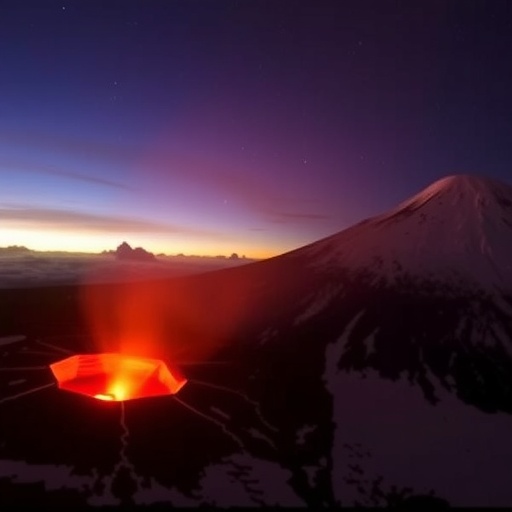
In a groundbreaking study recently published in Communications Earth & Environment, a multidisciplinary team of researchers has unveiled compelling evidence that links intensified Andean volcanism during the Late Miocene epoch with extensive ocean fertilization events, significant marine ecosystem turnovers, and a consequential phase of global cooling. This intricate web of geological and biological interplay sheds new light on Earth’s climatic and ecological transformations approximately 7 to 11 million years ago, a period pivotal for understanding the forces driving long-term climate dynamics and biotic evolution.
The Late Miocene marks a critical interval in Earth’s history characterized by notable climatic shifts and environmental changes. The study harnesses a robust geochemical and sedimentological dataset derived from marine and terrestrial archives adjacent to the Andes Mountains, enabling the researchers to reconstruct a timeline of volcanic activity and its cascading effects on marine productivity and climate. The Andes, as one of the world’s most active volcanic regions due to the ongoing subduction of the Nazca Plate beneath the South American Plate, exhibited an upswing in volcanic eruptions that had far-reaching consequences beyond the immediate vicinity of the mountain range.
Central to the findings is the concept of volcanically induced ocean fertilization—a mechanism where volcanic ash, enriched in iron and other essential micronutrients, is deposited into surface ocean waters. This influx of nutrients acts as a tracer for increased primary productivity by phytoplankton, microscopic marine plants that constitute the foundation of the oceanic food web. Enhanced phytoplankton blooms not only alter marine ecosystem structures but also play a critical role in atmospheric carbon dioxide regulation, as photosynthesis sequesters CO2 from the atmosphere and transfers organic carbon into deep ocean reservoirs upon phytoplankton death and sedimentation.
The researchers employed isotopic analyses and trace element geochemistry of marine sediments to quantify the extent of nutrient enrichment and its timing relative to increased volcanic activity. Their data reveal a clear correlation between peak Andean volcanism and episodes of heightened iron flux into the ocean, corroborating the hypothesis that the volcanogenic input acted as a catalyst for marine ecosystem changes. This enhanced productivity precipitated dramatic shifts in species composition, favoring taxa adept at exploiting the newly fertilized waters.
From a paleoceanographic perspective, the biological turnover triggered by volcanic nutrient input represents a profound ecological restructuring. Such shifts are linked to broader climatic feedback mechanisms, as changes in organic carbon burial rates modulate atmospheric greenhouse gas concentrations. The study shows that the Late Miocene cooling trend was, in part, driven by increased carbon drawdown from the atmosphere induced by these biogeochemical processes. This finding accentuates the intricate feedback loops between tectonic volcanism, ocean biogeochemistry, and global climate regulation.
Furthermore, the team employed climate modeling simulations to bridge observational data with Earth system responses. Models incorporating volcanic ash deposition and resultant ocean fertilization closely reproduced cooler sea surface temperatures observed in paleoclimate proxies. This integrative approach underscores volcanism’s dual role as both a direct source of atmospheric aerosols that reflect solar radiation and an indirect modulator of climate through enhancement of the biological carbon pump.
One of the study’s remarkable aspects is its synthesis of multidisciplinary techniques—including stratigraphic correlation, mineralogy, paleontology, and climate modeling—to unravel the cause-and-effect relationships governing ecosystem dynamics and climate during the Miocene. By dating volcanic ash layers and analyzing fossil assemblages, the researchers deciphered chronological sequences that reveal how environmental perturbations cascaded through marine ecosystems, culminating in a global biotic turnover event.
The implications of this research extend beyond paleoenvironmental reconstruction, providing analogs for understanding contemporary and future Earth system responses to intensified volcanic activity and nutrient inputs to marine environments. Given current concerns about anthropogenic climate change and ocean biogeochemical cycles, insights from such past natural experiments are invaluable for predicting oceanic carbon sequestration potential and biodiversity shifts under volatile environmental conditions.
Moreover, the study enriches our comprehension of the role of large-scale geological processes in modulating biological productivity and climate over geologic timescales. It highlights the Andes region not merely as a site of tectonic activity but as a global driver influencing Earth’s climate and marine ecosystems. This recognition opens new avenues for research into volcanic influences on ocean chemistry, particularly in subduction zone settings worldwide.
The authors call attention to the importance of integrating high-resolution geochemical analyses with paleontological data to capture the nuances of ecosystem transitions and their climatic repercussions. This strategy proved instrumental in unraveling the nuanced cause-and-effect chains linking episodic volcanic ash deposition with biotic responses and climatic cooling phases.
Additionally, the findings reveal that volcanic activity can act as both a destructive and constructive force—while eruptions pose immediate hazards, their long-term deposition of nutrients into marine systems fosters ecosystem productivity and influences global carbon cycles. Such dichotomy underscores the complexity inherent in Earth’s natural systems and their responses to episodic events.
In sum, this incisive research elucidates a profound interplay between volcanism, ocean fertilization, marine ecosystem turnover, and global climate regulation during the Late Miocene. By establishing clear mechanistic links between geological phenomena and biological-climatic feedbacks, the study provides a pivotal framework for future investigations into Earth system dynamics and their sensitivity to tectonic and volcanic forcings.
As climate change continues to dominate scientific discourse, this study offers a sobering reminder of the powerful forces governing Earth’s past climate and ecological states. It highlights the need to consider interconnected geological and biological processes when assessing future climate trajectories and marine ecosystem resilience in an era of rapid environmental change.
Ultimately, the integration of volcanology, oceanography, paleontology, and climate science exemplifies the value of interdisciplinary research in solving complex Earth system puzzles. This study stands as a testament to how unlocking Earth’s deep-time history can illuminate our understanding of present and future planetary health in an era of heightened environmental uncertainty.
Cite Scienmag News
Violet Maxwell. (April 13, 2026). Andean Volcanoes Trigger Ocean Boost, Cooling, Ecosystem Shift. Scienmag. https://scienmag.com/andean-volcanoes-trigger-ocean-boost-cooling-ecosystem-shift/
Violet Maxwell. "Andean Volcanoes Trigger Ocean Boost, Cooling, Ecosystem Shift." Scienmag, 13 April 2026, https://scienmag.com/andean-volcanoes-trigger-ocean-boost-cooling-ecosystem-shift/. Accessed 3 September 2026.
Violet Maxwell. "Andean Volcanoes Trigger Ocean Boost, Cooling, Ecosystem Shift." Scienmag. April 13, 2026. https://scienmag.com/andean-volcanoes-trigger-ocean-boost-cooling-ecosystem-shift/


