


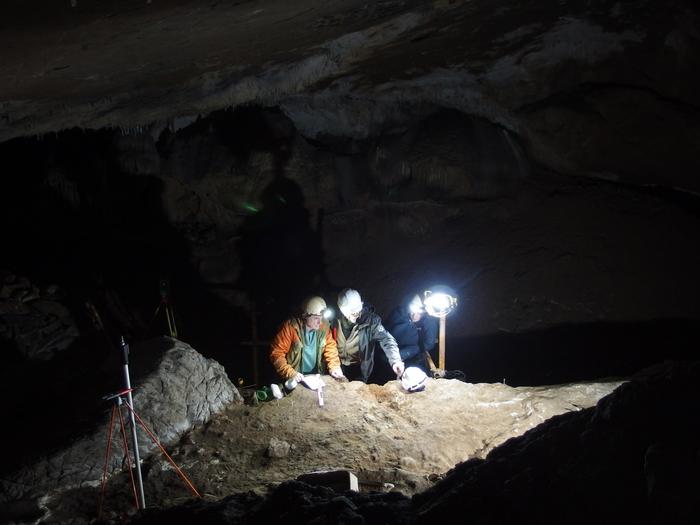
In a remarkable breakthrough that stretches the timeline of human interaction with marine life, scientists have discovered evidence of whale bone tools dating back approximately 20,000 years, unearthed from the depths of the Basque cave of Isturitz in France. This groundbreaking study, conducted by a collaborative team from the Institute of Environmental Science and Technology of the Universitat Autònoma de Barcelona (ICTA-UAB), the French National Centre for Scientific Research (CNRS), and the University of British Columbia, deepens our understanding of early human capabilities and their relationship with the marine environment.
The excavation that yielded these significant artefacts took place in 2022, marking a pivotal moment in archaeological research. The discovery of numerous whale bone objects indicates that humans were not only consuming whales for sustenance but were also adept at crafting sophisticated tools from their remains. This insight shifts the narrative surrounding early human survival strategies in coastal regions, where marine resources were crucial for sustenance and raw materials.
Whales have long been revered as giants of the sea, providing essential resources such as food, oil, and bones. Coastal communities depended heavily on these magnificent creatures, particularly during periods of scarcity. However, uncovering the historical context of these interactions has proven challenging. Coastal archaeological sites are notoriously delicate, often deteriorating due to rising sea levels, which complicates the preservation of physical evidence from these interactions.
The research led by Jean-Marc Pétillon and Krista McGrath focuses on an impressive collection of 83 bone tools retrieved from the vicinity of the Bay of Biscay, alongside an additional 90 bones discovered in the Santa Catalina Cave. In the pursuit of understanding the origins and uses of these artefacts, the team employed cutting-edge mass spectrometry and radiocarbon dating techniques. These methodologies not only helped establish the species from which the bones were derived but also provided accurate dating, revealing that the artefacts were crafted from at least five different whale species.
Among the species identified, some are still present in the Bay of Biscay today, including the sperm whale, fin whale, and blue whale. Intriguingly, the study also indicates the presence of grey whales in the region, a species whose contemporary range is mostly restricted to the North Pacific and Arctic Oceans. This evolutionary perspective enriches the narrative of marine biodiversity during the Late Paleolithic era.
Pétillon asserts that among the oldest evidence of human tool-making from whale remains are these objects, which challenge preconceived notions about the capabilities of Paleolithic societies. It suggests a highly resourceful and adaptable human population, capable of manipulating their environment and exploiting the full range of resources available to them, including marine life. Such discoveries serve as a testament to early humans’ ingenuity and cultural complexity.
In their analysis, the researchers identified differences in the feeding habits of ancient whales compared to their contemporary descendants. Chemical data extracted from the bones hint at behavioral adaptations and shifts in the marine environment over millennia. This revelation not only broadens our understanding of ancient whale ecology but also starkly highlights the dynamic interactions between species and the ecosystems they inhabit.
The implications of the study resonate far beyond the specific findings. Understanding how early humans utilized marine resources helps paint a clearer picture of human evolution, particularly in coastal regions. The maritime relationships forged by these early humans contributed significantly to their survival and cultural development, paving the way for future generations to engage with the challenges presented by changing climatic and environmental conditions.
Furthermore, the advanced techniques employed in this research, such as ZooMS (Zooarchaeology by Mass Spectrometry), underscore the importance of integrating modern scientific innovation into archaeological practices. This powerful approach allows researchers to identify marine mammal diversity even when traditional morphometric methods fall short due to incomplete or fragmentary remains. Through this lens, the study not only revitalizes archaeological inquiry into ancient human practices but actively engages with ongoing dialogue surrounding species conservation and ecological resilience.
The emerging discourse surrounding questions of biodiversity, conservation, and human impact on marine environments has never been more critical. As contemporary societies grapple with the repercussions of climate change and habitat destruction, the resilience exhibited by early human populations becomes a focal point for understanding how we might navigate our own ecological challenges.
In light of these findings, the research holds intrinsic value beyond mere historical curiosity. It serves as an urgent reminder of the deep interconnectedness of all life forms and the legacy of human interaction with the natural world. The path forward must involve learning from our ancestors, applying their lessons to develop sustainable practices that honor the ecological balance of our planet.
Ultimately, this seminal study not only enriches our understanding of Paleolithic life but draws our attention to the vital relationships that have existed for thousands of years between humans and marine life. As we continue to explore and uncover the stories embedded in our planet’s history, it becomes increasingly clear that the past holds keys to addressing the pressing issues of our time.
As humanity moves forward, the exploration of our historical connection to the natural environment becomes imperative. The implications of this research extend to the very fabric of our society, urging contemporary civilizations to reflect on our role as stewards of the Earth and the enduring legacy of our interactions with the magnificent creatures that dwell within its depths.
Keywords
Cite Scienmag News
Courtney Benton. (May 27, 2025). Ancient Whale Bone Tools Uncovered: A Groundbreaking Discovery in Archaeology. Scienmag. https://scienmag.com/ancient-whale-bone-tools-uncovered-a-groundbreaking-discovery-in-archaeology/
Courtney Benton. "Ancient Whale Bone Tools Uncovered: A Groundbreaking Discovery in Archaeology." Scienmag, 27 May 2025, https://scienmag.com/ancient-whale-bone-tools-uncovered-a-groundbreaking-discovery-in-archaeology/. Accessed 3 September 2026.
Courtney Benton. "Ancient Whale Bone Tools Uncovered: A Groundbreaking Discovery in Archaeology." Scienmag. May 27, 2025. https://scienmag.com/ancient-whale-bone-tools-uncovered-a-groundbreaking-discovery-in-archaeology/


