


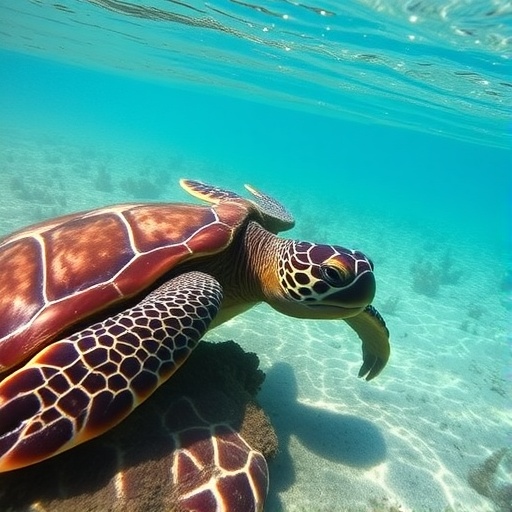
Despite the promise of rebounding green sea turtle numbers, many sea turtle populations continue to flounder under the pressures of changing climates, overfishing and urbanization.
Working with Caribbean partner organization, National Archaeological Anthropological Memory Management, Simon Fraser University researchers are shedding light on longstanding relationships between humans and sea turtles in the Southern Caribbean in hopes of informing modern-day conservation practices.
A new study, published in The Journal of Archaeological Science: Reports, is the first to complete a species-specific identification analysis of sea turtle bones at centuries-old archaeological sites across Curaçao and Bonaire.
The results reveal details of interactions between humans and turtles dating back 1,000-years and give researchers information they may need to protect populations going forward.
“When you’re trying to compare archaeological data to conservation data, if it’s really broad, the application isn’t there. What’s impacting a hawksbill sea turtle versus a green sea turtle is going to be really different,” says Christine Conlan, a PhD candidate in SFU’s Department of Archaeology and study lead.
Using zooarchaeology by mass spectrometry (ZooMS), the team obtained species identification for 37 samples from seven sites across the two islands. From these samples, 13 were identified as green sea turtles, 10 as loggerhead and two as hawksbill.
Green turtles were most heavily hunted, yet their populations today are doing well. Loggerheads, however, were the second most prevalent but are not common in the modern landscape. Hawksbills, while common across the islands, were rarely hunted. Conlan explains that the numbers alone paint a confusing picture, making the cultural contexts surrounding turtle hunting key to understanding these interactions.
“Leatherbacks and hawksbill turtles were likely minimally hunted prior to the 16th century, so it could be that their declines are resulting directly from European overhunting and the turtling industry that came around that time,” explains Conlan. “Whereas green turtles and loggerheads have been exploited by humans for a bit longer than that. Although, green turtles are recovering, so they may have developed an adaptive response.”
The decision to hunt one species over another is complex, and can come down to factors including abundance, taste, visibility, prey responses and more.
“We think people were preferentially selecting green sea turtles because they’re just so abundant,” says Conlan. “There’s also a lot of historic and ethnohistoric documentations about how green turtles taste a lot better.”
Loggerhead turtles were previously drawn to the area due to the prevalence of queen conch populations, which have since been extirpated, and are no longer common on the islands. Conlan explains that understanding this relationship could play a key role in the success of current conch restoration efforts.
“You see conch shells consistently throughout archaeological sites and over time you see them get smaller and smaller, which could indicate overexploitation,” says Conlan. “If they’re doing restoration programs, it could trigger more loggerhead turtle foraging to occur, which will have an impact on recovering conch populations.”
Understanding past human-turtle interactions allows researchers to establish population baselines and understand how they responded to historical pressures and factors that have led to present day conditions.
“Baselines can help us establish what these ecosystems looked like prior to heavy industrialization, heavy modern pollution and increased climate change, to see what these states were and to establish environmental parameters that can support species survival under modern conditions,” says Conlan.
As tourism continues to expand throughout the Southern Caribbean, knowing which species have existed on the beaches of Curacao and Bonaire for centuries can help move policies forward to protect critical nesting and feeding sites.
“We now have evidence of long-term nesting. We know that since at least CE 1040 green turtles, hawksbill turtles and loggerheads were nesting,” she says. “Because sea turtles always return to nesting sites, and we see them both in the past and present, it’s likely that they’re continuously going back.”
Paired with ancient DNA analysis to confirm familial heritage throughout these sites, this knowledge could help protect these beaches from development and construction as the islands continue to evolve.
For animals with extraordinarily long lifespans, Conlan explains that this understanding of their history and responses to pressures through deep time is incredibly important when making conservation decisions today.
“Conservationists are increasingly asking for long-term data, especially with sea turtles that can live for 70-plus years. Genetic and population changes aren’t going to show up for a long time, so you really need that long spanning lens,” says Conlan. “What we’ve done here is not just applicable to sea turtles; it’s not just applicable to Caribbean islands. This could be applied to any species anywhere where ZooMS markers exist for those species.”
This research was funded by SSHRC and National Geographic as a part of the Curaçao Cultural Landscape Project (CCLP).
Journal
Journal of Archaeological Science
Article Title
Ancient sea turtle (Chelonioidea) ZooMS identifications illuminate species-specific human interactions and long-term populations changes for Curaçao and Bonaire
Matt Kieltyka
Simon Fraser University
matt_kieltyka@sfu.ca
Journal
Journal of Archaeological Science
Article Title
Ancient sea turtle (Chelonioidea) ZooMS identifications illuminate species-specific human interactions and long-term populations changes for Curaçao and Bonaire
Tags
Cite Scienmag News
Margaret Porter. (July 29, 2026). Ancient turtle hunting could inform modern conservation throughout Southern Caribbean, SFU study. Scienmag. https://scienmag.com/ancient-turtle-hunting-could-inform-modern-conservation-throughout-southern-caribbean-sfu-study/
Margaret Porter. "Ancient turtle hunting could inform modern conservation throughout Southern Caribbean, SFU study." Scienmag, 29 July 2026, https://scienmag.com/ancient-turtle-hunting-could-inform-modern-conservation-throughout-southern-caribbean-sfu-study/. Accessed 3 September 2026.
Margaret Porter. "Ancient turtle hunting could inform modern conservation throughout Southern Caribbean, SFU study." Scienmag. July 29, 2026. https://scienmag.com/ancient-turtle-hunting-could-inform-modern-conservation-throughout-southern-caribbean-sfu-study/


