


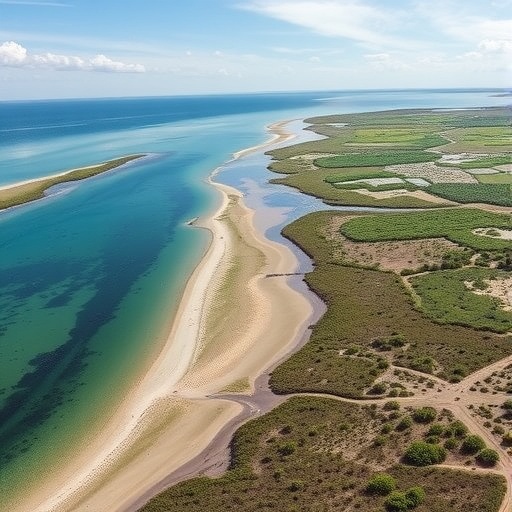
An international team of geoscientists has uncovered how an ancient coastal landscape keeps reshaping modern groundwater—long after the sea retreated. In a new study published in Nature Communications (2026), researchers led by B.J. Minsley report that a buried coastal paleo-estuary can leave behind a persistent “saline groundwater legacy” that continues to influence water chemistry and subsurface flow patterns today.
The work focuses on a large paleo-estuary—an inlet-like system formed in the past when sea level and coastal circulation conditions allowed seawater to mix with terrestrial aquifers. As the estuary became buried under younger sediments, the salt was not simply diluted or erased. Instead, it appears to have been conserved within the subsurface as distinct saline bodies, creating long-lived geochemical contrasts.
Using integrated field observations and modeling, the team mapped how salinity persists along subsurface pathways and how density-driven flow can keep salt from easily flushing out. Seawater-derived brines are known to behave like a “heavy” component in groundwater systems, potentially migrating downward and laterally while resisting replacement by fresher recharge waters.
A key finding is that the geometry and permeability of the buried sediment packages act as a gatekeeper for whether salinity disperses—or remains trapped. The researchers describe stratigraphic controls that promote mixing at some interfaces while isolating other layers, allowing brackish to saline signatures to survive for decades to centuries.
The study also highlights a dynamic chemical system. Salts alter not only salinity levels but can shift redox conditions, which influences the fate of dissolved constituents. In practical terms, legacy salinity can increase the likelihood of mobilizing other solutes, complicating groundwater management and monitoring strategies.
By treating the paleo-estuary as an active hydrogeologic archive, the researchers provide a framework for explaining “mysterious” salinity anomalies that can’t be traced to current coastline proximity alone. Instead of attributing salinity to present-day marine intrusion, the analysis points to earlier episodes that left a subsurface imprint.
This viral science-news angle matters now because coastal groundwater is under rising stress from pumping, drought, and sea-level rise. If buried estuarine salt plumes already exist, future intrusion may be amplified—or freshwater recovery may be harder than expected—because the baseline water chemistry is inherited from the past.
The authors argue that groundwater risk assessments should incorporate paleo-environmental history, not just modern hydraulic gradients. Their approach suggests that the subsurface can “remember” ancient coastlines, turning geological time into a direct factor for today’s water security.
Cite Scienmag News
Violet Maxwell. (July 27, 2026). Ancient Seawater Groundwater Still Shapes Coastal Paleo-Estuary Legacy. Scienmag. https://scienmag.com/ancient-seawater-groundwater-still-shapes-coastal-paleo-estuary-legacy/
Violet Maxwell. "Ancient Seawater Groundwater Still Shapes Coastal Paleo-Estuary Legacy." Scienmag, 27 July 2026, https://scienmag.com/ancient-seawater-groundwater-still-shapes-coastal-paleo-estuary-legacy/. Accessed 4 September 2026.
Violet Maxwell. "Ancient Seawater Groundwater Still Shapes Coastal Paleo-Estuary Legacy." Scienmag. July 27, 2026. https://scienmag.com/ancient-seawater-groundwater-still-shapes-coastal-paleo-estuary-legacy/


