


A fresh examination of landscape evolution casts new light on migration of the first humans to Sahul – the expansive single landmass including Australia, New Guinea and Tasmania that existed up to 75,000 years ago.

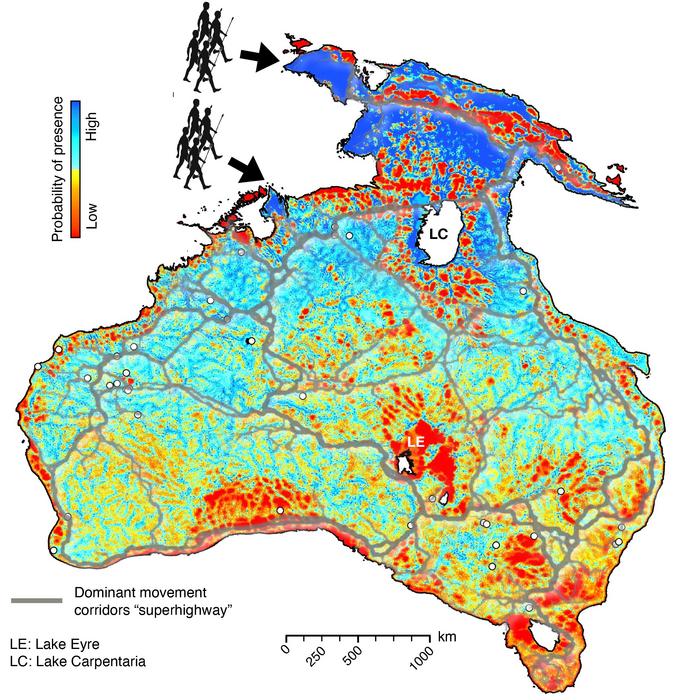
Credit: Nature Communications. Maps are produced with the open-source python interface for the Generic Mapping Tools ( based on paths generated with SimRiv software.
A fresh examination of landscape evolution casts new light on migration of the first humans to Sahul – the expansive single landmass including Australia, New Guinea and Tasmania that existed up to 75,000 years ago.
An interdisciplinary team from The University of Sydney, Southern Cross University, Flinders University and Université Grenoble-Alpes used a newly developed landscape evolution model that accounts for climatic evolution from 75,000 to 35,000 years ago, and it offers a fresh take on Pleistocene archaeology by examining the impact of a changing landscape on the dispersion of first humans in Sahul.
“The new landscape evolution model allows for a more realistic description of the terrains and environments inhabited by the first hunter-gatherer communities as they traversed Sahul,” explains research lead author Dr Tristan Salles from the University of Sydney.
“The model shows the impact of the physical environment on human mobility by combining time-evolving landscapes with foraging patterns, which accounts for a combination of short-distance steps and occasional longer moves that hunter-gatherers likely used for efficient exploration of new environments.”
To examine the peopling of Sahul, the researchers run thousands of mechanistic simulations on top of the evolving landscape. Two entry points for migration routes were considered: a northern route through West Papua (entry time: 73,000 years) and a southern entry point from the Timor Sea shelf (entry time: about 75,000 years).
From these simulations, calculations of the speeds of migration based on available archaeological sites produced a map of most likely visited regions in Australia, which suggests that people spread across the continent quite rapidly. The researchers then analysed the likelihood of archaeological sites and highlighted areas in Australia that hold archaeological potential.
“One aspect that has been mostly overlooked when evaluating this spread of first humans across Sahul is the impact of climate-driven evolution of Earth’ surface geography which took place during the time of migration,” says co-author Associate Professor Ian Moffat, an archaeological scientist from Flinders University.
The model didn’t identify well-defined migration routes, but instead showed a “radiating wave” of migrations across Sahul following riverine corridors and coastlines. However, it did indicate a high likelihood of human presence near several already-proposed pathways of Indigenous movement (called super-highways), including those to the east of Lake Carpentaria, along the southern corridors south of Lake Eyre, and traversing the Australian interior.
The researchers are hopeful the new model can now potentially pinpoint areas of archaeological significance and provide an indication of how much specific sites may have eroded or received extra sediment.
They also believe the model could be applied to other locations that could improve our understanding of humanity’s extraordinary journey out of Africa.
• The two accompanying diagrams show computer model images of entry points for migration routes through Sahul: a northern route through West Papua (entry time: 73,000 years) and a southern entry point from the Timor Sea shelf (entry time: about 75,000 years).
Journal
Nature Communications
Method of Research
Computational simulation/modeling
Subject of Research
People
Article Title
Physiography, foraging mobility, and the first peopling of Sahul
Article Publication Date
23-Apr-2024
Cite Scienmag News
Pamela Estes. (April 29, 2024). Ancient landscapes point to Australia’s initial human migration paths. Scienmag. https://scienmag.com/ancient-landscapes-point-to-australias-initial-human-migration-paths/
Pamela Estes. "Ancient landscapes point to Australia’s initial human migration paths." Scienmag, 29 April 2024, https://scienmag.com/ancient-landscapes-point-to-australias-initial-human-migration-paths/. Accessed 3 September 2026.
Pamela Estes. "Ancient landscapes point to Australia’s initial human migration paths." Scienmag. April 29, 2024. https://scienmag.com/ancient-landscapes-point-to-australias-initial-human-migration-paths/

