


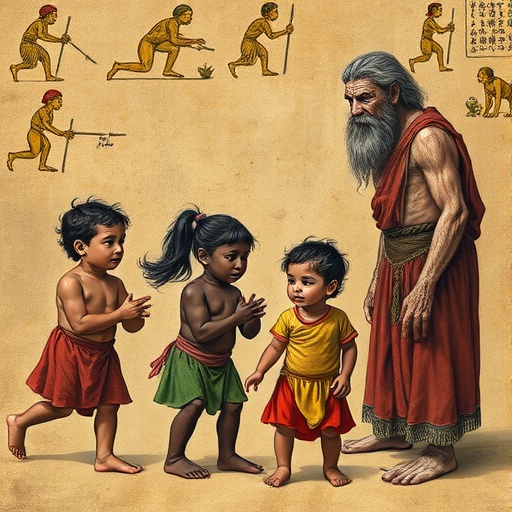
Archaic humans may have faced the same early-life challenge as modern parents: raising infants who were physically helpless at birth, according to new research from the University of Tokyo. The study focuses on a condition known today as deformational plagiocephaly, or “flat head syndrome,” where repeated pressure and limited head control can subtly reshape an infant’s skull.
In humans, babies are born with weak neck muscles and soft, rapidly changing cranial bones, leaving them less able to control their head position than other great apes. The researchers argue that this vulnerability is not unique to modern societies, but may extend deep into human evolution—affecting how our ancestors gave birth and how families cared for newborns.
To test when helpless infancy began, the team introduced a comparative cranial approach usable even when infant fossils are scarce. Their method tracks shape changes in the cranium that appear around birth and persist into adulthood, filtering out patterns inconsistent with disease or post-burial deformation.
They analyzed head shapes from 123 scanned, healthy modern infants aged from one day to 17 months, supplemented by measurements from historical Japanese skulls, extensive great ape samples, and fossil material attributed to Homo erectus and Homo floresiensis. By evaluating how far each specimen deviates from a baseline, the researchers quantified the degree and variability of cranial distortion.
The results show that great apes cluster within a narrower range of deformation, consistent with newborns that are more physically independent. Human samples—both modern and fossil—show a far wider spread of deformation, implying greater variability in early immobility and repeated positional pressure.
Notably, Homo erectus and Homo floresiensis fossils also fit this “human-like helpless” pattern. Since Homo erectus is represented mainly by stone tools rather than infant remains, the finding offers behavioral insight that goes beyond the archaeological record.
The study also addresses Homo floresiensis, whose small brains resemble those of chimpanzees. Despite the smaller brain size, their cranial deformation suggests a comparable difficulty during infancy, challenging a simple “large brain–late development” explanation for helplessness alone.
Finally, the authors propose that childcare and support for mothers may be integral to human history, likely dating back to the common ancestor shared by Homo erectus and Homo floresiensis more than one million years ago. In this view, helpless infancy may have helped shape cooperative social behaviors long before modern Homo sapiens emerged.
Cite Scienmag News
Harold Sullivan. (July 29, 2026). Ancient Human Parents Faced Challenges Raising Children, New Evidence Shows. Scienmag. https://scienmag.com/ancient-human-parents-faced-challenges-raising-children-new-evidence-shows/
Harold Sullivan. "Ancient Human Parents Faced Challenges Raising Children, New Evidence Shows." Scienmag, 29 July 2026, https://scienmag.com/ancient-human-parents-faced-challenges-raising-children-new-evidence-shows/. Accessed 3 September 2026.
Harold Sullivan. "Ancient Human Parents Faced Challenges Raising Children, New Evidence Shows." Scienmag. July 29, 2026. https://scienmag.com/ancient-human-parents-faced-challenges-raising-children-new-evidence-shows/


