


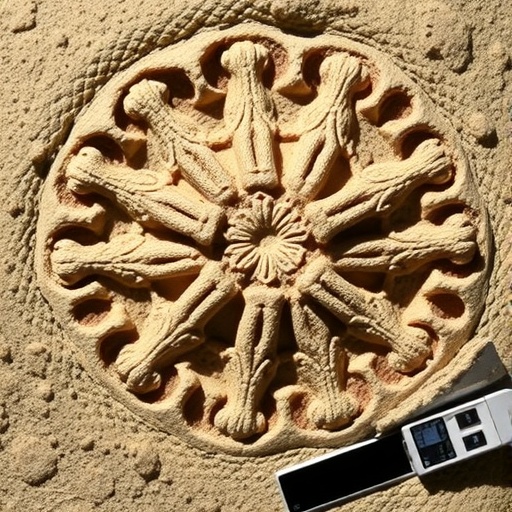
A groundbreaking discovery has reshaped our understanding of one of the most enigmatic groups in the animal kingdom: bryozoans. These tiny, colonial filter-feeders, omnipresent in today’s oceans, have long baffled paleontologists due to their conspicuous absence from the Cambrian fossil record. While the Cambrian explosion, occurring around 530 million years ago, heralded the rapid emergence of nearly all major animal phyla, bryozoans appeared to be absent until the Ordovician period, roughly 50 million years later. This puzzling gap, often dubbed the “elephant in the room” of Cambrian paleontology, may now be firmly closed thanks to the discovery of exquisitely preserved fossils from Southern China, dating back around 520 million years.
A multinational team of scientists from China, Sweden, Australia, and Germany recently unveiled a trove of fossils from the Xiannüdong Formation in southern Shaanxi Province. These fossils include detailed specimens of the previously known species Protomelission gatehousei and an entirely new genus and species, Dayingomelission hexaclitia. Both taxa thrived during the early Cambrian and provide compelling evidence that bryozoans were not only present but already exhibiting complex colony architectures at this early stage in animal evolution.
What sets these fossils apart is not solely their antiquity but the extraordinary quality of their preservation. The tiny colonies, each only a few millimeters in size, retain exquisite three-dimensional structures with internal soft tissues authentically mineralized in phosphate. This mineralization has allowed researchers to peer inside the original skeletal housing, revealing membranous sacs, minute muscle fibers, and distinctive skeletal features including diagnostic styles—unique structural spines characteristic of bryozoan anatomy. Such soft tissue detail is rarely captured in fossils this ancient, making these specimens an invaluable window into Cambrian marine ecosystems.
These findings decisively settle a long-standing debate over the affinities of these fossils. Some previous interpretations suggested Protomelission gatehousei could be a green alga or a collection of isolated, unrelated skeletal elements. However, the combination of hexagonal modular colony architecture and intricate internal anatomy makes the bryozoan affinity unequivocal. This marks an unprecedented confirmation that true bryozoans were indeed present during the Cambrian explosion, closing a perplexing gap in the fossil record.
Advanced imaging technologies played a crucial role in this breakthrough. Using state-of-the-art microscopic and tomographic techniques, researchers could visualize internal soft tissues and skeletal arrangements without damaging the specimens. This high-fidelity reconstruction allowed for a comprehensive phylogenetic analysis, clearly situating both Protomelission and Dayingomelission within Stenolaemata, one of the principal bryozoan classes still extant today. Such deep roots suggest that the bryozoan lineage originated even earlier than previously suspected—perhaps extending into the Ediacaran period, preceding the Cambrian radiation altogether.
These revelations carry profound implications for reconstructing early animal evolution. Bryozoans exhibit a highly modular colonial lifestyle in which genetically identical zooids cooperate within a shared skeleton—a key evolutionary innovation. The presence of fully developed modular colonies during the Cambrian implies that this mode of life was not a late development but a pivotal player in the Cambrian explosion itself. Consequently, the rise of complex multicellularity and functional integration within animal colonies must be reconsidered within this early evolutionary framework.
Additionally, the environmental context of these fossils offers insights into their preservation and ancient ecological niches. The bryozoans inhabited shallow, clear marine waters associated with reef settings—an environment contrasting with the deeper-water deposits typically yielding soft-tissue fossilization during the Cambrian. Such ecosystems may have fostered the radiation and diversification of early bryozoans, although their fossil record remained elusive until now due to specific taphonomic biases.
The significance of the discovery extends further: it suggests a more cosmopolitan distribution of early bryozoans in Cambrian seas. Combined with prior finds from ancient South Australian deposits, these Chinese fossils indicate that bryozoans were widespread and ecologically versatile much earlier than assumed. This cosmopolitanism hints at complex biogeographic patterns and diversification dynamics underpinning early marine ecosystems during one of Earth’s most transformative intervals.
Debunking alternative hypotheses about these Cambrian fossils not only clarifies bryozoan origins but also enhances our understanding of early marine biodiversity. A clearer timeline now places bryozoans as contemporaries of other foundational animal groups, reshaping models of early metazoan community structure. It emphasizes that the Cambrian explosion was as much about the emergence of novel ecological partnerships and colony-level complexity as it was about the appearance of individual taxa.
The ability to detect and interpret soft tissue mineralization in fossils surpasses traditional paleontological methods, underscoring technological advances that continue to revolutionize our window into deep time. These detailed anatomical insights would have been unthinkable decades ago, and they open fresh avenues for understanding evolutionary developmental biology and the genetic underpinnings of early animal form and function.
Moreover, the research highlights the synergy of international collaboration in paleontology. Combining expertise from institutions like Northwest University, the Swedish Museum of Natural History, and universities in Australia and Germany, alongside advanced imaging labs, coalesced into a breakthrough that will likely influence studies of other enigmatic Cambrian groups where fossil evidence remains scant or ambiguous.
In summation, these high-fidelity bryozoan fossils from the early Cambrian Xiannüdong Formation dramatically alter the evolutionary narrative of one of today’s most successful aquatic invertebrate phyla. By authenticating that bryozoans were indeed participants in the Cambrian explosion, this research closes a half-century-old mystery, revealing a much earlier and more complex history for these tiny, yet evolutionarily influential marine architects.
Cite Scienmag News
Drew Townsend. (June 3, 2026). Ancient Fossils Reveal Bryozoans Existed at the Dawn of Animal Life, Solving a 500-Million-Year Mystery. Scienmag. https://scienmag.com/ancient-fossils-reveal-bryozoans-existed-at-the-dawn-of-animal-life-solving-a-500-million-year-mystery/
Drew Townsend. "Ancient Fossils Reveal Bryozoans Existed at the Dawn of Animal Life, Solving a 500-Million-Year Mystery." Scienmag, 3 June 2026, https://scienmag.com/ancient-fossils-reveal-bryozoans-existed-at-the-dawn-of-animal-life-solving-a-500-million-year-mystery/. Accessed 3 September 2026.
Drew Townsend. "Ancient Fossils Reveal Bryozoans Existed at the Dawn of Animal Life, Solving a 500-Million-Year Mystery." Scienmag. June 3, 2026. https://scienmag.com/ancient-fossils-reveal-bryozoans-existed-at-the-dawn-of-animal-life-solving-a-500-million-year-mystery/


