


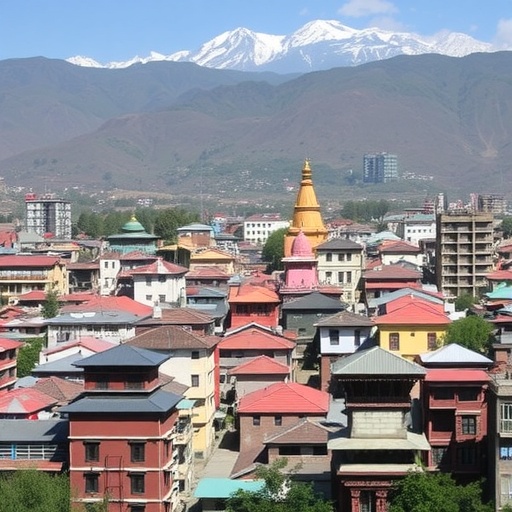
Urban growth represents a crucial aspect of modern societal evolution, as cities continue to expand in both population and physical footprint. The case of Kathmandu, located within the fragile geographies of the middle Himalayas, presents a unique subject for investigation into the patterns and implications of urban sprawl in a sensitive ecological area. Recent research by Tiwari and Kumar offers an in-depth examination of these dynamics, assessing not only the patterns of growth but also the inherent challenges posed by such rapid urbanization in an environmentally sensitive region.
Kathmandu, the capital of Nepal, has experienced significant demographic shifts and urban transformation in recent decades. As a focal point of political, economic, and cultural activities, the city has drawn individuals seeking opportunities, leading to increased migration from rural areas. This inflow has compounded the urban challenge, fostering rapid growth that strains infrastructure, resources, and local ecosystems. The research highlights that understanding the patterns of urban growth in such areas is vital for sustainable development and resource management.
The fragile geographies of the middle Himalayas involve towering mountains, steep valleys, and a climate vulnerable to both natural disasters and human-induced changes. In this delicate context, urban expansion poses risks not only to the built environment but also to the ecological balance. Tiwari and Kumar meticulously analyze how urbanization has been influenced by the geography of the region, showcasing that terrain and climatic factors significantly impact urban planning and development strategies in Kathmandu.
Urban sprawl in Kathmandu can be characterized by a blend of informal settlements and planned developments. The unique topography of the city, marked by valleys surrounded by hills, contributes to a distinctive growth pattern that is less linear than in many other urban areas. Consequently, the research underscores the necessity for implementing region-specific urban planning strategies that acknowledge environmental constraints while still facilitating growth.
Moreover, the sociocultural dimensions of urban growth are equally significant. As neighborhoods emerge rapidly, often in an unregulated manner, the sense of community and local identity can become compromised. The authors delve into how rapid urbanization has affected social cohesion and cultural heritage in Kathmandu, emphasizing the need to incorporate cultural considerations into urban planning efforts. Strategies that foster community engagement while addressing the demands of a growing population present both a challenge and an opportunity for local governance.
Tiwari and Kumar also focus on the environmental repercussions of urbanization in Kathmandu. The prospect of increased pollution, habitat destruction, and resource depletion is alarming. With the Himalayas being an ecological hotspot, the study exemplifies how urban growth must be managed to prevent significant environmental degradation. Sustainable practices must be integrated into urban planning initiatives to preserve natural environments surrounding urban localities.
In the face of these challenges, Tiwari and Kumar advocate for the implementation of advanced technologies and data-driven strategies to inform urban planning in Kathmandu. Geographic Information Systems (GIS) and remote sensing tools can provide critical insights into growth patterns and facilitate informed decision-making. Such innovations can aid local authorities in designing infrastructure and services that resonate with the diverse needs of an urban populace while minimizing ecological impacts.
The role of governmental policy in managing urban growth cannot be understated. The research calls for stronger regulatory frameworks to guide urban development in Kathmandu, emphasizing the need for policies that encourage sustainable practices and responsible urbanization. Furthermore, collaboration between local communities, government entities, and academic institutions is essential to devise initiatives that promote sustainable growth while safeguarding the environment.
Particularly noteworthy is the discussion around resilience in urban planning. As climate change poses increasing threats to Himalayan ecosystems, the authors suggest that the integration of resilience thinking into urban development plans is imperative. Strategies that prioritize adaptability and risk mitigation can bolster the city’s ability to withstand environmental shocks, ensuring that both the urban fabric and natural surroundings are preserved for future generations.
In conclusion, the findings presented by Tiwari and Kumar elucidate the complexities surrounding the urban growth patterns in Kathmandu. The intersection of environmental, social, and technological factors paints a nuanced picture of the city’s development trajectory. Their research serves as a clarion call for stakeholders to prioritize sustainable urban strategies before the implications of unchecked growth outweigh the benefits of development. As Kathmandu navigates its path forward, the insights offered in this study will be instrumental in shaping a sustainable urban future.
In acknowledging the fragility of its geographical setting, the city stands at a crossroads. The choices made today regarding urban growth patterns will have long-lasting impacts on its landscape, livability, and ecological integrity. The sustained collaboration of various sectors, emphasized within the research, could pave the way for innovative solutions that not only address immediate urban challenges but also align with broader sustainability goals in one of the most beautiful yet vulnerable regions on the planet.
Tiwari, D., Kumar, A. Evaluating urban growth patterns of Kathmandu in fragile geographies of the middle Himalayas.
Discov Cities 2, 83 (2025). https://doi.org/10.1007/s44327-025-00103-0
Cite Scienmag News
Courtney Benton. (November 15, 2025). Analyzing Kathmandu’s Urban Growth in Fragile Himalayas. Scienmag. https://scienmag.com/analyzing-kathmandus-urban-growth-in-fragile-himalayas/
Courtney Benton. "Analyzing Kathmandu’s Urban Growth in Fragile Himalayas." Scienmag, 15 November 2025, https://scienmag.com/analyzing-kathmandus-urban-growth-in-fragile-himalayas/. Accessed 3 September 2026.
Courtney Benton. "Analyzing Kathmandu’s Urban Growth in Fragile Himalayas." Scienmag. November 15, 2025. https://scienmag.com/analyzing-kathmandus-urban-growth-in-fragile-himalayas/


