


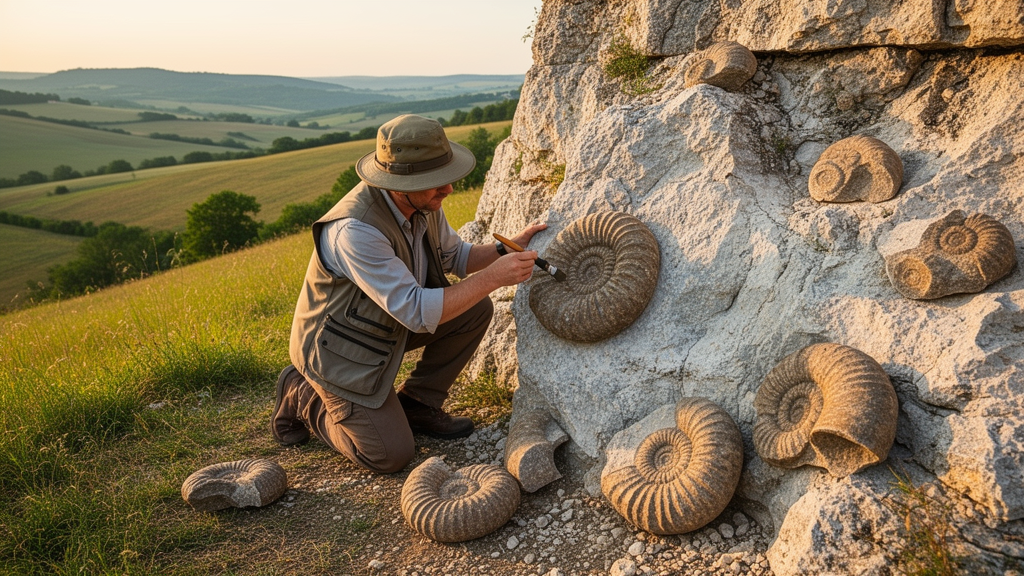
High on the cliffs of the Vercors massif in southeast France, a team of palaeontologists has spent six years hunting for the coiled, ribbed shells of ammonites — extinct squid-like cephalopods that once swarmed the shallow seas of the Cretaceous. Their quarry was not just fossils, but answers. The Urgonian limestones of the Vercors, a towering white cliff-forming unit famous among geologists since the nineteenth century, have resisted precise dating for more than 160 years because their shallow-water deposits almost never preserve cephalopods. Now, in a study published in the Swiss Journal of Palaeontology, researchers report that more than 100 ammonite specimens collected along a nearly 30-kilometre platform-to-slope transect have finally pinned down the ages of the platform’s key layers — and rewritten a century-old stratigraphic dispute in the process.
The Urgonian platform is one of the most spectacular carbonate systems of the Lower Cretaceous western Tethys. In the northern French subalpine chains it forms a prominent cliff of pure, rudist-bearing limestone at the summit of the Neocomian series, evolving southward into the clayey, ammonite-rich alternations of the Vocontian Trough, a deep basin that lay between the platform and the open ocean. Because the platform limestones teem with benthic fossils but almost never yield ammonites, geologists have long disagreed about their age. The new study focused on the southern edge of the Vercors, between the Grand Veymont and Plan-de-Baix, where the transition from shallow platform carbonates to slope deposits takes place — a zone where marly intercalations thin northward into the pure platformal sequences and where, crucially, ammonites can be found.
Between 2019 and 2025, the team logged twenty-two sections along two parallel transects running from northeast to southwest, from the Pas de Berrièves and Col de la Chau down to Plan-de-Baix. The sections capture a complete facies gradient: inner platform deposits of calcarenites and coral- and rudist-bearing limestones in the northeast, well-sorted sub-Urgonian packstones near the platform edge, storm-influenced calcarenites with hummocky cross-stratification, and finally grey hemipelagic slope limestones and dark marlstones dominated by pelagic fauna in the southwest. The researchers designated the limestone units U3 to U6, separated by marlstone intervals whose significance in terms of relative sea-level change will be treated in a companion paper on depositional sequences.
The search for ammonites was the central component of the work, and it paid off in unexpected ways. Initial lithostratigraphic correlations between the most prominent marlstone intervals turned out to be erroneous when tested against ammonite assemblages from closely spaced sections — discrepancies the authors attribute to synsedimentary fault activity, which shifted sediment depocentres laterally over time. Ammonites proved to be concentrated in condensed intervals: firmgrounds, hardgrounds, and glauconitic layers at transitions between massive limestones and marlstones, and interbedded marly layers within the platform interior. Massive sub-Urgonian limestones, thick marlstone packages, and fine claystones were far less conducive to preservation. Specimens smaller than 10 centimetres were whitened with ammonium chloride and photographed with high dynamic range imaging, while most larger specimens were scanned in 3D with an Artec Space Spider scanner combining lidar and photogrammetry.
The biostratigraphic payoff is substantial. All standard ammonite biozones and most subzones of the upper Barremian have been confidently identified along the transects, anchored to the most recent zonation for the Tethys realm established by the IUGS Lower Cretaceous Kilian Group. The Vercors and the Barremian stratotype at Angles, in the Alpes-de-Haute-Provence, share 26 genera and roughly 40 species, allowing the recognition of every upper Barremian biozone and the base of the Aptian Stage. Among the index taxa documented are Camereiceras limentinus and its supposed dimorphic partner Janusites janus, characterising the Gerhardtia sartousiana Subzone; Hemihoplites intermedius and the feraudianus–soulieri group, marking the uppermost provincialis and feraudianus subzones; and large heteromorphic Heteroceras and primitive Martelites specimens, dating the Pas de la Couronne marlstone to the Heteroceras emerici Subzone and the base of the Martelites sarasini Subzone.
A central achievement concerns Paquier’s so-called Heteroceras marlstone, a term introduced in 1900 for a laterally continuous, ammonite-bearing marly layer of late Barremian age that was thought to extend from the Vocontian facies of the Diois into the Vercors platform. The new analysis shows that this single term conflates two distinct marly intercalations of different ages. The researchers distinguish two major marlstone complexes: the Ambel–Font Froide–La Béguère complex, which spans the sartousiana and provincialis subzones, and the Pas de la Couronne–La Révolte–Lower Orbitolina Beds complex, which covers the upper Imerites giraudi Zone and the lower sarasini Subzone. Based on the ammonite evidence, only the second complex can be confidently correlated with the Heteroceras marlstone — a verdict that resolves a dispute between Paquier’s followers and his detractors, including Goguel’s 1944 criticisms and the competing models of Arnaud and Arnaud-Vanneau versus Clavel and colleagues, which had remained unresolved for decades.
The marlstone intervals themselves tell a dramatic environmental story. Together with the Upper Orbitolina Beds of late early Aptian age, the complexes record three successive marine ingressions across the peri-Vocontian platforms, each marked by glauconite- and phosphate-rich deposits along platform slopes and by mass proliferations of the large foraminifer Palorbitolina lenticularis. The final ingression, coinciding with the early Aptian Oceanic Anoxic Event 1a, marked the ultimate demise of the Urgonian platform near the Barremian–Aptian boundary, after a prolonged period of subaerial exposure that had already weakened the carbonate system. The authors link these events to the mid-Barremian, Sartousiana, Taxy, and Selli episodes — large-scale perturbations of the ocean–climate system recognised across the western Tethys.
The ammonites also recalibrated the platform’s architecture. Unit U4, a thick wedge of coarse calcarenites capped by Agriopleura-bearing rudist limestones, is interpreted as a lowstand systems tract deposited during the Toxancyloceras vandenheckii Zone, a time of forced regression recorded across the Vocontian Basin. The condensed Hemihoplites-bearing glauconitic bed within unit U5 covers at least the uppermost provincialis and feraudianus subzones, and possibly the base of the giraudi Subzone — a comparable condensed level is known from the Provence platform and the Castellon Arc. The Chironne calcarenites, previously correlated with the Lower Orbitolina Beds, are reinterpreted as a marginal prism formed during a prolonged phase of platform emersion in the latest Barremian, while the black flint-bearing limestones of Plan-de-Baix and the Ambel plateau, long considered distal equivalents of the upper Urgonian limestones, are shown to be transgressive deposits of earliest Aptian age, resting on the La Blache calcarenite via an ammonite-rich firmground bearing Deshayesites, Costidiscus, and ancyloceratids.
The study does not shy away from its predecessors’ shortcomings. The authors argue that the scarcity of reliable biostratigraphic markers led Arnaud and Arnaud-Vanneau to subdivide the succession into seven marlstone intervals, and that their influential sequential and sedimentary model was built from a purely hypothetical synthetic sequence — essentially a patchwork of data from various sections combined with faunal assemblages whose stratigraphic positions had been extrapolated. Some of the original ammonite collections, including most specimens from the former Institut Dolomieu, are now missing and untraceable, and a request to sample the Pas de Berrièves marlstone within the Réserve naturelle nationale des Hauts-Plateaux du Vercors was rejected, leaving the age of that unit tentatively placed around the lower–upper Barremian boundary based on dinoflagellate cyst data.
The implications reach far beyond the Vercors. Because platform faunal and floral assemblages are strongly facies-dependent, the authors call for more comprehensive biostratigraphic frameworks integrating a wider range of organisms adapted to shallow-water environments. The revised framework clarifies long-standing stratigraphic ambiguities, strengthens regional correlations across all peri-Vocontian platforms, and provides new insight into the timing and mechanisms of Lower Cretaceous carbonate platform evolution in the western Tethys — a reminder that even a cliff of seemingly featureless white limestone, read shell by shell, can yield a precise and surprising history of drowning, exposure, and renewal.
Subject of Research: Palaeontology
Article Title: Ammonite biostratigraphy on the platform–slope transition between the Vercors Urgonian platform and the Vocontian Trough (S–E France)
Article References: Pictet, A., Ferry, S., & Pietra, L. (2026). Ammonite biostratigraphy on the platform–slope transition between the Vercors Urgonian platform and the Vocontian Trough (S–E France). Swiss Journal of Palaeontology, 145, 17-76. https://doi.org/10.3897/sjp.145.175636
Image Credits: AI Generated
Keywords: ammonites, Urgonian platform, Barremian, Cretaceous, biostratigraphy, Vercors, Vocontian Trough, carbonate platform, France, palaeontology, Ammonite, platform
Cite Scienmag News
Violet Maxwell. (October 18, 2026). Ammonites Rewrite the Story of a Lost Cretaceous Sea in Southeast France. Scienmag. https://scienmag.com/ammonites-rewrite-the-story-of-a-lost-cretaceous-sea-in-southeast-france/
Violet Maxwell. "Ammonites Rewrite the Story of a Lost Cretaceous Sea in Southeast France." Scienmag, 18 October 2026, https://scienmag.com/ammonites-rewrite-the-story-of-a-lost-cretaceous-sea-in-southeast-france/. Accessed 18 October 2026.
Violet Maxwell. "Ammonites Rewrite the Story of a Lost Cretaceous Sea in Southeast France." Scienmag. October 18, 2026. https://scienmag.com/ammonites-rewrite-the-story-of-a-lost-cretaceous-sea-in-southeast-france/


