


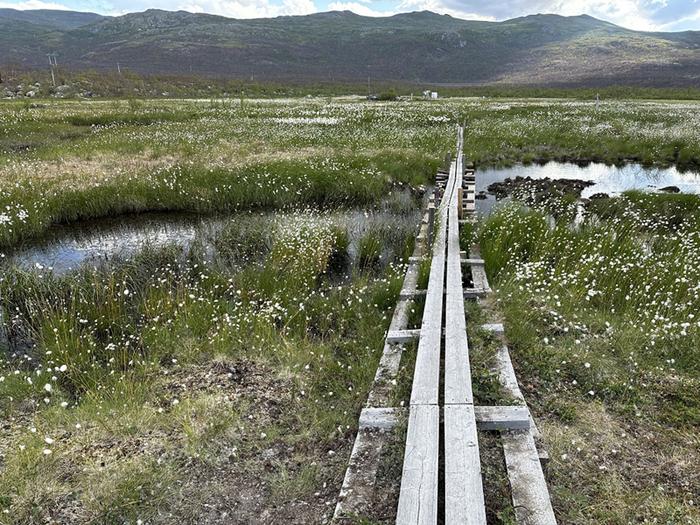
Polyphenols are a diverse group of organic compounds produced by plants. These compounds are often toxic to microorganisms. In peatlands, scientists thought that microorganisms avoided this toxicity by degrading polyphenols using an enzyme that requires oxygen. However, when there is little or no oxygen, like after flooding due to climate induced thawing, the enzyme is inactive, and polyphenols accumulate. This inhibits microbes’ carbon cycling. In this study, scientists mined data for thousands of microbial genomes recovered from Stordalen Mire, an Arctic peatland in Sweden. They discovered that these microorganisms used alternative polyphenol-active enzymes, with and without oxygen. The study underscores the significance of polyphenols in peatland carbon dynamics. It also suggests that the carbon stored in these ecosystems is at greater risk to be released into the atmosphere by climate change than previously thought.

Credit: Image courtesy of Benjamin Bolduc, The Ohio State University.
The Science
Polyphenols are a diverse group of organic compounds produced by plants. These compounds are often toxic to microorganisms. In peatlands, scientists thought that microorganisms avoided this toxicity by degrading polyphenols using an enzyme that requires oxygen. However, when there is little or no oxygen, like after flooding due to climate induced thawing, the enzyme is inactive, and polyphenols accumulate. This inhibits microbes’ carbon cycling. In this study, scientists mined data for thousands of microbial genomes recovered from Stordalen Mire, an Arctic peatland in Sweden. They discovered that these microorganisms used alternative polyphenol-active enzymes, with and without oxygen. The study underscores the significance of polyphenols in peatland carbon dynamics. It also suggests that the carbon stored in these ecosystems is at greater risk to be released into the atmosphere by climate change than previously thought.
The Impact
Arctic peatlands store vast amounts of carbon. As global temperatures increase and environments change in response, the stability of the carbon stored in these habitats has emerged as a pressing concern. Researchers delved deep into the soil microbiome, scrutinizing the functions of thousands of microorganisms in an Arctic peatland ecosystem. Contrary to previous assumptions, the study revealed that many microorganisms metabolize polyphenols. Scientists had believed that this complex class of carbon compounds was inert and an important part of carbon storage. Armed with this new insight, scientists are better equipped to forecast the impacts of climate change on Arctic ecosystems and devise targeted strategies for mitigating these effects.
Summary
Peatlands have long intrigued scientists as reservoirs of terrestrial carbon, yet the role of microorganisms in carbon cycling has remained enigmatic. Contrary to past assumptions, this new research challenges the notion that peatland microorganisms exclusively degrade polyphenols under oxygenated conditions using phenol oxidase. Drawing from insights derived from other oxygen-limited environments like the human gut and rumen, where alternative enzymes and pathways metabolize polyphenols, the research team developed a novel computational tool to rapidly profile polyphenol metabolisms in microbial genomes. This software, applied to thousands of microbial genomes sampled from an Arctic peatland, unveiled a surprising diversity of polyphenol-transforming biochemical pathways. Remarkably, certain microorganisms encoded a profusion of these genes, signifying a polyphenol degradation prowess. Furthermore, the findings highlight the adaptability of microbial gene expression to shifts in soil redox conditions across the landscape.
By uncovering this hidden biochemistry, this research pioneers a new understanding of carbon cycling in these climate critical ecosystems. These insights not only expand knowledge of microbial metabolism but also underscore the intricate interplay between microorganisms and carbon dynamics in the face of climate change.
Funding
This material was based on work supported by the Department of Energy (DOE) Office of Science, Biological and Environmental Research Program, as well as the National Sciences Foundation Biological Integration Institute. A portion of this research was performed under the DOE Facilities Integrating Collaborations for User Science program and used resources at the Joint Genome Institute and the Environmental Molecular Sciences Laboratory, both DOE Office of Science user facilities.
Journal
Nature Microbiology
Method of Research
Experimental study
Subject of Research
Not applicable
Article Title
Microbial polyphenol metabolism is part of the thawing permafrost carbon cycle
Article Publication Date
28-May-2024
Cite Scienmag News
Bethany Barker. (July 17, 2024). Although tiny, peatland microorganisms have a big impact on climate. Scienmag. https://scienmag.com/although-tiny-peatland-microorganisms-have-a-big-impact-on-climate/
Bethany Barker. "Although tiny, peatland microorganisms have a big impact on climate." Scienmag, 17 July 2024, https://scienmag.com/although-tiny-peatland-microorganisms-have-a-big-impact-on-climate/. Accessed 3 September 2026.
Bethany Barker. "Although tiny, peatland microorganisms have a big impact on climate." Scienmag. July 17, 2024. https://scienmag.com/although-tiny-peatland-microorganisms-have-a-big-impact-on-climate/

