


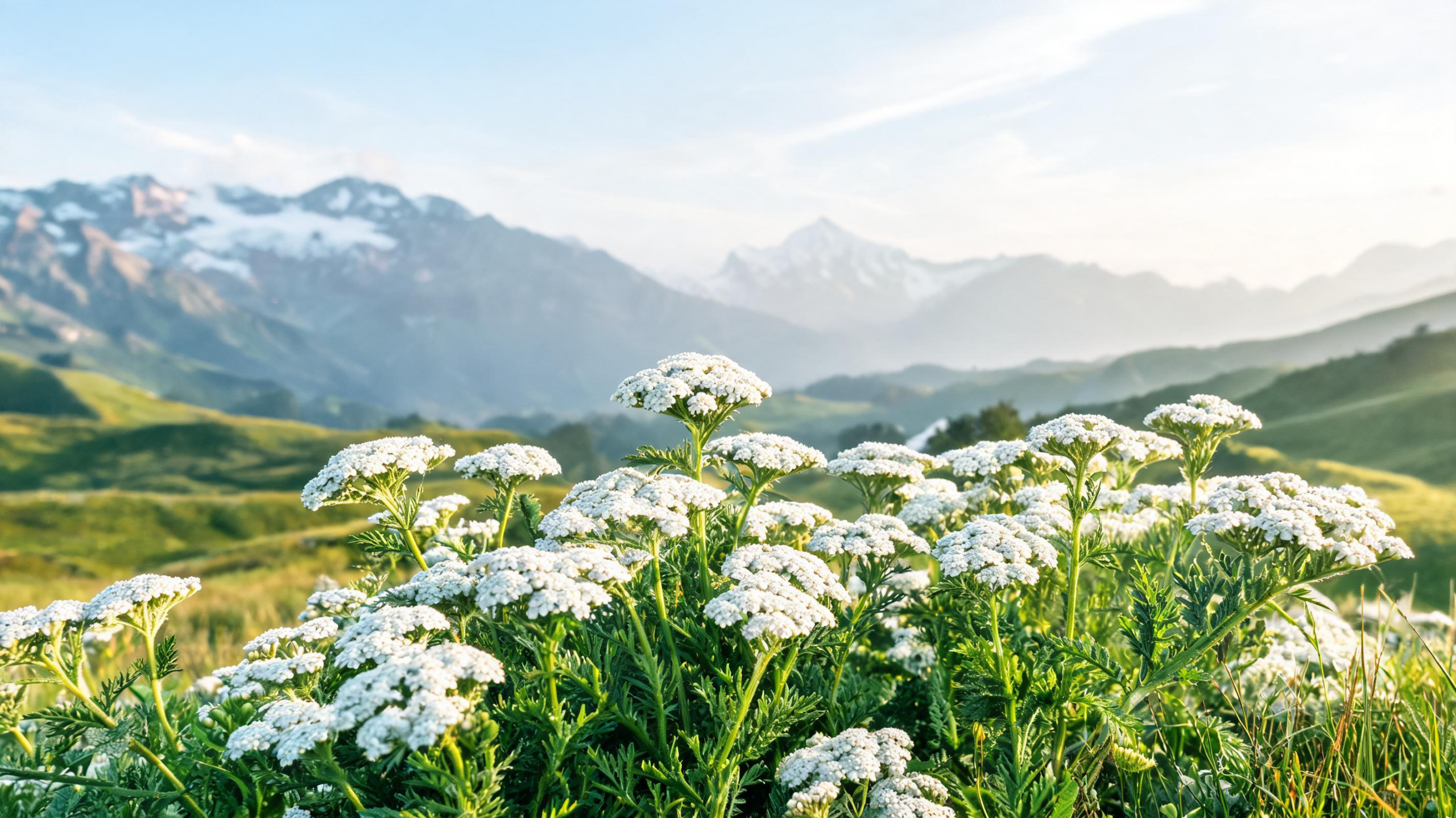
An alpine herb traditionally gathered for bitters and liquors may be one step closer to leaving the wild and entering cultivation. Researchers evaluating seven accessions of Achillea erba-rotta subsp. moschata, an aromatic perennial in the daisy family, identified three candidates with a useful combination of productivity, chemical composition and comparatively low thujone content. The study, published in Plant Biosystems, is the first reported comparison of the plant’s agronomic and qualitative traits when different genetic sources are grown under the same field conditions. The findings do not establish a commercial variety or a complete farming system, but they provide a starting point for domestication and breeding. That distinction matters for a plant whose flowering tops are still harvested exclusively from natural populations. In Italy alone, the processing industry has been estimated to require 8.4 tonnes of dried flowering aerial parts annually. Developing cultivated sources could reduce pressure on wild collection while creating another high-value crop option for farms in the Alps.
The plant is endemic to the Central Alps, where it occupies siliceous cliffs, screes and moraines at elevations of roughly 1,800 to 2,800 metres above sea level. In Italy, the subspecies occurs in the Eastern Alps, with Monte Bianco marking the western boundary of its range. Its flowering aerial parts have a long history in Alpine folk medicine and are used as an aromatic ingredient in distillates, bitters and liquors. The herb is known locally by names including “Erba Liva,” “Erba Iva,” “Genipè,” “Tanada” and “Taneda.” Despite this cultural and commercial importance, growers have no established cultivated varieties for the species. Earlier cultivation work examined techniques, yields, seed germination or plant morphology, but did not combine agronomic performance with a detailed assessment of the harvested product. The new study addresses that gap by asking not only whether the plant can grow in a field, but also whether cultivated material retains a chemical profile suitable for its traditional uses and potential future applications.
The researchers established their trial at Monte Bondone near Trento, Italy, at an altitude of 1,533 metres, during 2021 and 2022. Seeds came from seven natural populations in the Eastern Italian Alps, providing distinct accessions identified in the experiment as DOS, LAR, STA, FRE, SPE, STR and SAS. Before sowing, the seeds underwent cold stratification at 2 degrees Celsius for 14 days, a treatment intended to help overcome dormancy. Seedlings were raised in a cold greenhouse, transplanted into cell trays and then moved to the field in June 2021. The trial used a randomized block design with three replicates of 20 plants per accession. Rows were separated by 0.5 metres, with 0.25 metres between plants, producing a stand density of eight plants per square metre. Weeds were controlled manually, water was supplied at transplanting and as needed afterward, and no manure was applied. Plants remained vegetative during the first year. In their second year, researchers recorded traits at full bloom on June 14, 2022, then harvested the flowering tops by hand.
Harvested plants were cut approximately five centimetres above ground and dried in a thermostatic oven at 36 degrees Celsius, plus or minus one degree, for 48 hours. The researchers measured plant height, diameter, individual dry weight, flowering and missing-plant percentages, and total dry yield from each replicate. Across the accessions, the average proportion of missing plants was 6.3 percent, while 88.7 percent reached flowering in the second cultivation year. Plants averaged 16 centimetres in height, 23.9 centimetres in diameter and 8.4 grams of dry weight per plant. The DOS and STA accessions stood out for both individual plant weight and field yield. DOS produced 48.6 grams of dry flowering tops per square metre, while STA produced 47.5 grams per square metre. These values correspond to approximately 486 and 475 kilograms per hectare under the trial’s relatively low planting density. The researchers note that productivity might rise with denser planting, although yield comparisons with older studies are complicated because those experiments used substantially higher plant densities and different cultivation conditions.
Basic chemical measurements showed that the dried flowering material contained an average of 90.73 percent dry matter and 12.32 percent ash. Nitrogen averaged 2.26 percent, corresponding to 14.14 percent protein in the whole sample, or 16.05 percent when calculated relative to organic matter. Carbon represented 41.69 percent of the whole sample and 47.54 percent of its organic matter fraction. Only ash content differed significantly among accessions in these general measurements, with FRE showing more ash than SAS. The more distinctive differences emerged from analyses of volatile oils. The researchers extracted essential oils by hydrodistillation and characterized them with gas chromatography coupled with flame-ionization detection and mass spectrometry. Forty compounds were quantified, together accounting for an average of 94.64 percent of the total oil. Oxygenated monoterpenes dominated, representing 73.11 percent of the oil on average, followed by oxygenated sesquiterpenes at 12.30 percent, monoterpene hydrocarbons at 7.26 percent and sesquiterpene hydrocarbons at 1.97 percent.
The principal volatile constituents were camphor, cis-thujone, 1,8-cineole and trans-thujone, with average proportions of 22.82, 17.27, 9.83 and 7.04 percent, respectively. Terpinen-4-ol and bornyl acetate averaged 3.47 and 2.64 percent, while caryophyllene oxide and beta-eudesmol were among the more abundant sesquiterpenes. The chemical profile varied sharply between accessions. DOS, LAR and STA contained substantially more camphor than SAS and SPE. SAS, in contrast, had an average cis-thujone content of 50.69 percent and total thujones of 72.99 percent when the cis and trans forms were combined. Thujone is a monoterpene ketone that can have neurotoxic effects at high concentrations, and its presence in herbal products and beverages is regulated. The researchers therefore treated thujone content as a quality and safety consideration rather than simply a marker of aroma. The repeatability of several chemical patterns between cultivated accessions and their original wild populations also suggests that genetic differences, rather than environmental conditions alone, help shape the plant’s volatile-oil composition.
The team also examined nonvolatile phenolic compounds using ethanol extraction, ultra-performance liquid chromatography and liquid chromatography–mass spectrometry. Eighteen compounds were tentatively identified, with a combined average concentration of 73.48 milligrams per gram of dry weight. Phenolic acids accounted for 54.33 milligrams per gram, while flavonoids contributed 19.15 milligrams per gram. The most abundant compound was 3,5-dicaffeoylquinic acid at 31.18 milligrams per gram, followed by 5-caffeoylquinic acid at 17.79 milligrams per gram. Among the flavonoids, apigenin-7-O-glucoside averaged 5.13 milligrams per gram, syringetin hexoside 4.61 milligrams per gram, apigenin-7-O-glucoside-6”-O-malonate 4.30 milligrams per gram and luteolin-7-O-glucoside 1.56 milligrams per gram. DOS had the highest overall phenolic and flavonoid content, whereas LAR had the lowest overall levels. Differences were significant for 10 of the 18 compounds, but not for the two most abundant phenolic acids, indicating that some chemical features were relatively stable across the tested genetic material.
To combine the many measurements, the researchers used principal component analysis and agglomerative hierarchical clustering. The analysis considered dry yield, total phenolic content, camphor, 1,8-cineole and total thujones as indicators of cultivation potential and product quality. The first two principal components explained 83.23 percent of the total variation among accessions. The first component increased with total thujones but decreased with yield, camphor and 1,8-cineole. The second increased with both yield and total phenolic content. A separate clustering analysis divided the plants into three groups. DOS, LAR and STA formed a cluster characterized by high yields, high camphor and low total thujones. FRE, SPE and STR formed a middle group with intermediate amounts of the principal volatile compounds. SAS stood alone because of its exceptionally high thujone content and low camphor and 1,8-cineole levels. On the combined evidence, DOS, LAR and STA were considered the most promising accessions for potential domestication and future breeding programs.
The results offer a practical foundation, but they are not a final prescription for Alpine farmers or liquor producers. The experiment took place at one site and evaluated one harvest season after plants became productive, so additional trials will be needed to test performance across soils, elevations, climates, planting densities and years. Researchers will also need to determine how cultivation practices affect flowering time, harvest efficiency, essential-oil yield and the stability of thujone concentrations. The study did not demonstrate medicinal efficacy in people, and the presence of phenolic compounds associated in other research with antioxidant or biological activity should not be interpreted as proof of health benefits from the cultivated herb. Instead, its immediate contribution is agricultural: it shows that accessions differ in traits that can be measured and selected under shared conditions. By identifying plants that combine higher dry yields with lower thujones and a favorable phenolic profile, the work outlines a route toward a more controlled supply of a culturally important Alpine plant—one that could eventually complement, rather than depend on, harvesting from the wild.
Subject of Research: Evaluation of Alpine musk-yarrow accessions for domestication
Article Title: Evaluation of accessions of Achillea erba-rotta subsp. moschata (Asteraceae) for domestication
Article References: Fusani, P., Biazzi, E., Doria, F., & Tava, A. (2026). Evaluation of accessions of Achillea erba-rotta subsp. moschata (Asteraceae) for domestication. Plant Biosystems, 160(5), Article 261. https://doi.org/10.1007/s44473-026-00265-8
Image Credits: AI Generated
DOI: 10.1007/s44473-026-00265-8
Keywords: Achillea moschata, Alpine plants, Domestication, Medicinal plants, Essential oils, Phenolic compounds, Thujone, Plant breeding, Evaluation, accessions, Achillea, erba-rotta
Cite Scienmag News
Alan Morgan. (August 28, 2026). Alpine Yarrow Accessions Reveal Promising Path Toward Sustainable Cultivation. Scienmag. https://scienmag.com/alpine-yarrow-accessions-reveal-promising-path-toward-sustainable-cultivation/
Alan Morgan. "Alpine Yarrow Accessions Reveal Promising Path Toward Sustainable Cultivation." Scienmag, 28 August 2026, https://scienmag.com/alpine-yarrow-accessions-reveal-promising-path-toward-sustainable-cultivation/. Accessed 5 October 2026.
Alan Morgan. "Alpine Yarrow Accessions Reveal Promising Path Toward Sustainable Cultivation." Scienmag. August 28, 2026. https://scienmag.com/alpine-yarrow-accessions-reveal-promising-path-toward-sustainable-cultivation/


